
Final Report: Engagement and Consultation on Canada’s Black Justice Strategy
Executive summary
This report provides an overview of the engagement and consultation process regarding Canada’s Black Justice Strategy in Yellowknife, Northwest Territories. The purpose of these activities was to gather input from the Black community and other stakeholders in making informed decisions in the development and implementation of Canada’s Black Justice Strategy in the Northwest Territories. The engagement process spanned several months and involved a variety of methods to ensure inclusivity and accessibility.
Introduction and background
Canada’s Black Justice Strategy was launched by the federal government as part of the government’s commitment to address systemic racism within the justice system and ensure equitable access to justice for all Canadians, regardless of their racial background. The strategy aims to identify and rectify systemic barriers faced by Black Canadians in the justice system.
Black Advocacy Coalition Up North (BACupNorth)
Black Advocacy Coalition Up North is non-profit, Black-led organization based in Yellowknife with membership across the Northwest Territories. Our vision is to empower and advocate for the advancement of racial equality in the Northwest Territories. BACupNorth has a mission to tackle systemic racism and dismantle barriers to equity in law enforcement, justice, health, housing, education, research and media. We empower people of colour through advocacy, economic and social programs.
Methodology
The engagement and consultation process in Yellowknife followed a comprehensive approach to ensure a wide range of voices were heard. The methodology included:
- Community workshops on Black Justice (the subject matter): A series of community workshops were conducted at various locations in Yellowknife to facilitate open discussions. These workshops were attended by community members, justice system representatives, and advocates.
- Online surveys: An online survey was made available to residents in Yellowknife to collect input from those who were unable to attend in-person events. This ensured inclusivity and accessibility for a broader audience. We had 81 respondents amongst which 89.5% were individuals and 10.5% were organizations working with the black communities in NWT. Also, among the 81 respondents, there was a fair representation amongst the various age groups with 56.8 % between the ages of 30 years and 45 years, 21% between the ages of 18 years and 21years and 16% between the ages of 46 years and 60 years.

Text version
Pie chart illustrating the breakdown of responses to the question ’Are you responding as an organization or an individual?
Are you responding as an organization or an individual?
57 responses
Organization (89.5%)
Individual (10.5%)

Text version
Pie chart illustrating the breakdown of responses to the question ’What is your age range?’ The chart displays the distribution of participants across five age groups: 13-17 years, 18-29 years, 30-45 years, 46-60 years, and 60 years and above.
Personal Background: What is your age range?
81 responses
13 – 17 Years
18 – 29 Years (21%)
30 – 45 Years (56.8%)
46 – 60 Years (16%)
60 Years and Above
- Focus groups: Focus groups were organized with specific demographic groups, including youth, Elders, and individuals with lived experience within the justice system. These focus group discussions centered around lived experiences and community member’s interaction between the justice system, RCMP and correctional facilities in NWT. Most community members indicated that they have experienced unfair treatment from the system based on preconceived judgement from their race. One attendee mention:
“Yes- I have too many incidents to count which have happened to me and my family. These incidents have gone from illegal arrests, arrests made without opportunity to sign under takings, and a lack of action on the part of the police when we were experiencing violence/making the call”.
“Yes, I once got pulled over and before the cop came to talk to me and he called for backup and 8 other cops showed up, they talked to me with their hands on their weapons. Only for them to ask for id and they let me go. They needed 8 cops with their hands on weapons to do a traffic stop on a single black male”.
- Stakeholder meetings: Key stakeholders, including local government officials, community organizations, and legal professionals, were consulted to ensure a well-rounded understanding of the local context.
Key findings
The engagement and consultation process yielded several key findings which can be grouped under the following topics:
Social determinants of justice: Social determinants of justice for Black people in the Northwest Territories of Canada, like in many other regions are influenced by a range of social, economic, and systemic factors. It’s important to note that while the Northwest Territories has a relatively small Black population compared to other provinces, systemic issues still very much impact their access to justice and overall well-being. Here are some social determinants of justice that greatly affect Black individuals in the Northwest Territories.

Text version
Pie chart illustrating the breakdown of responses to the question ’Please identify the top three factors that have the greatest potential to eliminate anti-Black/Indigenous racism and systemic discrimination.’ The chart displays the distribution of responses across seven factors: Addressing racial disparities in education, improving access to economic opportunities, enhancing access to mental health services, strengthening community-based supports, addressing systemic racism in child welfare, addressing the needs of Black immigrants, and increasing housing stability.
Social Determinants of Justice Please identify top three factors that have the greatest potential to eliminate anti-Black/Indigenous racism and systemi… Indigenous people in the criminal justice system
57 responses
Addressing racial disparities in education (19.3%)
Improving access to economic opportunities (21.1%)
Enhancing access to mental health services
Strengthening community based supp…(31.6%)
Addressing systemic racism in child we…(12.3%)
Addressing needs of Black immigrants…(7%)
Increasing housing stability for Black a…
- Racial and systemic discrimination: Discrimination and racism plays a significant role in how Black individuals are treated within the criminal justice system. Racial bias affects interactions with law enforcement, the likelihood of being stopped, searched, or arrested. All these biases affect the outcomes of legal proceedings. Many participants expressed concerns about systemic discrimination within the justice system, including racial profiling and biased decision-making from judges.
“The systemic racism that places white people as superior above all others. Once we remove the colonial notion on indigenous or black people or slaves. Then we can start to see each other as equals. Equality stems from taking responsibility for the sins of our grandfathers and asking for forgiveness and creating a positive platform moving forward. The fact that blame keeps flying around and all parties are not willing to accept responsibility for what happened. We keep blame flying around. This blame leads to stereotypes and racial silos that divide people along racial lines. The institutions are using race to continue with colonialism by systemically leaving the indigenous and black races out of leadership. So, once we do not create an equal space for engagement, we will continue to see the BIPOC and the 2SLGBTQA+ communities being viewed as inferior hence their voices do not matter. There is need to address the existing power dynamics in the justice system. Stop using the justice system as a weapon against inferior groups”.
- Access to legal services: Access to affordable and culturally sensitive legal services was identified as a significant challenge for the Black community in the Northwest Territories. Black folks complain of the difficulty in accessing affordable legal counsel and navigating the legal process that affect their outcomes in legal proceedings. From the feedback while others think:
“To an extent, resources are available for everyone if you know where to find them in the black communities, the fear of the legal system and the police creates a barrier for accessibility”,
others are of the opinion that:
“No. Not all legal resources are equal. The more money you have, the more and better access you have. One’s financial resources play an important role is getting legal representation. Most times the cheaper options are overburdened to provide services that can compete with their counterparts”.
“Equal, but not necessarily equitable. One example is that a legal aid clinic in the NWT is available in only large centers, not in communities. Those with money will have a harder time finding a lawyer that they feel authentically advocates for them, and those without money will be without representation or rely on legal aid where the lawyers may not be able to help with all legal issues, have a cap on hours, or may be burnt out. These communities often have less personal connection and supports within the legal field as well”.
- Housing and homelessness: Stable housing is a crucial social determinant of justice. Homelessness and unstable housing situations can increase the risk of involvement with law enforcement and the justice system, and Black individuals face specific challenges in securing housing due to racial discrimination.
- Youth engagement: Youth participants emphasized the importance of engaging young people in discussions and initiatives related to justice reform.
- Education and youth justice: Access to quality education and support services influences youth behavioural outcomes. Disparities in education and support services result in Black youths becoming involved in crime, law enforcement and in the criminal justice system at higher rates.
- Mental health and wellness: Mental health and well-being support within the justice system was seen as an area in need of improvement. Health and mental health issues intersect with the criminal justice system. Black individuals in the Northwest Territories face disparities in access to healthcare and mental health services, which can impact their overall well-being and interactions with the justice system.
Policing Black folks in the Northwest Territories: Policing and law enforcement practices play a significant role in determining justice for Black people in the Northwest Territories, as they do in other regions. While the Northwest Territories has a relatively small Black population compared other provinces, there are still important considerations regarding how policing and law enforcement impact the justice system for Black individuals. Here are some ways in which policing and law enforcement can influence justice
- Use of force: The use of force by police can disproportionately affect Black individuals. Incidents of excessive force, brutality and violence by law enforcement can result in harm, injury, and death, that creates tensions between the Black community and the police. One example is the murder of George Floyd by a police officer in Minnesota.
- Racial profiling: Racial profiling involves law enforcement targeting individuals based on their perceived race or ethnicity rather than on evidence of criminal behavior. Black individuals in the Northwest Territories do experience racial profiling, leading to unwarranted stops, searches, and arrests. Judges often believe police officers over Black people and that can influence the outcome of legal proceedings.
- Arrest and detention rates: Black individuals are more likely to be arrested and detained by law enforcement compared to other racial groups. This is caused by racial bias. This can lead to overrepresentation in jails and the criminal justice system.
- Lack of cultural competency: The RCMP in the Northwest Territories may lack cultural competency training, which can result in misunderstandings and ineffective communication with Black individuals. Cultural sensitivity is crucial for building trust and cooperation between the police and the Black community.
- Implicit bias: Implicit bias can affect law enforcement decisions, such as who to stop, search, or question. Efforts to address and mitigate implicit bias within the RCMP in the Northwest Territories are very important for promoting fairness and justice.
Courts and legislations: The courts and legislations as part of the justice system in the Northwest Territories, play a crucial role in impacting justice for Black people:
- Racial discrimination cases: Courts should have the authority to hear cases related to racial discrimination involving Black individuals who have experienced discrimination in various aspects of life, including employment, housing, education, employment, and interactions with law enforcement.
- Legal representation: Access to affordable legal representation for black people is critical for achieving justice. Legislations can and should influence funding for legal aid services and the availability of affordable legal counsel, which can impact the ability of Black individuals to navigate the legal system effectively.
- Cultural sensitivity and fair trials: Courts can ensure that trials are conducted fairly and with cultural sensitivity, considering the unique experiences of Black individuals in the Northwest Territories. Judges and legal professionals undergo training in cultural competency to better understand the issues faced by Black communities.
- Sentencing disparities: Legislations and sentencing guidelines can contribute to sentencing disparities. Courts can address these disparities by considering factors such as systemic racism and the unique circumstances of Black individuals when determining sentences.
- Civil rights cases: Black individuals who believe their civil rights have been violated, such as incidents of racial profiling or police brutality, should be able to seek justice through the courts through affordable legal counsel and legal clinics. Legislation and court decisions can set precedents in such cases.
- Advocacy and legal reform: The legal system can be influenced by advocacy efforts and calls for legal reforms. Black activists and organizations like the Black Advocacy Coalition are working tirelessly to change legislation, policies, and court practices to promote justice and equality for black people in the Canadian justice system.
Correctional centers/services: Correctional centers in the Northwest Territories have a disproportionate overrepresentation of Black and Indigenous Peoples.
- Overrepresentation: The experience of Black inmates within the correctional system can be influenced by various factors, including systemic issues and racial disparities, which can be indicative of disparities in arrest and sentencing. Overrepresentation can be a result of racial profiling, socioeconomic factors, and systemic bias. Efforts to address these issues require collaboration between correctional authorities, policymakers, community organizations, and advocates:
- Discrimination and harassment: Black inmates in the Northwest Territories experience discrimination and harassment within correctional centers, which has gone a long way to negatively affect their mental and physical well-being.
- Cultural competency: Correctional centers and jails in the Northwest Territories should be culturally sensitive to the diverse backgrounds of all inmates, including Black individuals. The lack of cultural competency and sensitivity can result in misunderstandings and ineffective rehabilitation efforts.
- Advocacy and reform: Advocacy efforts and legal reforms can influence the conditions and practices within correctional centers. The Black Advocacy Coalition has been fighting and advocating for improved jail conditions, overrepresentation, discrimination, and the need for improved services.
Reintegration and re-entry into the community
- Rehab programs and services: The availability of rehabilitation, education, and mental health programs within correctional centers can impact an individual’s chances of successful reintegration into society. These programs should be designed with a multicultural lens in partnership with black community organizations and stakeholders working with the black communities in the Territories. Black individuals may face disparities in accessing already existing services which are not a cultural fit to the black community in cases where they are given a chance.
- Community reintegration efforts: Successful reintegration into society is a critical aspect of justice. Correctional centers can play a role in preparing all individuals including Black inmates, for their return to the community. This includes providing access to job training, housing support, addiction treatment, mental health support and even teaching them basic survival skills among other services. This will help set up individuals for success as opposed to allowing them to return to the community without appropriate supports. This will return them to where they started, and it will become a cycle.
- Evaluation and follow-up: There has to be a continuous assessment in the progress of released inmates through probation officers and adjust reintegration plans as needed. Provide ongoing support and resources to help individuals maintain a crime-free lifestyle. This can be achieved through collaborating with black organizations within the community and liaising with them to provide integrated case management services to individual living these facilities and linking them to community services which will support these individuals’ lives.
- Mental health and substance abuse treatment: There is no doubt that black inmates have developed mental health issues during their time in confinement. This could be as a result of trauma from wrongful accusations, unjust court processes, racism within their stay in jail, to name a few. It is important to note here that there is generally a denial in the black community about issues such as mental health as it is regarded as a taboo subject. This makes it tricky for black people to accept having these issues and working with organizations to design cultural appropriate mental health and substance abuse treatment programs both within and outside prisons would greatly be of help. Ensure that inmates have access to ongoing counseling and support upon release and thereafter.
Text version
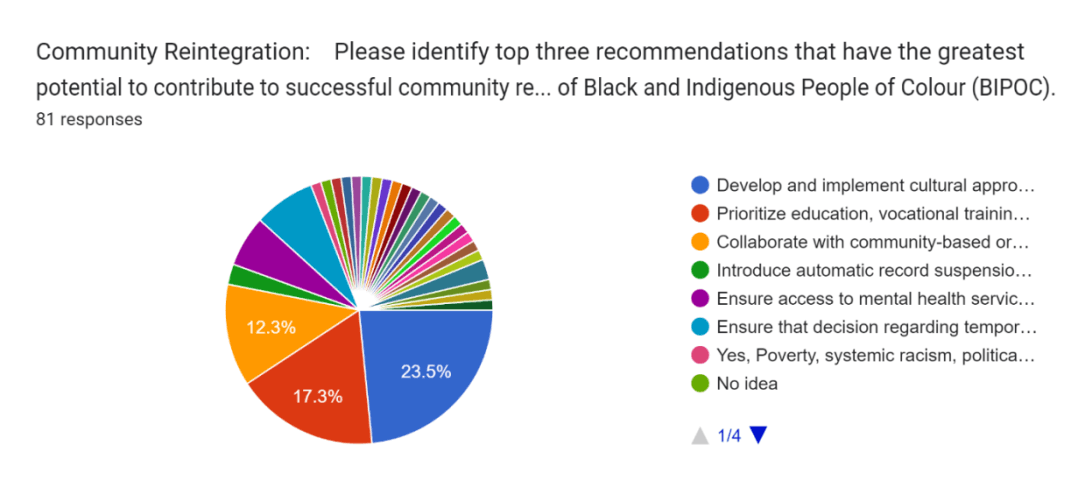
Pie chart illustrating the breakdown of responses to the question ’Please identify the top three recommendations that have the greatest potential to contribute to successful community reintegration of Black, Indigenous, and People of Colour.’ The chart displays the distribution of responses across various recommendations
Community Reintegration: Please identify top three recommendations that have the greatest potential to contribute to successful community re… of Black and Indigenous
81 responses
Develop and implement cultural appro…(23.5%)
Prioritize education, vocational trainin…(17.3%)
Collaborate with community-based or…(12.3%)
Introduce automatic record suspensio…
Ensure access to mental health servic…
Ensure that decision regarding tempor…
Yes, Poverty, systematic racism, politica…
No idea
Recommendations
Based on the findings from the engagement and consultation process, the following recommendations are proposed for the implementation of Canada’s Black Justice Strategy in the Northwest Territories:
- Cultural competency training: Ensure that justice system personnel, including police officers, lawyers, and judges, receive regular cultural competency training to address issues of bias and discrimination. This is very important because these trainings will be designed to incorporate of black cultures, and will aim at educating stakeholders on appropriate ways to work harmoniously with black community members.
- Community legal clinics: Establish community-based legal clinics in Yellowknife to provide accessible legal support, particularly for individuals from marginalized communities. These will ease the cost of accessing professional legal services as one of the barriers of black people being inadequately represented is lack of financial capacity.
- Community policing: Building positive relationships between law enforcement and Black communities through community policing initiatives can improve trust and cooperation. However, the effectiveness of such initiatives may vary based on certain factors. An ethnic police cadet program is recommended where youth from black decent will attend and learn the core values of policing and educate families and friends to change the narrative of black and police interactions.
- Accountability and oversight of the RCMP: The presence and effectiveness of oversight mechanisms, such as civilian review boards, can impact the accountability of law enforcement not only to Black people. Ensuring accountability for misconduct and excessive use of force is vital for justice for Black people in the Northwest Territories.
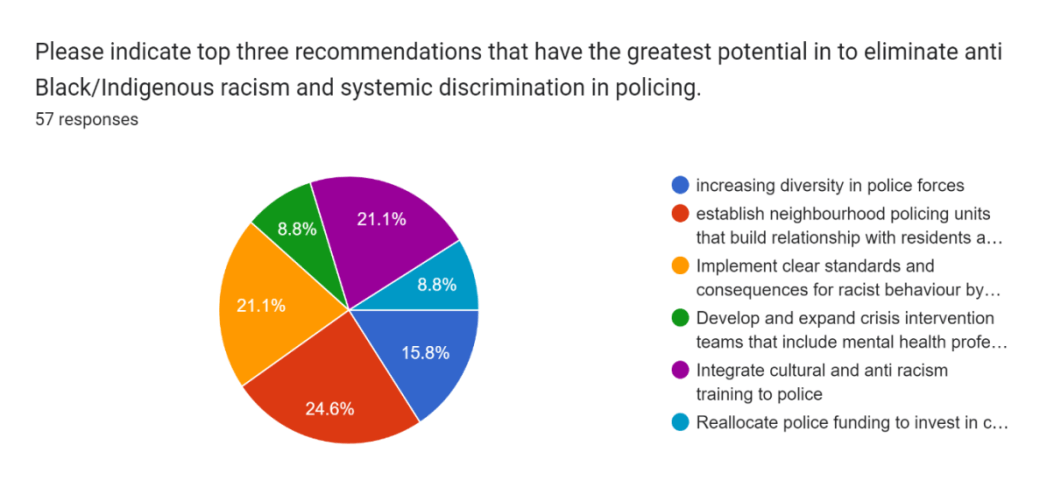
- Data collection and transparency in the RCMP: Comprehensive data collection on police interactions with the public, including race-based data, is essential for identifying and addressing disparities in policing practices. Transparency in reporting and sharing this data can help in promoting accountability. The three most important answered given when asked recommendations on how to eliminate racism within the police were; 24.6% recommended establishing policing units that build relationships with residents; 21.1% recommended clear standards and consequences for racist behaviours within the force and 15.8% recommended diversity within the force.
Text version
Pie chart illustrating the breakdown of responses to the question ’Please identify the top three recommendations that have the greatest potential to eliminate anti-Black/Indigenous racism and systemic discrimination in policing.’ The chart displays the distribution of responses across various recommendations.
Please indicate top three recommendations that have the greatest potential in to eliminate anti Black/Indigenous racism and systemic discrimination in policing
57 responses
Increasing diversity in police forces (15.8%)
Establish neighborhood policing units that build relationship with residents a…(24.6%)
Implement clear standards and consequences for racist behavior by…(21.1%)
Develop and expand crisis intervention teams that include mental health profe…(8.8%)
Integrate cultural and anti racism training to police (21.1%)
- Youth engagement programs: Develop programs that actively engage youth in discussions about justice reform and provide opportunities for their input.
- Mental health support services: Enhance cultural appropriate mental health and well-being support services within the justice system to address the unique needs of Black individuals involved in the system.

Text version
Pie chart illustrating the breakdown of responses to the question ’Please identify the top three recommendations that have the greatest potential to eliminate systemic anti-Black/Indigenous racism in the correctional system.’ The chart displays the distribution of responses across various recommendations.
Correctional System: Please Identify the top three recommendations that have the greatest potential to eliminate systemic and anti-Black and Indigenous racism in the correctional system.
57 responses
Prioritize education, vocational training and other programming for Black peo…(31.6%)
Ensure that involuntary transfer decisions are based on objective criter…(8.8%)
Regularly review disciplinary practices…(19.3%)
Ensure that decision regarding the us…
Review and revise use of force policie…(24.6%)
I don’t know
I don’t believe any of these solutions…
Train the legal officers on racism. Its c…
- Programs within and outside of corrections facilities: As represented in the diagram above, the major feedback from the survey indicates the prioritization of education, vocational training, and other programming for Black people in custody to support successful reintegration into the community.
- Date modified: