
Rights-based framework for reporting
While the focus of this year’s section of the Annual Report regarding the Action Plan focuses on its preparation, future years’ reporting will focus on the progress related to implementation of the Action Plan measures and the overall progress of the Government of Canada, in consultation and cooperation with Indigenous peoples, towards implementing measures to ensure the consistency of laws with the UN Declaration.
A rights-based approach to reporting on results and measuring progress on all of the articles of the UN Declaration, is intended to focus reporting on outcomes for Indigenous peoples rather than activities undertaken by government, and to help identify gaps as well as highlight some of the key strategic initiatives that federal departments and agencies have undertaken to advance the implementation of the UN Declaration. Thematic groupings provide an organizing framework for reporting, recognizing that the rights in the UN Declaration—like all human rights—are indivisible, interdependent, and inter-related, and that implementation of the Action Plan will need to be done in a holistic way.
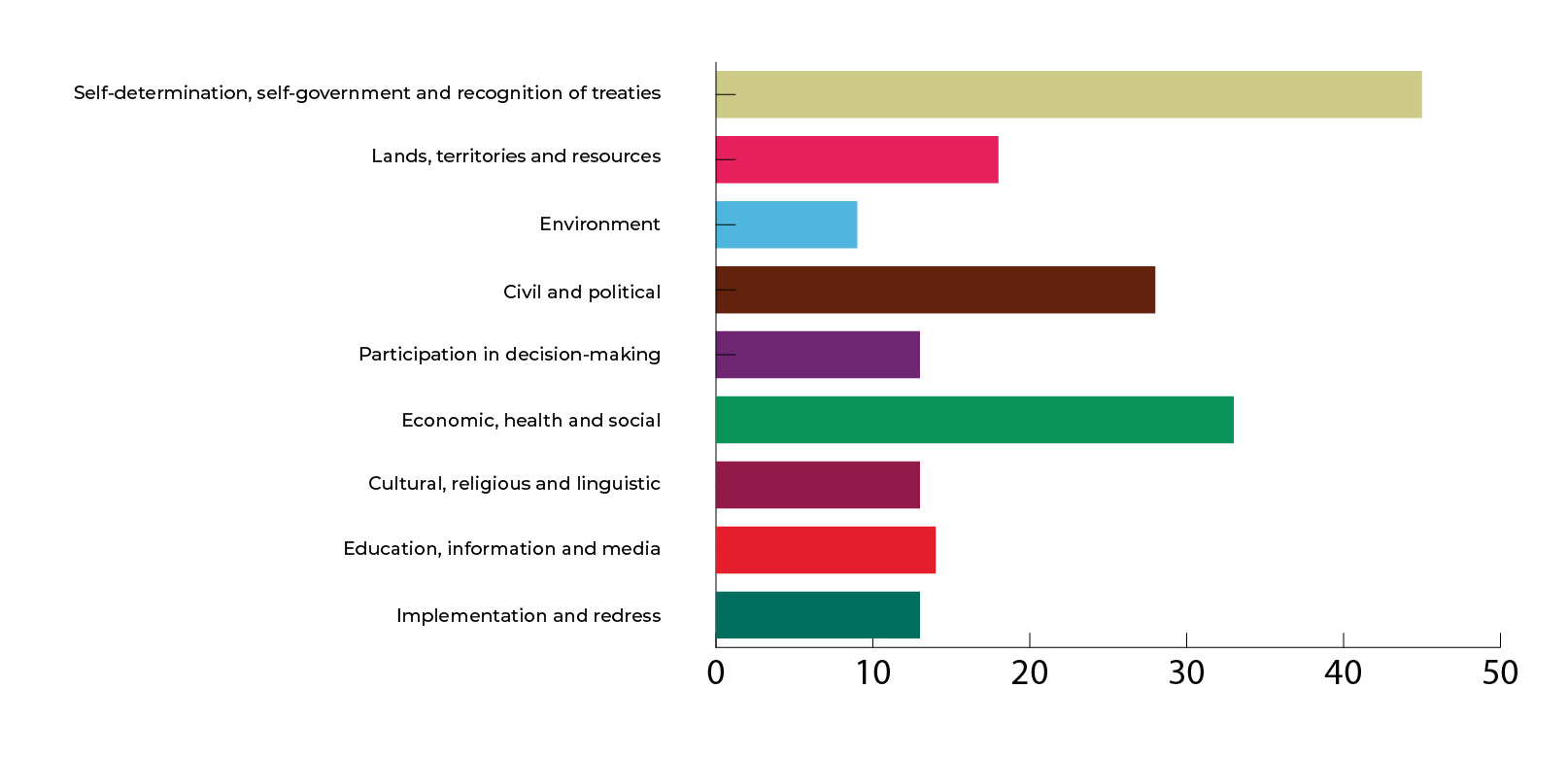
Number of Action Plan measures per UN Declaration theme
Text version
This bar chart represents the distribution of action plan measures by theme:
- Self-determination, self-government and recognition of treaties: 46 measures
- Lands, territories and resources: 17 measures
- Environment: 7 measures
- Civil and political rights: 29 measures
- Participation in decision-making: 12 measures
- Economic, health and social rights: 33 measures
- Cultural, religious and linguistic rights: 12
- Education, information and media: 13 measures
- Implementation and redress: 12 measures
These groupings, which are reflected in the organization of the Action Plan, are not meant to diminish the importance of each individual article in the UN Declaration, but rather recognize that measures to implement elements of the UN Declaration may implicate more than one article. The thematic groupings are also reflective of common intersections and themes found throughout international human rights instruments. By reporting on progress of actions at the level of thematic groupings, high-level progress in the implementation of rights flowing from the UN Declaration can be easily followed in a more global way.
Future reporting on progress
Much of the work done over the past year was focused on identifying the priorities of Indigenous peoples and determining solutions in the form of agreed upon language to define action plan measures. While this work will continue, the focus will shift towards implementation of those measures and development of implementation plans, timelines and metrics, in consultation and cooperation with Indigenous peoples. Metrics will be critical to mark progress on the implementation and to evaluate whether the action plan measures were successful in achieving their desired results. Like all initiatives under the Act, working in consultation and cooperation with Indigenous peoples will be necessary to ensure that measures are responsive to their priorities. Communicating progress in a way that responds to the needs and priorities of Indigenous peoples and holds the Government of Canada to account is going to be key to the work done over the coming years.
In the outreach done on the Annual Report, Indigenous partners have shared some priorities for future reporting.
Participation of Indigenous partners
The Government of Canada cannot evaluate progress on its own. As the impacts of action should be felt by Indigenous peoples, having Indigenous peoples’ perspectives reflected is critical for understanding whether and/or how progress is being made. It was suggested by a number of partners that Indigenous organizations need to be involved in the implementation of actions and in evaluating progress on implementing those measures.
Measuring progress
“Language used should be commitment oriented. Clear and specific targets are needed. SMART indicators are important. Report back mechanisms should be established to track and communicate actual progress. It is important to see tangible results.”
Bingwi Neyaashi Anishinaabek – Sandpoint First Nation
Indigenous partners want the measurement of progress to be transparent, objective, and speak to their communities. It will be important to develop a strategy or an overall evaluation framework that considers not only high-level results but that is reflective of experiences within communities. The importance of filling data gaps and collecting disaggregated data was also noted in order that impacts of the implementation of the Action Plan can be evaluated across distinctions groups as well as for urban Indigenous and diversity groups.
Using data is only one way to measure progress and we heard from numerous partners that data alone is insufficient. Elder Sakej Henderson of Eskasoni First Nation spoke to us about the inadequacy of Eurocentric measures and how it was important that evaluation tools be Mi’kmaq-based.
Others spoke of the need to establish timelines, milestones, and benchmarks that could be monitored and compared over time. Communities want to see tangible results from the implementation.
As metrics and other means of evaluating the implementation of measures are being developed, the Government of Canada will work in consultation and collaboration with Indigenous peoples on identification of data availability and data gaps, as well as measures to improve accessibility of information surrounding implementation of measures.
Reporting
A number of partners communicated that it was important that reporting done on implementation of the UN Declaration Act Action Plan be done in a manner that is accessible. This could include using plain language when reporting, as well as having reports translated into Indigenous languages; particularly for Indigenous peoples who have substantial numbers of citizens who may not have the requisite fluency in either English or French. It is critical that reporting on implementation of federal legislation related to the rights of Indigenous peoples be accessible and understood by Indigenous peoples. This includes development of one or more communications strategies, to ensure that Indigenous peoples are aware of the legislation, the proposed measures, and the progress in achieving those measures.
Indigenous partners also want to see progress at the community-level, regionally, in urban centres, as well as at the national level. Transparency in how progress is being measured—and accountability when results or progress is not achieved—were other key aspects of importance to partners. Having updates available for Indigenous peoples and the Canadian public between annual reports was also mentioned as being important.
Other reporting in support of implementation of the UN Declaration Act and reconciliation
While the passing of the UN Declaration Act and the work to implement its requirements present important milestones on Canada’s path of reconciliation, the work of the Act and the Action Plan can not, and will not, progress in isolation. The Action Plan has been informed by, builds upon, and should be read in harmony with the recommendations made by the Royal Commission on Aboriginal Peoples, the Calls to Action of the Truth and Reconciliation Commission, and the Calls for Justice of the National Inquiry into Missing and Murdered Indigenous Women and Girls. Reporting on the UN Declaration Act will be informed by reporting on other reconciliation work underway across the Government of Canada.
For example, on June 3, 2023, the second Federal Pathway Annual Progress Report was published, which tracks and reports on progress made to address the commitments in the Federal Pathway. This report outlines the work that has been undertaken by the federal government to respond to the Murdered and Missing Indigenous Women and Girls’ Calls for Justice, including updates on the implementation of UN Declaration Act and the development of the Action Plan (Call for Justice 1.2v).
Consistent with Canada’s commitment to implement the Truth and Reconciliation Commission Calls to Action, Justice Canada continues to respond to the Justice Canada-led Calls to Action. The department’s efforts have contributed to responding to Calls to Actions 43 and 44 through the implementation of the UN Declaration Act and the development of the First Annual Progress Report on the Act. Crown-Indigenous Relations and Northern Affairs Canada continues to lead the coordination of public reporting on the Government’s responses to the Calls to Action with input from all departments through a dedicated Calls to Action website.
As the work to respond to key reports and recommendations of special procedures, treaty bodies and the Human Rights Council and its subsidiary bodies continues, work continues across government to further the implementation of the UN Declaration and to coordinate reporting on outcomes and results. Please see Annex D for information about actions that government departments and agencies are taking concurrently to achieve the objectives of the UN Declaration. Details about how these initiatives are being done in consultation and cooperation with Indigenous peoples are also provided.
Department of Justice Canada
- Date modified: