
Crimes Against Humanity and War Crimes Program
Appendix D: Remedy Cost Estimates and Process Flow Diagrams
Remedy Cost Estimates and Process Flow Diagrams
Remedy 1: Denial of Visa to Persons outside Canada
This remedy was charted with the assistance of CBSA and CIC staff at national headquarters. Then headquarters staff and staff located at specific Canadian missions abroad provided cost estimates. The posts were chosen because they have processed the largest number of visas that warranted war crimes investigations of any city in their respective region (Europe, Africa, South America, and Middle East). According to CIC’s Computer Assisted Immigration System (CAIPS) database, between 2001 and 2007, the chosen posts denied 923 visas based on war crimes.
Cost estimates represent the salary and benefits of the human resource effort required to process a typical case. Cost estimates range from roughly $600 to $7,800, depending on the complexity of the case. For example, the cost estimate of a case originating in Africa where a non-permanent visa is denied based on war crimes is roughly $639. In a more complex case involving a permanent visa, where the applicant appeals the denial to Federal Court, the cost ranges between $7,000 and $8,000.
Remedy 2: Denial of Access to the Refugee Determination System
CBSA and CIC regional and national headquarters staff and the DOJ War Crimes Section staff provided cost estimates for this remedy. CIC regional staff provided cost estimates for steps carried out by CIC regional offices. CBSA regional staff provided cost estimates for steps carried out in the regions. Cost estimates include salaries and benefits, travel, and incarceration costs. In general, regions handle few of these cases (i.e., less than five) annually. There are two scenarios for this remedy.
Scenario 1: Person arrives at Canadian port of entry and files refugee claim
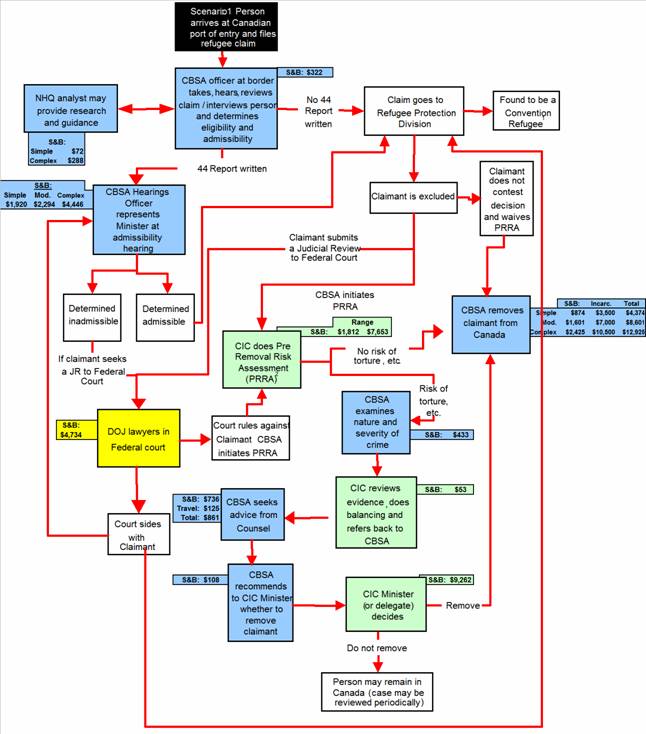
Under this scenario, CBSA performs the bulk of the upfront investigative activities. The complexity of this remedy can vary widely. In the simplest of cases, CBSA may send the refugee claim to the Refugee Protection Division, and if the claimant is excluded, does not contest the decision, waives his right to a Pre-Removal Risk Assessment (PRRA), and is quickly removed from Canada, the costs could be as low as $4,768. However, if the case is more complex, involving an admissibility hearing and if the claimant seeks a judicial review to Federal Court, a full PRRA is performed, and the person is incarcerated for two to three months before removal, the costs are estimated to rise to $41,085.
Scenario 2: Person already in Canada files a refugee claim
Under this scenario, a CIC officer conducts the initial investigative work. Depending on the complexity of the case, cost estimates range from $8,152 to $45,551. For instance, if the Refugee Protection Division rules that the claimant is to be excluded based on war crimes, and the PRRA finds that there is no risk of torture if the person is returned to his country, the costs would be approximately $8,152. However, if the case is more complex, involving an admissibility hearing and the claimant seeks a judicial review to Federal Court, a full PRRA is performed, and the person is incarcerated for two to three months, the costs are estimated at $45,551.
Remedy 3: Exclusion from Protection of the 1951 UN Convention Relating to the Status of Refugees
The steps undertaken and costs incurred by CBSA, CIC and DOJ essentially mirror those of Remedy 2. Cost estimates range from $8,152 (simple case) to $41,085 (complex case).
Remedy 4: Prosecution
Cost estimates for an African and European case are based on experience with prosecution, plus estimates of cost differentials by geographic area. They cover the entire process, beginning with the assignment of a case to the inventory by the file review sub-committee of PCOC and include the costs of investigation as well as prosecution.
The time and costs required to pursue this remedy vary depending on whether the person in question appeals the provincial court decision. If the person does not appeal, the costs of this remedy are estimated at about $4.0M. If the person appeals all the way to the Supreme Court, the costs are estimated at $4.2M. It is important to note that the prosecution costs for this remedy would be incurred over about two and a half years. Travel expenses for DOJ ($1.3M) and RCMP ($186,000) account for a significant portion of the overall costs.
It should be noted that interviewees at the RCMP War Crimes Section suggest that investigation costs can be expected to decline as investigators gain more experience with prosecutions of this type. DOJ War Crimes Section staff did not expect to see a similar decline in the cost of prosecutions because of the unique nature of each trial.
Remedy 5: Extradition to a Foreign Government
The time and cost required to conduct this remedy depend primarily on whether the individual in question appeals his decision to the provincial and federal courts. If an appeal occurs, the remedy is estimated to cost about $526,341. In a more straightforward case where the person does not appeal, the cost is estimated at $471,251. Most of the costs are salary and benefits, with travel by the RCMP estimated at only $8,000.
Remedy 6: Surrender to an International Tribunal
The process for surrender to international tribunal is essentially the same as for extradition to a foreign government.
Remedy 7: Revocation of Citizenship
Headquarters staff at DOJ, RCMP and CIC provided cost estimates for this remedy. In a simple case, where the remedy begins with the Review Committee recommending that citizenship be revoked, the Minister decides to revoke, and the person does not take the matter to court, the costs are estimated at $471,810. A significant portion of this cost is paralegal and travel costs. If the person takes the matter all the way to the Federal Court of Appeal, the costs are estimated at $1.3M.
If the intent to revoke citizenship does not come from the Review Committee, but instead results from a decision to terminate a criminal investigation in favor of pursuing citizenship revocation, the costs of the preceding criminal investigation should be factored in. The costs of the criminal investigation could be as high as $676,000.
Remedy 8: Inquiry and Removal from Canada under the Immigration and Refugee Protection Act (IRPA)
There are three scenarios in which this remedy can be used. A tip involving war crimes can be received on a person in Canada who falls under IRPA; a criminal investigation may be re-directed in favor of pursuing this remedy; and it may be initiated when a person’s citizenship is revoked for war crimes. Cost estimates were provided by CIC, CBSA and DOJ. In a relatively simple case, where the person’s refugee status is vacated, the Federal Court rules against the person, and the PRRA finds no risk of torture, the costs are estimated at $15,782. If however, the PRRA finds there is a risk of torture, more steps are required, and the costs are estimated at $46,961.
Remedy 9: Denial of Status to Senior Officials from Governments Considered to Have Engaged in Gross Human Rights Violations under Section 35 1 (b) of IRPA
There are three scenarios that may initiate this remedy. A visa application from a senior official of the government in question may be received at an overseas post; the official may present himself at an inland CIC office; and the official may present himself at a Canadian port of entry.
Cost estimates were provided by CIC, CBSA and the RCMP. If the remedy initiates from an overseas application, the costs may be as low as about $500. If, however, the official presents himself at an inland office or port of entry, and a PRRA is eventually required and incarceration costs are incurred, the costs could be as high as $36,351.
Introduction to Process Flow Diagrams
The following pages contain diagrams that present the sequence of steps and estimated costs associated with the war crimes remedies. Each department has been assigned a color (RCMP = red, DOJ = yellow, CBSA = blue, and CIC = green). In cases where regions provided costing, these are noted. Estimates are provided for a wide range of costs such as salaries and benefits (S&B); travel, paralegal costs, etc. Please note that overhead costs such as rent and taxes are not reflected in these estimates. Only direct costs have been estimated.
Remedy 2: Denial of Access to Refugee Determination System
Scenario 1: Person arrives at Canadian port of entry and files refugee claimRemedy 2: Denial of Access to Refugee Determination System
Scenario 2: Person already in Canada files refugee claimRemedy 3: Exclusion from Protection of the 1951 UN Convention Relating to the Status of Refugees
Remedy 8: Inquiry and Removal from Canada under the Immigration and Refugee Protection Act

- Date modified: