
Contraventions Act Evaluation, Final Report
3. Logic Of The Contraventions Act
The logic of the Act, as illustrated in Figure 1, is driven by its two main objectives: to implement a new procedure to allow for the prosecution of federal contraventions by way of a ticket, and to lessen the consequences of being convicted of a federal offence designated as a contravention (see subsection 2.2). To support these goals, the implementation of the Act triggered a number of activities and their associated outputs and outcomes. The following subsections further describe these various components.
3.1. Activities and outputs
The first task that the federal government needed to undertake to implement the Act was to designate federal statutory offences as contraventions. This process, which is expected to be continuously evolving, is done in direct collaboration with the various federal departments and enforcement authorities responsible for the enforcement of federal statutory offences.
Once federal contraventions exist, the federal government undertakes the process of incorporating existing provincial prosecution schemes for the purpose of prosecuting federal contraventions. It also signs agreements with provinces to establish the overall set of parameters of the federal/provincial collaboration required under the Act. This process may involve a number of ministries (e.g., Attorney General, Justice, Correctional Services) in addition to court administrators, and typically requires extensive negotiations between the federal and provincial governments.
Once that foundation has been established, enforcement officers come into play. They must receive the required tools (including, predominantly, contraventions tickets) and training to start using this new prosecution scheme. They can then proceed to issue contraventions tickets.
If all of these activities are successfully carried out, federal contraventions will have been established, the required regulatory framework and agreements will have been put in place, and enforcement officers will, in fact, issue contraventions tickets.
3.2. Expected outcomes
The fact that enforcement officers use a ticketing system to enforce federal contraventions is expected to have direct impacts at multiple levels:
- Enforcement officers:
By having the option of using a ticket, enforcement officers are expected to be better equipped to enforce federal contraventions. A more straightforward ticketing system, compared to the summary conviction process, is expected to act as an incentive for officers to support a stronger enforcement of federal statutory offences.
- Parliament:
Having federal statutory offences more readily enforced supports the fundamental role of Parliament to secure the integrity of the rule of law.
- Court system:
The ticketing system allows the prosecution of federal contraventions to be partly redirected away from the court system, when compared with the summary conviction process. Unless someone who is alleged to have committed a federal contravention wishes to challenge a ticket, the ticketing system typically allows the person to simply pay the fine. This is clearly expected to reduce the pressure on the court system.
- Canadians:
It has long been argued that issuing a criminal record for contravening some of the federal statutory offences was a disproportionate penalty, considering the nature of these offences. The implementation of the Act is therefore expected to reduce the number of Canadians who end up with a criminal record as a result of a violation of a federal statutory offence.
In the long term, the implementation of the Act should ensure that the justice system more accurately reflects the distinction between statutory offences and criminal offences. And by lessening the consequences of being convicted of a federal contravention, the Act also contributes to the goal of ensuring that Canada's justice system remains fair and equitable.
Figure 1: Logic of the Contraventions Act

[ Description ]
3.3. Systemic environment
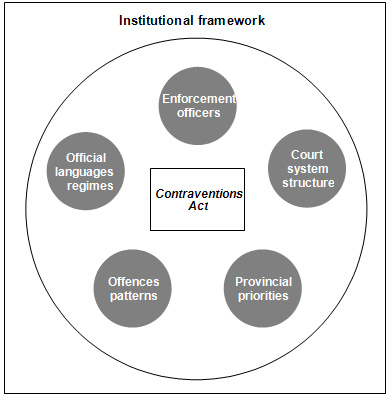
The implementation of the Act is not done in a vacuum. On the contrary, there are a number of systemic factors that are bound to influence the extent to which the implementation of the Act is achieved, and its expected outcomes realized. In other words, these systemic factors are expected to have an impact (positive or negative) on the extent to which the logic illustrated in Figure 1 will unfold as planned.
Figure 2 lists five of these factors:
- Enforcement officers:
The successful implementation of the Act relies heavily on the behaviour of enforcement officers. It could be argued that requirements associated with the summary conviction process acted as a disincentive to the enforcement of some federal offences that were of a less serious nature. Now that a ticketing system is available, factors such as training on the use of the ticketing system and the administrative and operational structure of enforcement authorities will play a pivotal role in the implementation of the Act.
- Court system structure:
While similarities cut across jurisdictions, each province has its own court system, with its own rules, its own culture, and its own administrative procedures. Federal contraventions are adding a new component to these already complicated systems. Again, this requires the court administrators and personnel to understand the specific requirements associated with federal contraventions. Their collaboration is essential to avoid judicial challenges based on a misunderstanding of the new prosecution scheme.
- Provincial priorities:
More than 12 years after its adoption, the Act is still not operational in some jurisdictions in Canada. This reflects the fact that provincial governments must be willing to focus time and resources to work with the federal government to implement the Act. There are a multitude of considerations, whether administrative or financial, that must be addressed before the Act can become fully operational. The negotiation of an agreement, as well as the communication and training required of court personnel and enforcement officers are all fundamental conditions for the successful implementation of the Act. For various reasons, a provincial government may conclude that the implementation of the Act in their province is not sufficiently a priority to allocate the required resources.
- Offences patterns:
The nature of the offences listed in Table 1 is such that some provinces are bound to face more cases of federal contravention violations than other provinces. A large portion of statutory offences designated as contraventions relate to the environment (marine activities, fisheries, national parks, wildlife, migratory birds) and transportation (shipping, ground transportation, and transportation of dangerous goods). Provinces with several national parks, protected habitats, or direct access to large bodies of water have a particular interest in ensuring an effective enforcement of federal contraventions. Along the same line, provinces with small populations may only rarely face the list of scenarios currently covered by statutory offences designated as contraventions.
- Official languages regimes:
The 2001 ruling from the Federal Court confirmed the range of language rights applicable to federal contraventions. Essentially, provinces that enforce federal contraventions are acting on behalf of the federal government and, as such, must uphold all language rights applicable to a federal institution or to the prosecution of a federal offence. Experience to date with the Contraventions Act Fund has demonstrated the need to assist some provinces that have limited capacity to deliver services in both official languages. Ultimately, these language requirements may raise challenges that will act as a disincentive for a province to embark in the processing and enforcement of federal contraventions. In that sense, the Contraventions Act Fund plays a pivotal role, as documented in the two formal evaluations the Department of Justice Canada has conducted on the Fund.
Figure 2: Institutional framework
[ Description ]
- Date modified: