
Special Advocates Program Evaluation
4. Evaluation findings
This section of the report describes the evaluation findings related to SAP. The information is based on findings that emerged from both the document review and interviews.
4.1 Relevance of the Special Advocates Program
This first subsection explores the relevance of the SAP over the period covered by this evaluation, as well as the expected demand for the Program in the future. It also addresses the extent to which the Program aligns with both the role of the federal government, and its current priorities, particularly those related to national security.
4.1.1 The role of the Federal Government in Providing Special Advocates
When asked about the relevance of the SAP, key informants typically pointed to the legislative requirements included in section 85 of IRPA. As already noted, the Minister of Justice has a statutory obligation to maintain a list of individuals who may act as special advocates, to provide them with the support and resources they require, and to ensure that they are ready and able to provide a reasonable substitute for full disclosure to the named person involved in Division 9 proceedings.
Over the period covered by this evaluation, an important development has added a new dimension to the federal role related to special advocates. In its recent decision in the Harkat case, the Supreme Court of Canada concluded that the provisions of IRPA covering the role of special advocates meet the requirements of a fair process as protected by section 7 of the Charter by providing a “substantial substitute” to the direct participation of the named person and his or her counsel in closed proceedings. Footnote 13
The confirmed legality of IRPA provisions related to special advocates is significant. It demonstrates that the federal response to the Charkaoui decision, through the set of legislative amendments made to IRPA in 2008, Footnote 14 is in fact appropriate. In Charkaoui, the Supreme Court of Canada had stated that, in order for the security certificate scheme to be Charter compliant, “either the person must be given the necessary information, or a substantial substitute for that information must be found”, before concluding that “neither is the case here”. Footnote 15 At the time, the Court did not specify what the “substantial substitute” ought to be, leaving it to Parliament to proceed with legislative amendments that it deemed appropriate. This inevitably left the question open as to whether the 2008 amendments to IRPA were providing that sought-after “substantial substitute”. With the Harkat decision, this ambiguity can now be set aside.
This context of greater certainty logically extends to the actual role that the federal government is expected to play through the SAP. The Department of Justice Canada must plan its activities related to the Program knowing that it stands on firm ground that can only be shifted through legislative amendments.
4.1.2 Alignment of the SAP with Federal Priorities
In supporting the use of classified information in applicable proceedings under IRPA, the Program aligns with the current priorities of the federal government related to national security. Although the concept of detaining and removing non-citizens for security purposes dates back to the Immigration Act (1985), the security certificate process became a central component of the legislative changes introduced in 2001 in the wake of the terrorist attacks perpetrated in the United States on September 11, 2001. Since then, threats to national security have continued to remain a federal priority, as illustrated more recently by the tabling in Parliament, on January 30, 2015, of Bill C-51, the Anti-Terrorism Act, 2015. Footnote 16 Among other things, the set of proposed legislative changes seeks to enhance the ability of federal agencies and departments to gather and share information pertaining to national security, some of which may ultimately be used as classified information in proceedings under IRPA.
The enhancement of anti-terrorism mechanisms further highlights the importance of ensuring that the Canadian justice system remains fair, relevant, and accessible, which is a core component of the role played by the Department and, as such, constitutes one of its strategic outcomes. Footnote 17 By protecting the interests of non-citizens subject to inadmissibility and other related proceedings, the Program supports the integrity of the Canadian justice system, which ultimately supports the goal of ensuring that “Canada remains a recognized international leader in the fair administration of its justice system”. Footnote 18
4.1.3 The Ongoing Need for Special Advocates
Beyond the fact that the SAP ought to operate due to a legislative requirement, the evaluation explored the expected needs for special advocates in future proceedings. Although there is a large speculative dimension to this question, it nonetheless provides important contextual information, which may ultimately affect not so much the existence of the Program itself, but rather how it is managed and the challenges that it may face in achieving its expected outcomes (i.e., the federal government can successfully use classified information in inadmissibility proceedings under IRPA, and named individuals involved in inadmissibility proceedings under IRPA are provided with a fair process, namely protection of their interests when information is heard in their or their lawyer’s absence).
The obvious trend that emerged during the period covered by the evaluation is illustrated in Figure 1 (next page). The total number of hours billed by special advocates has decreased steadily and significantly, shifting from 5,485 hours billed in 2010–11 to 551 hours billed in the current fiscal year (as of January 30, 2015).
Individuals interviewed as part of the evaluation were invited to comment on this trend. As noted during these interviews, a great deal of uncertainty surrounded the security certificate scheme during the court challenges that led to the Charkaoui decision in 2007, and the resulting amendments to IRPA introduced in 2008. The federal government reissued security certificates in what is referred to as the “five legacy cases”, Footnote 19 which all proceeded in a context of further Charter-based court challenges that ultimately led to the Harkat decision issued by the Supreme Court of Canada in 2014. In most cases, these certificates were based on facts that had accumulated over an extended period of time, in some cases dating back to the mid-1990s. The procedural challenges in dealing with such significant volumes of evidence were therefore compounded by the requirements associated with the Charter-based challenge to the security certificate scheme itself. Special advocates became heavily involved on both fronts. In particular, while dealing predominantly with substantive questions of law, hearings at the Supreme Court of Canada in the Harkat case did involve special advocates, as classified information whose disclosure was alleged to be injurious to national security was shared with the Court.
Figure 1
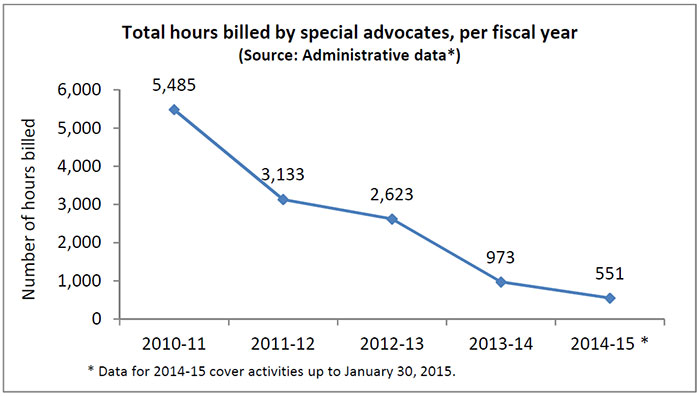
Figure 1 - Text equivalent
- In 2010-11, 5,485 hours were billed by special advocates
- In 2011-12, 3,133 hours were billed by special advocates
- In 2012-13, 2,623 hours were billed by special advocates
- In 2013-14, 973 hours were billed by special advocates
- In 2014-15, 551 hours were billed by special advocates (data for 2014-15 cover activities up to January 30, 2015)
Individuals who were consulted noted that, in the wake of the Harkat decision, the federal government may be more readily disposed to using security certificates as new circumstances warrant, knowing that new cases will likely involve a lesser volume of evidence, and that sustained Charter-based challenges may be more limited.
The other aspect that may have an impact on the future use of special advocates is the extent to which non-disclosure applications will be made in other proceedings under IRPA. As noted in section 2.1 of this report, special advocates may be required during admissibility hearings and detention reviews heard by the Immigration and Refugee Board, during appeals before the Immigration Appeal Division, or during judicial reviews by the Federal Court of decisions or orders made by the Immigration Refugee Board, whenever applications of non-disclosure are made. Consultations held as part of this evaluation indicate that the experience gained to date with security certificates may lead to a greater use of classified information during these proceedings, which would trigger a greater involvement of special advocates.
Ultimately, however, it is worth observing that the demand for special advocates will be shaped by the strategic value attributed to security certificates and other related proceedings under IRPA to combat threats to national security, let alone the degree to which Canada will be targeted by terrorist activities, the assessment of which far exceeds the scope of this evaluation.
4.2 Achievement of the Special Advocates Program’s Expected Outcomes
This subsection of the report assesses the extent to which the Program has achieved its expected results, notably in establishing a list of individuals who may act as special advocates and providing them with the required resources and support, in engaging special advocates in actual judicial proceedings, and in maintaining the administration of a fair process that is Charter compliant.
4.2.1 Establishment of the Special Advocate Roster
Initial Selection Process
At the time of this evaluation, the Department of Justice Canada had only issued one request for expression of interest in order to select individuals who may act as special advocates. Although this process precedes the period covered by the evaluation, it is summarized for reference purposes.
Following the Charkaoui decision from the Supreme Court of Canada (released on February 23, 2007) and the tabling of Bill C-3 to amend IRPA (introduced on October 22, 2007), the Department of Justice Canada, with the support of Public Safety Canada, issued a request for expression of interest on December 18, 2007. Footnote 20 The Department invited lawyers who had been members of the Bar for at least 10 years and who had significant litigation experience, preferably in immigration law, criminal law, national security law, or human rights law, to submit their application in order to be included in a list of individuals who may act as special advocates. The document was posted on the website of the Department of Justice Canada, in addition to being promoted by relevant stakeholders, such as the Canadian Bar Association.
The Department of Justice Canada mandated a committee presided by a retired judge from the Federal Court, and including representatives from the Federation of Law Societies of Canada and the Canadian Bar Association, with the task of reviewing the applications and providing a list of names for consideration by the Minister of Justice. Over 100 individuals responded to this initial call, and the committee recommended 28 names to be included on the list. By the time the new legislative scheme related to special advocates came into force on February 22, 2008, the Minister of Justice had published a list containing an initial 15 recommended names. The rest of the recommended names were published shortly thereafter.
Current List of Special Advocates
As of February 2015, the list of individuals who may act as special advocates had 22 names. Some individuals initially included in the list were removed due to judicial or other appointments, or personal circumstances. In terms of regional distribution, the list had 16 names from Ontario, five from Quebec, and one from Alberta.
Findings from the consultations held as part of this evaluation point to a great level of support for the current roster of individuals who may act as special advocates. All individuals included in the list offer strong credentials that directly relate to the knowledge and competencies described in the initial call for expression of interest and, considered as a whole, the roster offers the capacity to operate in both official languages. More specifically, public counsel consulted as part of this evaluation voiced no concern regarding the current roster and were comfortable recommending names from it to their clients, for approval by the presiding judge or the applicable division of the Immigration and Refugee Board.
Considering the reduced demand for special advocates over the past five years (as illustrated in Figure 1 above), the evaluation explored whether the list should consequently be reduced. Evaluation findings indicate that the advantages of keeping the list at its current level outweigh any potential benefits that could come from removing some of the names. First, the ongoing expenditures associated with each member of the roster are minimal and are largely limited to their participation in professional development activities, which normally occurs once a year. Second, at a more substantive level, there must be a sufficient number of individuals on the roster to ensure that both the named person in an applicable proceeding under IRPA and his or her counsel may recommend individuals that satisfy the criteria established in paragraph 83. (1.2) of IRPA, particularly as it relates to the absence of any conflict of interest or any risk of inadvertent disclosure of classified information that requires protection for national security or personal safety purposes.
As for the current regional distribution of individuals who may act as special advocates, it leaves little doubt as to the high concentration of special advocates in Montréal, Ottawa and Toronto. Individuals consulted as part of this evaluation recognized that having a greater regional coverage could arguably be desirable, but they also noted that the nature of the work of special advocates limits the ability of individuals from other regions to engage in it. All evidence must be consulted and analyzed in the designated secure sites of the Federal Court and the Immigration and Refugee Board which are located in Ottawa, and multiple sessions are needed to complete any assignment.
4.2.2 Support and Resources Provided to Special Advocates
In assessing the support provided to special advocates, the evaluation focussed on both the assistance provided to those special advocates assigned to specific cases, and the ongoing professional development provided to all individuals who may act as special advocates. The evaluation has purposely excluded certain activities that were carried out when individuals were initially added to the list of those who may act as special advocates, as none of these activities were carried out during the period covered by this evaluation. Footnote 21
Case-Specific Support
Evaluation findings indicate that the Program provides adequate support to special advocates assigned to specific cases. There are, however, challenges that special advocates continue to face in fulfilling their assigned mandate.
Overall, consultations held with special advocates indicate that the Program has been providing strong support throughout the course of their assignments. This includes managing contribution agreements, processing payments, and providing any other assistance that special advocates may require. Program representatives have been described as accessible, professional, flexible and pro-active when it comes to supporting special advocates.
However, it is important to note that the case-specific support required by special advocates extends beyond the set of activities for which the Program has direct authority. In particular, the Courts Administration Service and the Immigration and Refugee Board must ensure that special advocates are provided with adequate access to the classified information stored in their secure locations. In practical terms, adequate access must include the ability for special advocates to consult, analyze and safeguard the work they perform on the basis of the classified information.
Although the Program may, when circumstances warrant, advocate on behalf of special advocates — and evaluation findings indicate that they have done so — it can instruct neither the Courts Administration Service nor the Immigration and Refugee Board. This in itself raises questions as to the scope of the statutory obligation established in section 85. (3) of IRPA. If the Minister of Justice “shall ensure that special advocates are provided with adequate administrative support and resources”, but that some of this support ought to be provided by institutions that operate at arm’s length from the Government of Canada, it is unclear as to how the Minister of Justice may readily and fully address any shortcomings on the part of these arm’s length institutions.
Prior to the period covered by the evaluation, both the Courts Administration Service and the Immigration and Refugee Board had faced logistical and administrative challenges in integrating special advocates in the management of the applicable proceedings under IRPA. As such, evaluation findings indicate that an incremental approach has proven necessary to find proper space that could meet security requirements, and to establish procedures that could provide special advocates with a reasonable access to these facilities. For instance, the desire by some special advocates to work in these secure facilities well past normal business hours has required the establishment of new procedures that balance the needs of special advocates and the operational context within which these institutions must operate. Another example was provided when special advocates assigned to the Mahjoub case faced logistical issues that were brought to the attention of the presiding judge, who concluded that the special advocates “have not been provided with adequate administrative support” and ordered the Minister of Justice to “provide a progress report on how and when the technical issues identified herein will be resolved”. Footnote 22 At the time of this evaluation, findings indicate that these various administrative and logistical challenges had been reasonably accommodated.
Assistance to Special Advocates
According to those consulted as part of this evaluation, what remains the most significant challenge for special advocates assigned to specific cases is the absence of any assistance during the execution of their various tasks performed in secure locations. In other and more typical circumstances, senior law practitioners would work with junior practitioners to complete some of the work required on a file, and would also benefit from the assistance of an administrative assistant to complete clerical tasks (photocopying and assembling documents, for instance). This organization of the work cannot be readily applied to special advocates, since the material they work with in secure locations is information whose disclosure could be injurious to national security or could endanger the safety of individuals. As such, only those with the appropriate security clearance and who have been permanently bound to secrecy may come in contact with this material. Even if a junior practitioner or an administrative assistant could meet these security requirements, they are not officially part of the list of individuals who may act as special advocates and as such, they are not directly covered by the provision of IRPA applicable to the nomination of special advocates.
This challenge was brought to the attention of the Federal Court in the Harkat case, when the special advocates assigned to this file requested the appointment of an individual who was in a position to provide administrative assistance and who met all applicable security requirements. A significant dimension of this request was the fact that the volume of evidence that needed to be reviewed in this case had greatly expanded, as a result of the disclosure requirements set out in the 2008 Charkaoui decision from the Supreme Court of Canada. Footnote 23 The Federal Court proceeded with the appointment of the individual, noting that “it is consistent with the intent of the legislator to read ‘adequate administrative support and resources’ as encompassing limited forms of human support. Human support is a necessary part of an efficient office environment.” Footnote 24 The Court established strict parameters for the role of this appointed individual, specifying that she was not being appointed as a special advocate, was not to play any advocacy role, was not having any relationship with the named person, was not charged with representing his interest, and was not to be present during the closed hearing. Footnote 25
Consultations held with special advocates as part of this evaluation indicate that this appointment has proven to be the exception rather than the norm. These special advocates have systematically noted the inefficiency that results from having them spend several hours photocopying and assembling information, let alone having to do all the review of the evidence themselves, without any support from more junior practitioners. Citing the example of the Special Advocates Program in the United Kingdom, they recommended that more junior practitioners be added to the list of individuals who may act as special advocates. Such a change, combined with the appointment of a junior counsel, as authorized by the Federal Court in the Harkat case, could arguably go a long way in addressing these concerns.
Professional Development
During the period covered by this evaluation, the SAP has offered professional development activities that have provided valuable knowledge and insights on matters relevant to the role of special advocates. These activities have covered substantive areas of the law related to a wide range of issues, such as intelligence and evidence gathering, terrorism, national security, and relevant case law. The Program has been alternating between in-person sessions and webinars. Consequently, in-person professional development sessions were held in 2011–12 (18 participants) and 2013–14 (13 participants), whereas webinar sessions were held in 2012–13 (11 participants) and in 2014–15 (12 participants).
In addition to these activities, the Program has been managing a web portal that contains a wide variety of resources related to the role of special advocates, including information pertaining to IRPA, relevant court decisions, and professional development activities. Administrative data indicate that in 2012–2013, 10 individuals included on the list of those who may act as special advocates spent a total of 69 hours consulting the portal for professional development purposes. The equivalent number in 2013–2014 stood at 72 hours among nine individuals.
It is worth noting that the web portal contains all public orders and decisions pertaining to security certificates and other related proceedings that were active at the time of the Program implementation. This is a significant achievement when one considers the fact that in the Mahjoub case alone, a total of 212 such decisions and orders had been issued at the time of this evaluation. As such, the web portal represents an important resource that acts, in some regard, as a corporate memory or repository that supports the ongoing management of the Program.
The SAP representatives have indicated that an upgrade to the software currently used to host these resources will be implemented to facilitate their search and access. The review of the portal undertaken as part of this evaluation confirms that such an upgrade would support a more efficient navigation of the portal’s resources.
4.2.3 Involvement of Special Advocates in IRPA Proceedings
By establishing a list of individuals who may act as special advocates and providing them with the support they require, the Program is expected to set the stage for the actual involvement of special advocates in specific inadmissibility and other related proceedings under IRPA. The experience gained during the period covered by this evaluation confirms that special advocates have, in fact, played a significant role in a number of proceedings. As illustrated in Table 1, special advocates have billed close to 13,000 hours related to six cases heard by the Immigration and Refugee Board, the Federal Court, the Federal Court of Appeal, or the Supreme Court of Canada.
| Cases | 2010–11 | 2011–12 | 2012–13 | 2013–14 | 2014–15 | Totals |
|---|---|---|---|---|---|---|
| Almrei | 17 | 0 | 0 | 0 | 0 | 17 |
| Harkat | 597 | 741 | 153 | 446 | 21 | 1,958 |
| Jaballah | 1,176 | 428 | 1,100 | 113 | 367 | 3,784 |
| Mahjoub | 1,793 | 1,373 | 1,156 | 272 | 92 | 4,686 |
| Surresh | 0 | 176 | 175 | 142 | 71 | 564 |
| Torres | 1,302 | 415 | 39 | 0 | 0 | 1,756 |
| Total | 5,485 | 3,133 | 2,623 | 973 | 551 | 12,765 |
Source: SAP performance information data.
During the period covered by this evaluation, a total of five new appointments of special advocates were made, including two appointments in the Harkat proceedings before the Federal Court of Appeal (in 2011–12), two appointments in the Harkat proceedings before the Supreme Court of Canada (in 2013–14), and one appointment in the Surresh case before the Immigration and Refugee Board (in 2011–12). The remaining appointments were made prior to the period covered by this evaluation.
One unexpected development that was systematically noted throughout the consultations held as part of this evaluation relates to the appointment of individuals from the roster of special advocates to act as amicus curiae (friend of the court). Such appointment is made whenever a court is of the opinion that it “is necessary to permit a particular proceeding to be successfully and justly adjudicated”. Footnote 26 These appointments may relate to any areas of law, including proceedings other than those included in IRPA where classified information is being used, such as those involving section 38 of the Canada Evidence Act. In such cases, it appears that courts have, from time to time, turned to the list of special advocates to select amici, as these individuals possess the required expertise to manage classified information, in addition to meeting all security requirements.
This trend is, in principle, irrelevant for the purpose of this evaluation, unless it negatively affects the ability of the Program to meet its expected results. This would be the case, for instance, if the volume and intensity of the work done by individuals from the roster of special advocates who happen to be appointed as amici was such that it would, de facto, make it impossible for them to act as special advocates. Evidence gathered indicates that, to this day, such concern has not materialized, and it is unlikely to do so in the future. Individuals consulted noted that the number of appointments of amici remains limited and that, in any case, an individual could reasonably manage being appointed both as amicus and as special advocate, as any law practitioner is expected to manage multiple files at once.
4.2.4 The SAP’s Contribution to Ensuring a Fair Judicial Process
The central goal of this evaluation was to assess the extent to which the SAP has assisted the Minister of Justice in successfully discharging his statutory obligation as established in section 85 of IRPA. As such, the focus of the evaluation has been the Program itself, and not the special advocate scheme as a whole. Keeping this in mind, the data collection process used in support of this evaluation has gathered some evidence that arguably relates more directly to the special advocate scheme. It is briefly summarized here for contextual purposes.
The overwhelming impression communicated by those consulted as part of this evaluation reflects the conclusion of the Supreme Court of Canada in Harkat, that the special advocate scheme as currently structured in IRPA, while not perfect, does constitute a substantial substitute to the direct participation of the named person and his or her counsel in closed proceedings. It appears that special advocates have, in fact, been in a position to challenge the Minister’s claims related to the protection of certain information, and to challenge the relevance, reliability or sufficiency of the protected information. As a note of caution, it is worth adding that this assessment of the actual work performed by special advocates is bound to be of limited depth, as it is, by its very nature, secret and protected. As public counsel noted during the consultations, they have little choice but to trust that special advocates are performing well, as they have no means of assessing it directly.
The most pressing concern voiced by special advocates and public counsel related to the strict parameters that IRPA currently imposes on the communications between these two groups. As stated in section 85.4 (2) of IRPA:
After that information or other evidence is received by the special advocate, the special advocate may, during the remainder of the proceeding, communicate with another person about the proceeding only with the judge’s authorization and subject to any conditions that the judge considers appropriate.
According to public counsel and special advocates interviewed, this framework has proven to be particularly challenging. However, as this is an issue that exceeds the scope of this evaluation, it is noted but not further analyzed.
4.3 Efficiency and Economy
This last subsection focuses on the extent to which resource use has been minimized in the implementation and delivery of SAP.
The evidence gathered indicates that the Program has been administered effectively and economically, as illustrated by the following developments:
- Although the Program was initially allocated a PM-05 position, it has elected not to fill that position in light of the level of activities experienced by the Program.
- The Program has made an increasing use of online technologies to deliver its professional development activities.
- The per diem offered to special advocates is well below what these law practitioners typically earn in their own practice. This could constitute a risk by acting as a disincentive among qualified law practitioner to apply to become part of those who may act as special advocates; however, the experience to date indicates that such a risk has not materialized.
As for the number of hours billed by special advocates, the Program cannot impose parameters that would limit their ability to adequately fulfill their mandate. The number of hours billed by special advocates is dependent on a number of factors, including the extent of disclosure to be reviewed and fluctuations in the number of proceedings involving special advocates, which will require ongoing monitoring and management on the part of the SAP.
Finally, this assessment of efficiency and economy must also consider the broader contribution of the SAP to Division 9 proceedings under IRPA. Various departments and agencies invest considerable resources to pursue security certificate and other related proceedings. The legislative scheme related to special advocates — which becomes operational through the Program — ensures the constitutionality of these proceedings. As such, the SAP represents a well contained investment that provides essential support to a wider set of activities that involve far larger investments in resources.
- Date modified: