
Evaluation of the Contraventions Act Program
4. Key findings
This section presents key findings related to the Program. More specifically, it explores the relevance of the Program and its performance during the period covered by the evaluation.
4.1. Relevance
Just over 20 years ago, the federal government proceeded with the implementation of the Contraventions Act, whose relevance had been established through a number of studies, including those of the Law Reform Commission described in sub-section 2.1 of this report. The Act’s relevance has also been confirmed through evaluation studies undertaken by the Department of the Act or of the Fund.Footnote 23 This evaluation indicates that the relevance of the Program remains as valid as ever before; however, it may be compromised by the inability of the Department to achieve a complete implementation of the Act. These findings are further described in the following sub-sections.
4.1.1. The alignment of the Act with federal priorities
The Contraventions Act Program continues to support one of the two strategic outcomes of the Department, which is to contribute to “a fair, relevant, and accessible Canadian justice system.
”Footnote 24 The Department recognizes the stewardship role it plays in that regard, particularly through the establishment of a national legal framework that is expected to contribute to “a safe and just society,” and to nurture and sustain Canadians’ confidence in their justice system.Footnote 25
The Contraventions Act is one component of this national legal framework. As countless federal legislation serve to clarify what Canadians can and cannot do, what they are entitled to, and what their obligations are, the Contraventions Act stands largely apart, as it strictly concerns itself with the actual enforcement of some of these legislative provisions. It supports an efficient legislative and regulatory enforcement process, which has long been recognized as a cornerstone of the rule of law.Footnote 26
While there are a number of options for prosecuting alleged offenders, the summary conviction process has long served as the predominant one for matters relating to statutory offences.Footnote 27 However, little doubt remains that this summary conviction process is inadequate in many scenarios involving statutory offences. For instance, the 2010 evaluation of the Act concluded that “leaving enforcement officers with no other option but to enforce federal statutory offences by way of summary conviction is immensely problematic
,” as systemic barriers create strong disincentives to actually enforce these offences.Footnote 28 The report added:
“Simply put, the summary conviction process seems at odds with the nature of many federal statutory offences. So, how do enforcement officers react? Often by simply not laying a charge, as made abundantly clear during interviews held as part of this evaluation.”Footnote 29
Six years later, interviews with enforcement officers conducted as part of the current evaluation confirm the validity of that statement. Enforcement officers repeatedly emphasized that the ticketing system under the Contraventions Act is an essential component of the range of tools they require to adequately fulfill their mandate. Many acknowledged that, in the absence of a ticketing system, they would routinely elect not to enforce many of these statutory offences or turn to warnings, which have no legal strength. And while warnings are a legitimate tool to support the work of enforcement officers, they are not meant to replace, when circumstances warrant, a formal enforcement mechanism that rests on an actual legal foundation.
4.1.2. Upcoming legislative initiatives
The relevance of the ticketing system provided by the Contraventions Act should also be considered in light of the current legislative priorities of the federal government. One of the most prominent initiatives being considered in that regard is the legalization and regulation of marijuana in Canada.Footnote 30 The government has confirmed its intention to introduce legislation in support of this goal in the spring of 2017.Footnote 31 At the time of this evaluation, it was not yet known whether marijuana would be primarily regulated federally or provincially. In the meantime, the government has established the Task Force on Marijuana Legalization and Regulation, which is consulting with a wide range of stakeholders, based on a discussion paper that lays out some of the key considerations that ought to guide the work of Parliament.Footnote 32
The enforcement process that has accompanied, to this day, offences related to marijuana provides an illustration of the challenges that enforcement authorities often face in fulfilling their mandate. In 2010, enforcement authorities laid approximately 74,000 charges related to all types of drugs in Canada (which is typically done through the summary conviction process), and about 10% of those resulted in a guilty verdict. The remaining 90% of these charges were abandoned by the Crown, stayed or withdrawn in court, or resulted in acquittals.Footnote 33 Considering the level of effort associated with each charge laid under the summary conviction process, it is rather alarming to think that more than 65,000 of these charges did not lead to their expected outcomes. In this context, it will come as no surprise that in 2013, the Canadian Association of Chiefs of Police voted overwhelmingly in favour of reforming the enforcement system to allow “officers to have the ability to ticket people found with 30 grams of marijuana or less
,”Footnote 34 something that would likely need to be done through the Contraventions Act.
To this day, the Contraventions Act has never been used to enforce criminal offences, and whether this will ever be done is a question that falls beyond the scope of this evaluation. Should marijuana be regulated federally, its legalization could trigger the adoption of a range of statutory offences. As stated in the discussion paper published by the Task Force, one of the goals of the federal government is to:
“establish and enforce a system of strict production, distribution and sales, taking a public health approach, with regulation of quality and safety (e.g., child-proof packaging, warning labels), restriction of access, and application of taxes, with programmatic support for addiction treatment, mental health support and education programs.”Footnote 35
The legal framework required to support this objective may extend beyond the Criminal Code or the Controlled Drugs and Substances Act, to include a range of statutory offences related to health, transport, or commerce. The extent to which some of these offences will be designated as contraventions is something that will need to be considered in due time, but one could presume that enforcement authorities will wish to ensure that the range of tools with which they are provided are adequate to ensure the proper enforcement of these offences. As noted by the Task Force, if the new regime “is too complex or onerous for enforcement and legal production and access, there will be opportunities for organized crime to satisfy the demand through the illicit market.
”Footnote 36
As predominant as it is, the legalization and regulation of marijuana is only one example of a legislative initiative that will continue to shape the range of statutory offences that authorities are expected to enforce, and that the Contraventions Act may be expected to support, when applicable.
4.1.3. The relevance of the Fund (Official Languages)
The Contraventions Act Fund is an essential part of the Program. In fact, without the Fund, the entire Program, in its present form, would largely collapse. This comes from the fact that, of the two options available for the implementation of the ticketing system, the federal government opted for the use of existing provincial prosecution schemes (as described in sub-section 2.3 of this report). In this context, since provinces act on behalf of the federal government, they must uphold all language rights applicable to a federal institution or to the prosecution of a federal offence. To this end, the Fund has been providing the necessary support to allow provinces to deliver services in both official languages, in accordance with these language right requirements. In the end, and as pointed out in the 2012 evaluation of the Fund, “the Department of Justice has little choice but to keep the Implementation Fund for as long as it intends to keep the Act in its current implementation framework in the provinces.
”Footnote 37
At the time of this report, the Fund continued to be integrated into the federal government’s Roadmap for Canada’s Official Languages 2013–2018. Footnote 38 Reflecting the ongoing commitment of the federal government to “enhance the vitality of official language minority communities and to contribute to strengthened linguistic duality
,”Footnote 39 the Roadmap supports the implementation of 28 initiatives, involving 14 federal partners. The Contraventions Act Fund is one of these 28 initiatives.
This evaluation has found no substantive rationale for integrating the Fund in the Roadmap, and evidence indicates that keeping the Fund within the Roadmap is, in fact, counterproductive. As its title indicates, the Roadmap rests on three pillars: education, immigration, and communities. Technically, the Fund is part of the “community pillar.” When looking at the range of initiatives that fall under that pillar, they largely share a common goal of contributing to the enhancement and the vitality of OLMCs through arts and culture, economic development, and the provision of direct services in key sectors, such as health and justice (e.g., through legal information centres). In that sense, the Roadmap (and certainly the community pillar) is directly linked to the commitments contained in Part VII of the Official Languages Act, to enhance the vitality of the English and French linguistic minority communities in Canada and to support and assist their development.Footnote 40
The Contraventions Act Fund certainly relates to official languages as it allows alleged offenders to receive their ticket in both official languages, and to obtain any applicable services covered by the linguistic provisions of the Criminal Code or Part IV of the Official Languages Act (communications with and services to the public) in both official languages. However, so are the countless other service structures, communication tools, and policies that allow Canadians to peruse government websites in both official languages, renew their passports in either one of the two official languages, or receive services regarding income taxes, pensions, or employment insurance (to name but a few domains) in both official languages. While they are part of the overall official languages program of the federal government, these activities are not directly included in the Roadmap, as they do not share the goals specific to its three pillars.
If the inclusion of the Contraventions Act Fund into the Roadmap was questionable but largely inconsequential, it may not deserve much attention. But this is not the case. By being integrated in the Roadmap, the Fund also becomes integrated in an accountability structure and logic, and a renewal process, which do not reflect its nature and purpose. It also creates an artificial distinction between the Fund and the Act itself. Whether financial resources are allocated to the Fund has little to do with the future of the Roadmap. As already noted, for as long as the Contraventions Act continues to be implemented using the provincial prosecution scheme, the Fund will be needed. And ultimately, the renewal of the Fund is about law enforcement, first and foremost, and meeting the applicable conditions for these activities to occur in accordance with applicable language rights. In this context, neither the Fund nor the Roadmap appears to be well served by the status quo.
4.1.4. The systemic shortcomings of the Program
While all the evidence collected as part of this evaluation confirm the relevance of the Program, it also indicates that some of its shortcomings, which were expected to be temporary, have now turned into systemic barriers that weaken the actual relevance of the Program. The two shortcomings that deserve immediate attention are that the Act is still not operational in three provinces, and that the range of offences covered by the Act is too limited.
The Act is still not operational in three provinces
Previous evaluations of the Act and the Fund
Justice Canada conducted its first evaluation involving the Contraventions Act in 2006, which focussed specifically on the Fund that supports bilingual services. The formative evaluation report noted that the Act was still not operational in Newfoundland, Saskatchewan, and Alberta, but added, “the Department’s goal remains to have agreements in place in all jurisdictions before the end of fiscal year 2007–08.
”Footnote 41 The report cautioned that “failing to have agreements in place in all jurisdictions may affect the achievement of the Contraventions Act’s stated objective.
”Footnote 42
The following year, the Department tabled the summative evaluation of the Contraventions Act Fund, and noted that negotiations were still proceeding in the three provinces where the Act was not yet operational, but no agreement had been signed. It added that failing to implement the ticketing system was forcing enforcement officers in the applicable provinces to use the summary conviction process, which represents a significant setback in the achievement of the objectives pursued through the Act.Footnote 43
The most exhaustive analysis of the impact of not having the Act operational in three provinces is contained in the 2010 evaluation of the Contraventions Act, which focussed on the Act itself, and not on the Fund. The report describes some of the risks that the Department is facing by maintaining an uneven application of the Act. First, all the systemic barriers to the work of enforcement officers that the Act is attempting to address have remained in these three provinces. And perhaps more importantly, the resulting outcome of having the Act operational in only a portion of the country contravenes the goal of maintaining a fair, even, and predictable enforcement of the law, which is a fundamental component of the rule of law. As stated in the report:
“The fact that the Act is not yet operational in three provinces is a concern. It creates a situation whereby the exact same unlawful behaviour that would contravene a federal statutory offence designated as a contravention is treated differently, based on the geographical location of the offender. This could trigger legal risks, particularly in provinces where the Act is not operational, in light of the fact that offenders are exposed to greater penalties.”Footnote 44
The evaluation report included a recommendation that the implementation of the Act in the remaining provinces be considered a priority of the Department.Footnote 45 The following management response was tabled by the Department:
“Management agrees with this recommendation. The Department is already in negotiations with Newfoundland and Labrador and anticipates being able to enter into an agreement with the province by the end of the fiscal year. The delay in reaching agreement has been outside of the control of the Department. The Department will also pursue the interest of Alberta and Saskatchewan in entering into an agreement to implement contraventions in their respective jurisdictions.”
Finally, the 2012 evaluation of the Fund noted that no progress had been made in making the Act operational in the remaining three provinces, and added that the “partial implementation of the Contraventions Act will not likely be permanently sustainable,” as it was creating legal risks associated with non-uniform application of federal law.
”Footnote 46
An absence of departmental strategy
Twenty-five years after the Act became de facto operational, and 10 years after the completion of the first evaluation relating to the Contraventions Act, federal offences designated as contraventions must still be enforced by way of the summary conviction process in Newfoundland and Labrador, Saskatchewan, and Alberta. Arguably, this anomaly has lost any provisional dimension, and has turned into a systemic flaw (un vice de fond).
In its management response issued in 2010, the Department emphasized that the delay in reaching new agreements has been outside of its control. The willingness of a province to support the implementation of the Act is indeed an essential condition that can be facilitated or nurtured, but that cannot be forced. Furthermore, findings gathered as part of this evaluation indicate that the Contraventions Act Implementation Management Team has invested considerable efforts in trying to secure new agreements.
Despite these sustained and commendable efforts, the fact remains that, at the time of this evaluation, the Department had no strategy to deal with the likely scenario that the Act may never become applicable throughout Canada. In other words, by maintaining the same approach, there is little reason to believe that a nation-wide application of the Act is within reach. This is incompatible with the stewardship role that the Department plays in relation to the Canadian justice system and the rule of law.
As a result, the Department is faced with two viable options. It can either implement a revised strategy to deal with the three provinces that have yet to sign agreements, which would likely require the involvement of senior management officials within the Department and perhaps the Minister, or it can initiate the design of an alternative process that would allow for tickets to be issued in these jurisdictions, without having to use provincial enforcement schemes.
The impact of the status quo
In the meantime, evaluation findings confirm once again that maintaining an uneven implementation of the Act is triggering risks. As previously noted, interviews conducted with enforcement officers have indicated that, in the absence of a ticketing system, there is a greater likelihood that offences designated as contraventions will not be as readily enforced in jurisdictions where the Act is not operational. Having a person receive a warning (in Newfoundland for instance), while another person receives a ticket and a fine in another province (in New Brunswick for instance) for the very same offence, committed in the same circumstances, is evidently problematic.
What is perhaps more concerning is that the reverse scenario is also occurring. In some jurisdictions where the Act is not operational, Canadians who are alleged to have contravened a statutory offence designated as a contravention are currently being prosecuted by way of the summary conviction process. Considered in isolation of the overall implementation of the Contraventions Act, there are no issues with having such charges proceeding. The fact that the ticketing system is available was never meant to replace the summary conviction process as an option. The broader concern, however, comes again from the uneven treatment to which alleged offenders are exposed across Canada.
A good illustration of this is provided by national parks. In 2014–15, more than 14 million people visited one of Canada’s national parks.Footnote 47 By far the two most popular parks are Banff and Jasper, located in Alberta. Those two parks combined received a little more than six million visits that same year, which represented more than 40% of all visits. A number of statutory offences applicable to national parks, including those under the Canada National Park Act, have been designated as contraventions. Enforcement authorities consulted as part of this evaluation confirmed that, in light of the strategic importance that Banff and Jasper represent and in light of the fact that the ticketing system under the Contraventions Act is not available in Alberta, they systematically enforce offences using the summary conviction process. While precise statistics on the number of charges laid were not available, key informants estimated that approximately 1,000 charges are laid every year for offences occurring in Banff alone, all of which must proceed through the summary conviction process. As a point of comparison, interviewees estimated that between 300 and 400 offences of the same nature are enforced in national parks located in British Columbia, and that approximately 90% of those are enforced using the ticketing system. They estimated that, in the event that the ticketing system under the Contraventions Act was to become available in Alberta, the same proportion of offences occurring in its national parks would be enforced by way of tickets.
During interviews, enforcement officers pointed to many concerns with the summary conviction process, which have also been documented in previous evaluations of the Act.Footnote 48 From the citizens’ perspective, there is little doubt that the consequences of having to go through the summary conviction process, which was designed to deal with criminal offences, are often disproportionate considering the nature of the offence. For enforcement officers, the lengthy steps required by the summary conviction process also limit their ability to be “on the ground,” assuming their primary responsibility is to enforce federal legislation.
The current range of offences designated as contraventions is too narrow
The second substantial shortcoming of the Program that emerged from evaluation findings relates to the range of offences currently designated as contraventions. The evidence supports a significant expansion of the current scopeFootnote 49, and indicates that a failure to do so considerably weakens the relevance of the Program.
At the time of this report (and as previously noted in sub-section 2.3 of this report), there were 1,300 statutory provisions that contained offences designated as contraventions. While it is challenging to find a current account of the total number of federal statutory offences, the Department of Justice provided an estimate of approximately 97,000 in 1983,Footnote 50 and there is no reason to believe that the number today would be radically lower. In any case, it is evident that only a fraction of all federal statutory offences can currently be enforced using the ticketing system provided by the Contraventions Act.
Previous recommendation
The 2010 evaluation of the Contraventions Act included a recommendation specific to the scope of the Act: “The Department of Justice Canada, in collaboration with other federal departments, should assess opportunities for expanding the current scope of the Contraventions Act.
”Footnote 51 On this point, the report also noted that:
“At a conceptual level, it may not be apparent why the Contraventions Act would not cover essentially any federal offence for which a limited and set fine appears appropriate when no aggravating circumstances exist. As already noted, the Act adds a new component to an enforcement officer’s tool box, but it does not take anything away from it. When circumstances warrant it, enforcement officers always maintain the option of proceeding by way of summary conviction.”
The Department agreed with the recommendation, and indicated that a network of institutions involved with contraventions would be established to explore potential strategies to expand the scope of the Act, recognizing that any such decision to expand the scope of the Act belongs to each client-department. To this end, the Department established the Contraventions Act Study Group, which involves the Contraventions Act Implementation Management Team, as well as Justice Canada legal counsel assigned to legal services units in federal departments that oversee laws containing statutory offences designated as contraventions. Evaluation findings indicate that the Study Group was active throughout the period covered by the evaluation, meeting approximately once per year. Further, the Contraventions Act Implementation Management Team became an active member of the Community of Federal Regulators, speaking at its Annual Workshop, providing lectures at Regulators Speakers Series and partnering with the Community in holding a full-day Federal Regulatory Law Enforcement Symposium in January 2013. These efforts have not resulted, however, in a significant increase in the number of offences covered by the Contraventions Act.
The need to pursue the expansion
During the period that followed the 2010 evaluation of the Act, some additional offences have in fact been added to the list of those that are designated as contraventions. Such is the case of offences that fall under the Canadian Environmental Protection Act (1999). However, interviews conducted as part of this evaluation, particularly those with enforcement officers, confirm that this expansion process is far from being completed.
It is not within the scope of this evaluation to identify all other statutory offences that should be designated as contraventions. That said, evaluation findings do provide informative illustrations of the need to expand the scope of the Act.
Dry cleaning related prohibitions
The first example is provided by the Canadian Environmental Protection Act (1999), which is a particularly complex regulatory framework. At the time of the evaluation, there were 59 active regulations that had been adopted under this legislation. A total of 18 of these regulations included offences designated as contraventions. Interviews with enforcement officers first indicate that a third of these regulations are no longer enforced or very rarely used, which provides important contextual information on the range of offences designated as contraventions. As for statutory offences that are enforced, a particularly important one (in terms of volume of offences) is the Tetrachloroethylene (Use in Dry Cleaning and Reporting Requirements) Regulations. As its title indicates, this set of regulations applies to the dry cleaning industry, which operates using a range of chemicals, including tetrachloroethylene. For enforcement purposes, it is worth noting that the dry cleaning industry, which includes over 3,000 businesses across Canada employing close to 25,000 individuals, is particularly fragmented, as the vast majority of dry cleaning companies operate only one establishment.Footnote 52 Considering the significant environmental damage and associated health risks caused by tetrachloroethylene, these industries are considered a priority target of inspection and enforcement.
Of all the offences included in the Tetrachloroethylene (Use in Dry Cleaning and Reporting Requirements) Regulations, the ones that are designated as contraventions are largely limited to reporting requirements (Part 2 of the regulations). For instance, if a dry cleaning operator fails to submit the required form and information relating to the importation, recycling, sale, or purchase of tetrachloroethylene, they may receive a ticket under the regulation. The only offence designated as a contravention that relates to a prohibited use of tetrachloroethylene is found in section 4 of the regulations, which mandates all operators to store this chemical in closed containers. Enforcement officers consulted as part of this evaluation indicated that all the other prohibitions found in the regulations should also be designated as contraventions. This would include, for instance, the prohibition to use tetrachloroethylene in spotting agents, or failing to recover or appropriately dispose of water containing tetrachloroethylene. While no official statistics were available, enforcement officers indicated that in approximately 50% of cases, an inspection will result in a non-compliance to this list of prohibitions. Since these offences cannot be enforced through contravention tickets, and prosecutors rarely agree to take them on, the alleged offenders often end up with only a warning. According to interviewees, this high level of non-compliance comes from the fact that taking all required measures can be expensive, and that the dry cleaning industry operates in a highly competitive market. Offences are therefore committed to avoid these additional costs. While warnings have no financial consequences, tickets do, and they would allow for the proper enforcement of these important prohibitions.
Other examples provided by enforcement officers
During interviews, enforcement officers identified other areas of their work that would greatly benefit from being able to use the ticketing system under the Contraventions Act. While not exhaustive by any means, the list of these other examples includes the following:
- Under the National Parks of Canada Camping Regulations, one of the most frequent offences committed falls under section 9, which states that the “
holder of a camping permit shall, at all times, maintain the campsite to which the permit applies in a condition satisfactory to the superintendent
.” Among other things, being able to appropriately enforce this requirement is critical for wildlife control. Enforcement officers noted that they have been forced to kill a number of dominant wolves over the past year that were feeding on food left on camping sites. This offence has yet to be designated as a contravention. - Under the Fishery (General) Regulations, a frequent offence falls under section 11, which states that “
every holder of a licence or fisher’s registration card shall carry it at all times while engaged in any activity to which it relates and shall produce it on the demand of a fishery officer or fishery guardian.
” As mentioned by interviewees, these are rarely cases where a full procedure under the summary conviction process is appropriate. A ticket under the Contraventions Act would be far more appropriate, but this option is not available at this point. - The Canada Shipping Act is another regulatory framework that is particularly complex. At the time of the evaluation, a total of 58 regulations had been adopted under this law, five of which include offences designated as contraventions. Enforcement officers consulted as part of this evaluation indicated that other sets of regulations should be covered, including the Special-purpose Vessels Regulations, and that the range of offences included in current regulations — such as the Collision Regulations and the Small Vessels Regulations — should be expanded.
A collaborative approach
As noted during interviews, the Department of Justice cannot unilaterally increase the number of offences covered under the Contraventions Act. Each department responsible for the management and enforcement of these various laws and regulations must agree to any such changes. The fact remains, however, that the Department of Justice has a fundamental responsibility to ensure that the Contraventions Act can achieve its stated objectives, which directly support the rule of law. Evaluation findings confirm that this can only be done by ensuring that appropriate offences fall within the scope of the Contraventions Act, an outcome that has yet to be achieved.
4.2. Performance – Effectiveness
Findings from this evaluation indicate that an increasing number of federal offences designated as contraventions are being enforced across Canada. Also, participating provinces continue to use the Contraventions Act Fund to ensure that these enforcement activities are being carried out in accordance with applicable language rights. As a result, while challenges remain, the Program has had positive impacts on key stakeholders, namely enforcement officers, Canadians, and the court system.
4.2.1. Program activities
This section focusses first on enforcement activities undertaken in accordance with the Contraventions Act. It then turns to the range of activities undertaken through the Contraventions Act Fund.
Enforcement of statutory offences designated as contraventions
Level of enforcement activities
To offer an overview of enforcement activities across participating provinces, data for a four-year period covering 2011–12 to 2014–15 were selected, and they are included in Table 5 . It indicates that, on a yearly basis, between 16,000 and 23,000 federal contraventions tickets have been issued and delivered.
| ProvincesTable note i | 2011–12 | 2012–13 | 2013–14 | 2014–15 |
|---|---|---|---|---|
| PE | 0 | 16 | 70 | 44 |
| NS | 737 | 1,237 | 1,199 | 1,328 |
| QC Footnote 53 | 8,825 | 8,139 | 8,404 | 4,932 |
| ON | 10,580 | 8,981 | 8,554 | 8,223 |
| MB | 316 | 300 | 329 | 318 |
| BC | 2,634 | 2,306 | 1,870 | 1,870 |
| Total | 23,092 | 20,979 | 20,426 | 16,715 |
- Table note i
-
Data from New Brunswick were not available at the time of this evaluation.
Source: Annual reports submitted by provincial authorities.
Reflecting their demographic size, Ontario and Québec combined issued just over 80% of all contraventions tickets. While this is significant, other important trends are emerging from the Maritimes:
- The province of Nova Scotia continues to expand its use of the contraventions tickets scheme. Over the four years covered by the table, the number of contraventions tickets has increased by more than 80%.
- Prince Edward Island is also engaging more systematically in the ticketing regime. Interviews conducted as part of this evaluation confirmed that enforcement agencies have established the required procedures and training to support an enhanced use of contravention tickets. Considering the level of tourism experienced in that province, the need to enforce statutory offences applicable to the Confederation Bridge, and the presence of a national park and historic sites, this was seen as a positive outcome by representatives of the provincial government and enforcement authorities.
- New Brunswick is also making a more systematic use of the ticketing system included in the Contraventions Act. At the time of the evaluation, no official statistics were available on the number of tickets issued in that province. However, interviews conducted with provincial representatives confirmed that enforcement authorities are increasingly using the ticketing scheme. It was estimated that approximately 250 tickets are currently being issued in New Brunswick, relating predominantly to offences in the areas of fisheries and the environment.
Data for the previous five years provide additional insights on the implementation of the Act over time. Table 6 reproduces the statistics related to this five-year period, and the trend line in Figure 1 confirms the overall increase in the number of contraventions tickets issued over timeFootnote 54.
| Provinces | 2006–07 | 2007–08 | 2008–09 | 2009–10 | 2010–11 |
|---|---|---|---|---|---|
| PE | 0 | 0 | 0 | 0 | 0 |
| NS | 364 | 326 | 198 | 355 | 487 |
| QC | 6,191 | 4,978 | 7,120 | 7,870 | 8,282 |
| ON | 11,831 | 10,361 | 8,235 | 10,850 | 10,621 |
| MB | 305 | 225 | 422 | 360 | 282 |
| BC | 1,155 | 1,924 | 1,960 | 1,815 | 2,068 |
| Total | 19,846 | 17,814 | 17,935 | 21,250 | 21,740 |
Source: Department of Justice Canada. (2010). Contraventions Act Evaluation: Final Report. Ottawa, p. 35, and annual reports submitted by the provinces.
These numbers also confirm the fluctuations that some provinces have been experiencing, along with the more steady growth that is experienced in Atlantic Canada, and in Nova Scotia in particular.
As emphasized through interviews conducted as part of this evaluation, adding Newfoundland and Labrador to the list of participating provinces would arguably lead to a sharp increase in the number of offences enforced through contravention tickets, particularly in light of fisheries and tourism activities found in that province. As noted in sub-section 4.1.4, the same conclusion applies to Alberta, which invests considerable resources in the monitoring and management of tourism activities occurring in its national parks, including the protection of wildlife found in these parks.
Figure 1: Total number of contraventions tickets issued between 2006-07 and 2013-14
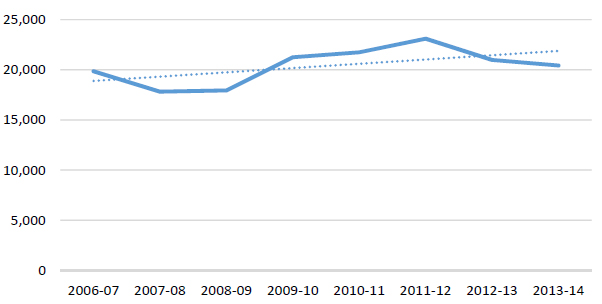
Text version – Figure 1: Total number of contraventions tickets issued between 2006-07 and 2013-14
A line graph is showing the number of contraventions tickets issued between 2006-07 and 2013-14. A trend line shows a gradual increase over time.
Number of contraventions tickets issued:
- In 2006-07: 19,846
- In 2007-08: 17,814
- In 2008-09: 17,935
- In 2009-10: 21,250
- In 2010-11: 21,740
- In 2011-12: 23,092
- In 2012-13: 20,979
- In 2013-14: 20,426
The extent to which each set of offences designated as contraventions is relevant or applicable varies among provinces. Using 2013–14 data,Footnote 55 the following trends illustrate some of these variations:
- In Prince Edward Island, almost half of the tickets issued related to the Government Property Traffic Act (the Confederation Bridge for the most part), and close to a third related to the Fisheries Act.
- In Nova Scotia, 90% of all tickets issued related to the Government Property Traffic Act, which covers all traffic offences occurring on federal properties (such as those surrounding airports).
- In Manitoba, just over 40% of tickets issued related to provisions under the Railway Safety Act, while another 18% related to the Motor Vehicle Transport Act (which deals with commercial drivers).
- In British Columbia, the most applicable laws have been the Government Property Traffic Act (40% of tickets issued), the Railway Safety Act (33% of tickets issued), and the Canada Shipping Act (20% of tickets issued).
These statistics illustrate the importance of the Government Property Traffic Act, but they also provide contextual information on the current scope of offences covered by each law included in the Contraventions Act. In other words, the fact that few tickets are issued under some of the laws covered by the Contraventions Act supports the call to expand the scope of offences designated as contraventions.
Enforcement training and tools
While they contain similarities, each provincial ticketing system has its own characteristics, which enforcement officers must learn about and be able to navigate through in order to use the ticketing system provided through the Contraventions Act. This, in turn, requires appropriate training and tools.
For the purpose of this evaluation, it is important to recognize that, ultimately, it is up to each enforcement agency to train its officers and to provide the tools they require to conduct their activities. The role of Justice Canada is limited to providing the appropriate support and expertise.
Evaluation findings indicate that, overall, enforcement officers are adequately trained and do have access to the tools they need to enforce federal statutory offences designated as contraventions. None of the evidence collected as part of this evaluation pointed to significant shortcomings that could substantively affect the ability of enforcement officers to operate within the Contraventions Act ticketing scheme.
In considering training needs, it must first be noted that some federal departments turn to provincial agents to enforce federal offences. This is the case, for instance, for the Department of Environment and Climate Change Canada, which uses provincial officers to enforce a number of federal contraventions in Nova Scotia. In such cases, since these provincial officers are already familiar with their ticketing system, they require limited training related to the contraventions schemes.
It is rather in the more traditional and prevalent case of federal agencies using their own enforcement officers that some challenges relating to training was identified. Before the Contraventions Act becomes operational in their jurisdictions, when it comes to prosecution the experience of these federal enforcement officers is typically limited to the summary conviction process. As a result, federal agencies have put in place a range of training activities that reflect their operational realities. In some cases, key informants noted that group training is provided, whereas other agencies will provide more informal training to new officers on an individual basis. This latter form of training becomes particularly important when enforcement officers transition from one province to the next.
When asked, representatives from the Contraventions Act Implementation Management Team have participated in the provision of these training activities. Enforcement managers consulted as part of this evaluation were generally aware and appreciative of this support.
Other challenges
Regardless of the means by which it is done, enforcing offences is bound to raise a number of challenges that reflect the nature of offences, and the context in which they are occurring. Throughout the interviews conducted as part of this evaluation, enforcement officers raised a number of these challenges, such as delivering a hand-written ticket in a moving boat under heavy rain, having to work with prosecutors or judges who know very little about the specific area of law covered by the ticket, or the lack of database information on offenders (to determine whether they are repeat offenders). While important, these challenges extend beyond the Program, and simply relate to the larger structures in which enforcement officers must operate.
Two specific challenges emerged from evaluation findings that cut across all categories of offences.
Forcing the payment of a fine
The first of these challenges relates to the enforcement of fines. Most provinces have incorporated the forcing of a payment of outstanding federal contraventions fines into their existing systems for collecting unpaid provincial fines, such as through the driver’s licence renewal process. However, the evaluation indicates that this remains a challenge in some jurisdictions. During interviews conducted as part of this evaluation, a number of enforcement officers noted that this shortcoming is weakening the relevance of the ticketing system, as some alleged offenders no longer “take these tickets seriously,” as failing to pay them is of no material consequence. Ultimately, enforcement officers may deal with these cases by electing to proceed through the summary conviction process, but this is not in line with the objectives of the Contraventions Act.
Reviewing and updating penalties
Another challenge comes from the current levels of fines, which have largely remained unchanged for an extended period of time.Footnote 56 As a result, a number of similar offences that are established in both provincial and federal laws, such as traffic offences occurring on either a federal or provincial territory, lead to significantly different fines. As an example, the fine resulting from parking in a zone reserved for individuals with disabilities on federal land is $50, while the City of Ottawa charges $450 for the same offence. The evaluation confirms, however, that when Justice Canada has been made aware of these instances of fine discrepancies, it has taken action to address them.
It must be emphasized that a range of views were expressed on the extent to which current levels of fines are appropriate. This is to be expected considering all the different laws and offences covered by the Contraventions Act. That said, the challenge remains to ensure that fine levels remain relevant and modified as needed, since they do not undergo a systematic and regular review.
It is also worth noting that modifying fine levels is a time-consuming process that requires various types of legal and economic input and analyses. Unless it is prioritized, proceeding with these changes may remain at the bottom of the planned list of statutory activities of a department.
Activities supported by the Contraventions Act Fund
Range of activities supported
As previously noted in the description of the Program (see sub-section 2.4), the Contraventions Act Fund supports a range of measures ensuring the provision of bilingual services in five provinces: Prince Edward Island, Nova Scotia, Ontario, Manitoba, and British Columbia. While the Act is also operational in New Brunswick and Québec, funding is not required as these two provinces already provide bilingual judicial and extra-judicial services to offenders.
When it comes to language rights applicable in the context of the Contraventions Act, two dimensions must be addressed:
- During the initial enforcement process, officers must be in a position to deliver bilingual tickets and to provide bilingual services in accordance with Part IV of the Official Languages Act. This applies equally to enforcement officers working for a federal department or agency, and to municipal or provincial enforcement officers who are mandated to enforce federal offences designated as contraventions. This applies as well to provincial court services personnel assigned to the provision of information on federal contraventions.
- During any judicial proceedings, particularly but not limited to instances where contravention tickets are being challenged, judiciary services must be delivered in accordance with language rights established in the Criminal Code (sections 530 and 530.1), and Part IV of the Official Languages Act.
The range of activities supported by the Fund varies in each of the targeted provinces. The flexibility allowed by the Program to tailor each agreement based on the needs of provincial institutions to deliver services in both official languages is a significant strength that must be preserved, particularly in light of any negotiation that could allow the remaining provinces to support the implementation of the ticketing system.
A review of existing agreements indicates that the types of measures currently supported through the Contraventions Act Fund include (but are not limited to) the following:
- hiring bilingual judges, justices of the peace, and clerical support
- traveling expenses for out-of-province bilingual judges
- language training for judges and court personnel
- printing bilingual tickets
- signage and other required equipment (such as bilingual websites, toll-free lines for bilingual services, or video/audio links to provide bilingual services at a distance)
As indicated in Table 7, the federal government has committed between $3.3 million and $4.9 million annually to support the provision of bilingual services, through the six agreements it has signed with participating provinces and city.
| Provinces/City | 2013–14 | 2014–15 | 2015–16 |
|---|---|---|---|
| PE | $219,010 | $222,964 | $225,347 |
| NS | $756,050 | $777,450 | $804,050 |
| ON | $2,800,000 | $1,626,900 | $1,165,558 |
| MB | $350,000 | $350,000 | $315,000 |
| BC | $675,000 | $689,375 | $704,109 |
| City of Miississauga | $138,651 | $144,132 | $149,896 |
| Total | $4,938,711 | $3,810,821 | $3,363,960 |
Source: Agreements signed under the Contraventions Act.
Evaluation findings indicate that not all committed funds are systematically used by the signatory provinces. This is expected, as these financial projections are based on a number of assumptions in terms of tickets delivered or actual services delivered. Using the fiscal year 2014-15 as an example, Table 8 indicates that, out of the $3,810,821 reported through Public Accounts, an amount of $2,948,977 was actually spent, leaving an additional surplus for that year of $861,844.
| Provinces/City | Actuals (as per Public Accounts)Table note ii | Payment Based on Final Claims Received | Difference |
|---|---|---|---|
| PE | $222,964 | $184,920 | $38,044 |
| NS | $777,450 | $711,883 | $65,567 |
| ON | $1,626,900 | $997,680 | $629,220 |
| MB | $350,000 | $290,184 | $59,816 |
| BC | $689,375 | $620,178 | $69,197 |
| City of Mississauga | $144,132 | $144,132 | $0 |
| Total | $3,810,821 | $2,948,977 | $861,844 |
Source: Public Accounts and the Financial System.
- Table note ii
-
Amounts include payables at year end (PAYE)
Capacity to deliver bilingual services
The evaluation has not identified any deficiencies with regard to the capacity of enforcement authorities or the court system to enforce and process federal offences designated as contraventions in accordance with applicable language rights.
All enforcement authorities that were consulted were well aware of the applicable language rights and had established procedures that would ensure that any individual who is served with a ticket is able to receive information and be assisted in the official language of their choice.
As for the court system, the required capacity has been established to process tickets in either one of the two official languages, and to allow individuals who wish to challenge their ticket to do so in the language of their choice.
As indicated in Table 9 , a relatively small portion of tickets issued end up being challenged in court. Using the fiscal year 2014–15 as an example, the data shows that 11% of individuals who received a contravention ticket challenged it. Of that number, very few requested trials in French (1.4%).
| Provinces | Total number of tickets issued | Number of trials held (including French trials) | Number of French trials held |
|---|---|---|---|
| PE | 44 | 0 | 0 |
| NS | 1,328 | 8 | 1 |
| ON | 8,223 | 1,119 | 17 |
| MB | 318 | n/a | n/a |
| BC | 1,870 | 125 | 0 |
| Total | 11,783 | 1,252 | 18 |
Source: Agreements signed under the Contraventions Act.
There are contextual considerations that must be kept in mind when assessing the information contained in Table 9:
- The fundamental goal of the Fund is to ensure capacity to provide bilingual services. Having this capacity in place is a necessary condition in order for the federal government to use provincial schemes to enforce contraventions tickets. In its absence, the current model would violate constitutional and quasi-constitutional language rights and would need to be replaced (as described in more detail in sub-section 2.4 of this report). Consequently, the number of French trials held is informative, but does not affect the rationale for having the Fund in the first place.
- The fact that few trials have been held in French does not mean that no services have been offered in French. A portion of the financial support provided by the Fund serves to print tickets in both official languages. Considering the fact that many individuals simply pay the fine they have received, having tickets printed in both languages goes a long way in ensuring that services are provided in both languages. The same applies to bilingual websites, or phone services that are offered to those who may have questions regarding their tickets. During interviews, court representatives confirmed that such calls are made, and that they have procedures in place to ensure that information can be provided in both languages.
4.2.2. Program impacts
As this report illustrates, there is a strong rationale for having the Contraventions Act in place. The Act was designed to facilitate the work of enforcement officers, and to be fairer to Canadians. It was also designed to avoid having these offences dealt with by the court system, whenever the person who is alleged to have contravened a federal offence designated as a contravention does not wish to challenge that ticket. Evaluation findings confirm that the Program is contributing to the achievement of these expected outcomes. This, however, only extends to provinces where the Act is operational.
Impacts on enforcement officers
Not a single enforcement officer consulted as part of this evaluation has questioned the usefulness of the ticketing system available under the Act. As noted throughout the report, they certainly provided suggestions to improve it, but always with a view of turning a good tool into a better one. The following quotes from interviews conducted as part of this evaluation illustrate the benefits enforcement officers derive from the Program:
“We are very satisfied. We no longer have officers spending all this time in court. And the fact that we serve these tickets on the spot has a greater impact on individuals. With the summary conviction process, all the papers are served at a later point, which has less impact.”
“It’s much easier for us to prepare our case and provide the evidence, and it relieves the courts from having to deal with all these cases.”
“I used to work in Alberta where we could not use the ticketing system. It makes a lot of difference. Tickets have more weight than a warning letter and are less cumbersome (than the summary conviction process) for smaller files. They save time and public funds.”
“There was sort of a gap between violation and prosecution before, without the ticketing measures in place. Money talks. Ticketing makes people take the necessary actions earlier. And we have busy courts. Ticketing reduces the load and costs on that side as well.”
“It helps to motivate, encourage, and establish an enforcement presence on the water. It’s probably the best tool we have. From our officers’ perspectives, it brings significant value to what they are doing.”
The views of enforcement officers are critical in the context of this evaluation. The significant efforts and resources that have been mobilized to date to support the implementation of the Contraventions Act would largely be pointless if enforcement officers were to disregard it, and continue to operate strictly with the other available options. This is not the scenario that has unfolded. On the contrary, it is now evident that, in the absence of the ticketing system, the ability of enforcement officers to carry out their mandate is reduced.
Impacts on Canadians
The Program is also achieving its outcomes when it comes to limiting the consequences of being found guilty of an offence designated as a contravention. As stated in section 4 (b), the Contraventions Act aims “to alter or abolish the consequences in law of being convicted of a contravention.
” This outcome is achieved in all provinces where the Act is operational. Those individuals who have contravened a federal contravention can readily pay the fine and settle the matter for good. They face no criminal record, no possibility of imprisonment, and a consistent fine applied across Canada.Footnote 57 In that sense, the fundamental distinction between a criminal and a statutory offence is achieved.
As made clear in this report, Canadians who live in provinces where the Act is not operational, or who happen to contravene a federal contravention while visiting one of these provinces, continue to be exposed to the consequences of having been found guilty of a federal offence under the summary conviction process. While, in some cases, enforcement authorities hesitate to enforce these offences (and limit themselves to issuing a warning), in other cases they systematically proceed under the summary conviction process. While precise numbers are not available, evaluation findings indicate that, at the time of this report, there were several hundred Canadians (and foreigners traveling in Canada) who were charged yearly under the summary conviction process for offences that are otherwise enforced through the ticketing system in the majority of Canadian provinces. This outcome is not compatible with the proper application of the rule of law.
Impacts on the court system
Evaluation findings indicate that the Contraventions Act is also providing relief to the court system. As illustrated in Table 9 , during the years covered by this evaluation, approximately 14% of tickets issued under the Act have been challenged in court. This number is consistent with findings contained in the 2010 evaluation of the Act.Footnote 58
In the absence of the Act, and assuming that offences would be as readily enforced, close to 20,000 files would need to be prepared each year by enforcement officers and would require at least some involvement of the court system, regardless of their outcome. This would be a highly inefficient use of court time and resources. The experience in provinces where the Act is operational demonstrates that, without being perfect, the ticketing system is more appropriate for dealing with statutory offences. When circumstances warrant it, the summary conviction process continues to be used in all provinces where the Act is operational.
At the time of this evaluation, courts in Newfoundland and Labrador, Saskatchewan, and Alberta continue to deal with federal contraventions exclusively through the summary conviction process. As noted during interviews, enforcement officers are not spending as much time enforcing federal laws (as they spend more time in court), prosecutors and court personnel must engage in every file that is brought forward, and the entire court must dedicate time and resources for dealing with matters that, in the vast majority of cases, would have been dealt with through the ticketing system if it were available. This further contributes to the systemic bottlenecks faced by courts in Canada. As noted by the Supreme Court of Canada in a recent decision:
“Timely trials further the interests of justice. They ensure that the system functions in a fair and efficient manner; tolerating trials after long delays does not. Swift, predictable justice, ‘the most powerful deterrent of crime’ is seriously undermined and in some cases rendered illusory by delayed trials.”Footnote 59
Implementing the Contraventions Act can only provide a modest contribution to reducing court delays, but evaluation findings confirm that it does support this goal.
4.3. Performance – Efficiency and Economy
This final subsection covers three dimensions that speak to the efficiency and economy of the Program. It first addresses the quality of reporting provided by the participating provinces. It is followed by a discussion on the cost-effectiveness of the Program, and the extent to which alternatives to the Program exist.
Current reporting requirements
In order for federal contraventions to be enforced through the provincial prosecution scheme, the Department of Justice must sign an agreement with each participating province. As already noted in this report, some of these agreements cover contributions provided by the federal government to support the provision of bilingual services, whereas other agreements (as is currently the case with New Brunswick and Québec) focus essentially on the management and sharing of revenues generated by the payment of contraventions tickets fines.
During the period covered by the evaluation, the Contraventions Act Management Implementation Team had initiated the renewal of these agreements with the goal of having more consistent agreements in place. This process was largely completed, as only the new agreement in New Brunswick had to be finalized.
Reports provided by participating provinces contain critical information that supports the ongoing management of these agreements, and the evaluation of the Program. As illustrated throughout this report, data from these reports have provided important insights on the rationale and effectiveness of the Program.
Cost-effectiveness of the Program
The cost-effectiveness of the Program must be considered from the perspective of the administration of federal tickets generally, and from the perspective of the Fund that relates specifically to official languages duties.
Administration of tickets
When it comes to the actual administration and processing of federal tickets (regardless of official languages considerations), the fundamental principle behind the Program is that these activities must, at a minimum, be cost neutral for the participating provinces. As such, these provinces are allowed to deduct, from all fines collected through contravention tickets, an amount equivalent to all administration costs related to the administration and enforcement of federal contraventions. They may also use other means — such as administrative provincial fees charged in addition to the amount of the fine indicated on the ticket — to ensure that all their costs are covered.
In the event that the sum collected through federal contraventions tickets is greater than those administration costs, participating provinces retain half of this surplus amount, and remit the other half to the federal government. As a result, participating provinces never incur net costs for supporting the enforcement of federal tickets.
| Provinces | 2011–12 | 2012–13 | 2013–14 | 2014–15 |
|---|---|---|---|---|
| PE | $645 | $646 | $2,693 | $1,392 |
| NS | $15,526 | $23,243 | $18,767 | $19,127 |
| NB | n/a | n/a | n/a | n/a |
| QC | $231,245 | $275,793 | $201,414 | $140,173 |
| ON | n/a | n/a | n/a | $440,054 |
| MB | $30,836 | $34,718 | $33,076 | $13,397 |
| BC | $33,672 | $30,469 | $31,195 | $31,630 |
- Table note iii
-
These revenues represent half of the total revenues collected through contraventions tickets, once all administrative costs incurred by participating provinces have been deducted. The other half of these net revenues is remitted to the federal government.
Source: Annual reports submitted by provincial authorities.
Data from the past four years on the net amounts that provinces generated in revenues is presented in Table 10 . These numbers reflect the volume of tickets issued and confirm that administrating the Contravention Act regime reduces court expenditures that would otherwise be incurred in the event that these offences would have been prosecuted through the summary conviction process, and provides a revenue generating opportunity.
Contraventions Act Fund
When it comes to the Fund that supports the provision of services in both official languages, the Program has used consistently fewer resources than initially allocated. As illustrated in Table 11 , this trend is also reflected for the period covered by the evaluation. In 2013–14, the Program used 60% of the allocated resources. In 2014–15 and 2015-16, it dropped to 44% and 41% respectively.
| 2013–14 | 2014–15 | 2015–16 | |
|---|---|---|---|
| Operational costs | |||
| Budgeted | $781,060 | $827,426 | $781,060 |
| Actual | $984,599 | $530,565 | $652,324 |
| Difference | -$203,539 | $296,861 | $128,736 |
| Contributions | |||
| Budgeted | $9,094,900 | $9,094,900 | $9,094,900 |
| Actuals (as per Public Accounts)Table note iv | $4,938,711 | $3,810,821 | $3,363,960 |
| Difference | $4,156,189 | $5,284,079 | $5,730,940 |
| Total costs | |||
| Budgeted | $9,875,960 | $9,922,326 | $9,875,960 |
| Actual | $5,923,310 | $4,341,386 | $4,016,284 |
| Difference | $3,952,650 | $5,580,940 | $5,859,676 |
Source: Public Accounts and Financial System.
- Table note iv
-
Amounts include payables at year end (PAYE).
As indicated during interviews, a primary reason behind these results is that the Department of Justice is still pursuing the goal of signing agreements with the remaining provinces where the Act has yet to become operational. Based on the experience to date, it is likely that contributions would need to be provided to these provinces to ensure that the enforcement of federal contraventions is conducted in accordance with applicable language rights. The exact amount of these contributions would be the subject of negotiations.
At a more fundamental level, the Program supports an effective approach to implementing the Contraventions Act. Using existing structures and processes established by provincial governments is far more effective than creating a separate and parallel structure at the federal level, which would lead to substantial duplication of efforts. Although there have been some challenges, a number of which are documented in this report, the experience to date confirms that federal contraventions can be effectively processed and managed using provincial structures. Furthermore, and as documented in the 2010 evaluation of the Contraventions Act, the ticketing system is far more efficient than having each offence dealt with using the summary conviction process.Footnote 60
As for the specific issue of economy, the goal is to assess “the extent to which resource use has been minimized in the implementation and delivery of programs
.”Footnote 61 In the case of the Contraventions Act Program, two dimensions must be considered:
- In the case of the contributions provided to provinces, which represented approximately 85% of the total amount of resources invested during the period covered by the evaluation, these are established in each agreement, based on Program eligibility criteria and on a needs assessment that takes into account the characteristics of each province. As noted in Table 8, the experience to date indicates that provinces only use the resources needed, which has typically been less than anticipated.
- As for operational costs, they largely reflect the range of expenditures associated with programs of this nature. In the specific case of the Contraventions Act Implementation Management Team, this consists of two legal counsel, along with the required operational support for the management of the signed agreements. In the event that the Department of Justice pursues a more systematic implementation of the Act in the three remaining provinces and supports an increase in the number of offences designated as contraventions, it may be necessary to enhance the capacity of the Team to support these efforts.
The alternative: Administrative Monetary Penalties (AMPs)
When it comes to alternatives to the Contraventions Act Program, the report has already noted that establishing a separate and parallel system to enforce federal contraventions would be far less efficient than using existing provincial schemes.
The only other alternative that was raised during the evaluation consists of the AMP scheme. In a study completed in 2014, the Department of Justice analyzed the AMP scheme, and compared it with the contravention one.Footnote 62 As noted in the study, AMP schemes generally consist of an administrative procedure established and managed by a federal department in order to promote compliance with specific legislative or regulatory measures. AMP schemes use civil sanctions in the form of monetary penalties to address any occurring violations to these legislative or regulatory provisions.Footnote 63 At the time of this evaluation, there were 31 federal laws, along with a set of associated regulations, which included some form of AMP scheme. They cover a number of areas including (but not limited to) aeronautics, agriculture, transportation, employment insurance, the environment, income tax, nuclear safety, and telecommunications.Footnote 64
The study notes that these two schemes, while related to the enforcement of statutory provisions, pursue distinct objectives. Whereas the goal of the contravention scheme is to provide an alternative to the summary conviction process to prosecute offenders of certain statutory offences while limiting the involvement of the courts, AMP schemes “are autonomous systems that create an administrative procedure to ensure compliance through civil penalties
.” Footnote 65
The study notes that AMP schemes are particularly well suited for “regulated fields that require a high level of expertise or where traditional sanctions, including fines and imprisonment, do not ensure full compliance
.”Footnote 66 As such, they facilitate the management of these particularly complex offences, by ensuring that all those involved in the enforcement and management of these administrative penalties possess the required expertise to adequately consider each alleged violation.
From an operational and efficiency perspective, it is important to emphasize one fundamental distinction between the contraventions scheme and the AMP schemes. Whereas the contravention scheme is centralized with the Department of Justice, each AMP scheme is established and managed by the department responsible for the legislation covered by the scheme. It is for this reason that we currently have multiple and distinct AMP schemes being implemented throughout the federal government.
In assessing the appropriateness of either the contraventions scheme or the AMP schemes, each department must therefore take into account a number of factors, such as the nature of the statutory provision, the target audience, the level of fines to be imposed, and the level of resources available to support the enforcement of or the compliance with these statutory provisions.
It is beyond the scope of this evaluation to assess whether the current distribution of offences between the contraventions scheme and the AMP schemes is the most appropriate one. What evaluation findings indicate, however, is that a number of federal departments are now planning to move away from the contravention scheme and turn more systematically to the AMP system, based primarily on the premise that the Contraventions Act will never be applicable across the country. As such, the decision is no longer based on the actual characteristics and benefits of each scheme, but rather on the fact that one of them (contraventions scheme) will arguably never be fully available, creating inconsistencies that cannot be sustained indefinitely.
As documented throughout this report, the contraventions scheme represents, when available, an efficient option for enforcing a number of statutory offences in a manner that is both efficient and fair. In the event that the Act was to become operational across Canada, it would provide departments with a genuine choice between two schemes that each have their advantages and limitations. This further reinforces the need to make the implementation of the Act in Newfoundland and Labrador, Saskatchewan, and Alberta a departmental priority.
- Date modified: