Evaluation of Litigation Services
2. Program Profile
2.1 Program Description
2.1.1 Brief Overview
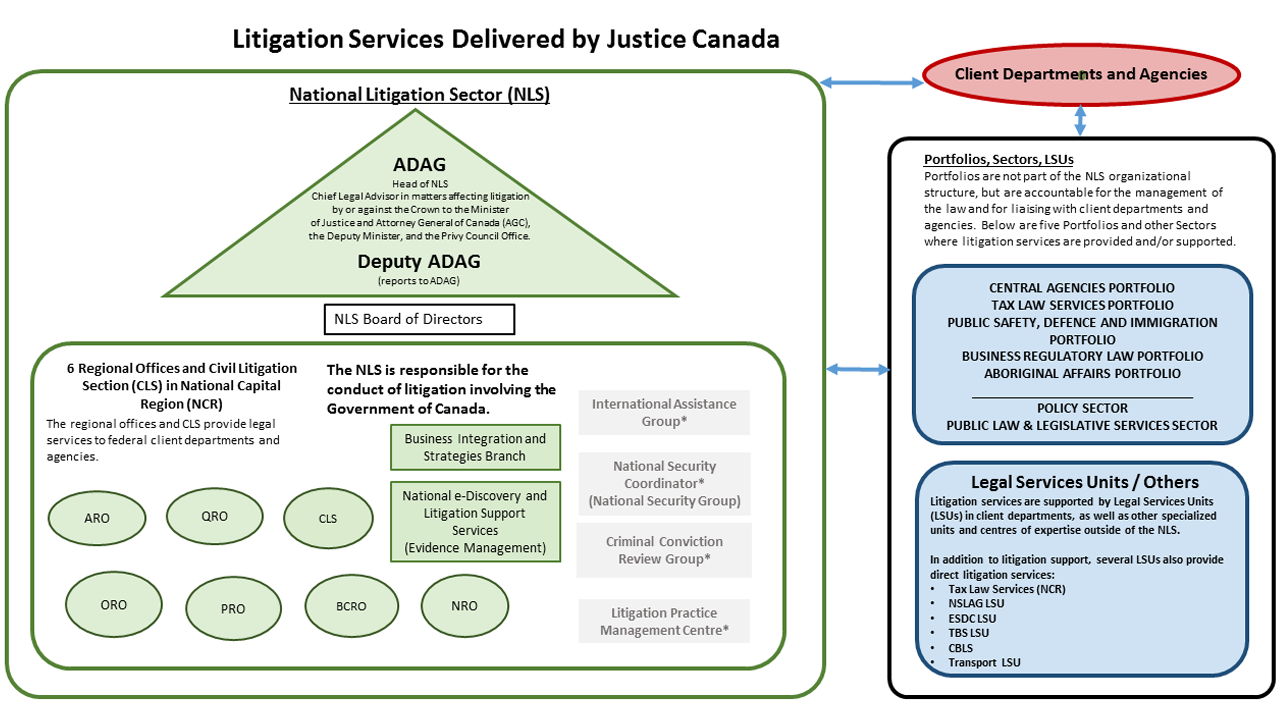
Litigation services are integral to Justice Canada’s role in supporting the Minister and the Attorney General of Canada as the government’s chief law officer and as the officer responsible for the conduct of all litigation on behalf of the Crown before any court, administrative tribunal, or inquiry body. Justice Canada’s litigation services are primarily provided by litigators who work in regional offices or the CLS, which is located in the NCR. As mentioned in Section 1.2, other litigation units also exist that specialize in certain legal areas and/or appear before administrative tribunals (TLS unit, NSLAG LSU, ESDC/VAC LSU, CBLS, TC LSU, and TBS LSU).
Litigation services include a variety of tasks that are part of representing the federal government in the resolution of litigious or potentially litigious matters. More specifically, litigation services includes using the appropriate dispute prevention and resolution methods to promote early settlement; gathering and challenging evidence in accordance with applicable rules of evidence; developing legal positions and making submissions; and litigating cases before adjudicative bodies. This work is done in order to preserve and protect the interests of client departments and agencies and those of the federal government as a whole.
Litigation support is provided to litigators by LSUs that are co-located with client departments and agencies. Each LSU is assigned to one of five Portfolios that is responsible for structuring and managing the range of advisory, legislative, and litigation services provided by the Portfolio’s LSUs to client departments or agencies.The five Portfolios are: TLSP, which provides legal services to the Canada Revenue Agency (CRA); PSDIP, which provides legal services to departments and agencies that deal with transnational criminal matters and immigration laws; Aboriginal Affairs Portfolio (AAP), which provides legal services to Crown-Indigenous Relations and Northern Affairs Canada (CIRNAC), Indigenous Services Canada (ISC), and other departments or agencies that have policies, programs, or services that target Indigenous clients; CAP, which provides legal services to the central agencies of government, such as the TB, the Department of Finance, and the Public Service Commission; and BRLP, which provides legal services to client departments and agencies that have a business or regulatory law component.
Litigators work directly with the LSUs, which serve as a liaison to the client and assist litigators with developing legal positions or strategies, obtaining instructions from the client, document production, and other litigation support tasks. Litigators also receive litigation support from the NeDLSS, which is a single point of access for discovery, e-discovery, and disclosure resources and services.
The relationship between Justice Canada and client departments and agencies is governed by standardized Memoranda of Understanding (MOUs), which guide both parties in their joint management of the demand for legal services and include service standards for the legal services that Justice Canada provides.Footnote 4
2.1.2 Governance Structure
In early 2016, Justice Canada announced a series of organizational changes designed to foster a cooperative approach at the departmental level. These changes included the creation of the NLS. The NLS became fully effective on April 1, 2016 and was intended to plan, manage, deliver, and oversee litigation services for the government as a whole, and to enable a more consistent and efficient approach with clearer accountability. Regional offices, which formerly reported directly to the Deputy Minister (DM) and Associate Deputy Minister of Justice, now report to the Assistant Deputy Attorney General (ADAG NLS).
The NLS is governed by a Board of Directors (BoD), which meets weekly and is chaired by the ADAG NLS and includes the Regional Directors General (RDGs) from all six regional offices, NCR Directors General and Directors, a Financial Management Advisor, and a Human Resources Client Services Director.
The NLS also relies on a committee structure to oversee significant litigation and ensure that consistent positions are adopted nationally. The National Litigation Committee (NLC) is a Standing Advisory Committee to the Deputy Minister and Deputy Attorney General of Canada and makes recommendations on legal positions in significant litigation, as well as on other litigation-related matters, such as practice directives and guidelines. In addition, each regional office has a litigation committee, as do (collectively) the litigation units located in the NCR. These regional litigation committees help to ensure that consistent positions are taken in litigation. For more on the litigation committees, see Appendix B.
While the NLS manages litigation services, the Portfolios and their LSUs continue to be accountable for the management of the law and for liaising with client departments and agencies.Footnote 5 Litigation services provided by the other litigation units mentioned above report to their Portfolio and are provided with functional direction from the NLS.
The DM expected outcomes for the NLS are as follows:
- improved coherence and consistency of litigation service delivery at the national level
- more flexibility in the use of litigation resources
- more efficient management of litigation operations and the ability to speak with one voice
- clarified accountability structures
- increased analytical and strategic capacity for litigation services
- institutionalized capacity to drive continuous improvement and innovationFootnote 6
The expected outcomes for NLS exist in the broader context of the overarching Vision for Justice Canada. Through Canada’s Legal Team Vision, Justice Canada aims to extend a culture of collaboration across the Department and to clients. The goal is to position Justice as a trusted, collaborative strategic partner focused on supporting clients in their quest for solutions that benefit Canadians. Justice has an undisputed tradition of legal excellence, but becoming strategic partner requires moving beyond the traditional provision of legal advice that focuses mainly on the legal position and the assessment of the legal risks.Footnote 7
The graphic on the following page provides an overview of the structure and relationships of the areas of Justice Canada involved in the provision of litigation services.
Figure 1: Litigation Services Delivered by Justice Canada
2.1.3 NLS Resources
NLS litigation expenditures
Litigation work in the Department is primarily conducted in the NLS, specifically within the NCRFootnote 8 and the six regions (ARO, QRO, ORO, NRO, PRO, BCRO).Footnote 9 Expenditures related to litigation services within the NLS averaged $222 million over five years, with salary dollars accounting for approximately 94% of expenditures and O&M accounting for the remaining 6% (see Figure 2). Litigation expenditures were distributed across the NCR and the six regions, with some of the highest expenditures in larger regions where more litigation work is done (e.g., ORO, BCRO, QRO).
Overall, litigation expenditures within the NLS remained relatively stable between FY 2014-2015 and FY 2017-2018. Between FY 2017-2018 and FY 2018-2019, there was a 6% ($13M) increase in expenditures (see Figure 2). The increase in expenditures can be attributed to an increase in salary, due to the implementation of collective bargaining agreements in FY 2018-2019, and an increase in full-time equivalents to manage demand on litigation files.
Figure 2: Litigation Expenditures in the NLS

Notes:
Litigation expenditures in other Sectors in Justice Canada
In addition to litigation work in the NLS, additional litigation is conducted within the Department, primarily in six units outside the NLS (i.e., CBLS, TBS LSU, TLS, ESDC/VAC LSUs, NSLAG LSU, TC LSUs). Based on 2018-2019 data, the NLS accounted for the majority of litigation expenditures (88%), with litigation work conducted outside of the NLS accounting for the remaining 12% of all litigation expenditures across the Department.Footnote 10
A glossary of key litigation terms is included in Appendix A and a more detailed program description can be found in Appendix B.
- Date modified: