
Overview – Charter Statements
In accordance with the Department of Justice Act, the Minister of Justice is responsible for tabling a Charter Statement for every government bill introduced in Parliament. Since this legislative requirement came into force in December 2019, over 110 Charter Statements have been tabled, which are intended to identify potential effects that a bill may have on Charter rights and freedoms.
Overview of Charter Statements
What Charter Statements are
Charter Statements are short documents that describe, in an informal manner and using accessible language, the potential effects of a bill on the rights and freedoms included in the Canadian Charter of Rights and Freedoms (the Charter). They are intended to inform parliamentary and public debate on a bill, by explaining how certain Charter rights and freedoms may be engaged, including the possibility of how a bill may limit these rights and freedoms in a manner that is demonstrably justifiable in a free and democratic society.
What Charter Statements are not
While Charter Statements provide legal information, they are not legal opinions on the constitutionality of a bill. As such, they do not provide a legal risk assessment of the proposed legislative provisions. Rather, they describe the key considerations that support the constitutionality of a proposed bill, recognizing that the courts have the final say on the constitutionality of any legislative provision.
Each Charter Statement is based on the provisions of a bill at the time that it was introduced in Parliament. While amendments to a bill may be introduced, Charter Statements are not required to be updated.
Starting in 2016, the federal government began to table Charter Statements on a voluntary basis. The Department of Justice Act was modified and the obligation to table these statements came into force in December 2019. As of October 2023, 140 Charter Statements had been tabled in Parliament, including 26 that were published on a voluntary basis (prior to December 2019).
Department of Justice Act (R.S.C., 1985, c. J-2)
Charter Statement
4.2 (1) The Minister shall, for every Bill introduced in or presented to either House of Parliament by a minister or other representative of the Crown, cause to be tabled, in the House in which the Bill originates, a statement that sets out potential effects of the Bill on the rights and freedoms that are guaranteed by the Canadian Charter of Rights and Freedoms.
Charter Statements as part of the parliamentary process
The Department of Justice Act provides limited guidance on what Charter Statements must contain, or when they must be tabled in Parliament. Essentially, they must be drafted and tabled in a manner that is consistent with their intended purpose, which is to “inform members of the Senate and the House of Commons as well as the public” of a bill’s potential impact on Charter rights and freedoms.
- On that basis, Justice has established an operational goal to have a draft Charter Statement ready for the Minister of Justice to consider around the time that the associated bill is tabled in Parliament for first reading.
- Justice (CPAU) assists the Minister in having it tabled in Parliament around the time the second reading process is initiated.
- Following opening statements and debate on the general scope and principle of the bill, if the bill passes second reading, it will be sent to parliamentary committees for review, debate, and potential amendments.
- Completion of the third reading signals the end of the process in one house of Parliament (House of Commons or Senate), and the beginning of the same process in the other house.
- Once all three readings are completed in both houses, the bill is submitted to the Governor General for royal assent.
While the parliamentary process is somewhat linear, it may in fact take various forms, and unfold in many different ways. With the consent of the members of Parliament, a bill may complete all three readings in both houses in one or two days, essentially skipping any parliamentary committee proceedings. At the other end of the spectrum, a bill may take months to complete the process in both houses, due to its complexity, the approach adopted by parliamentary committees, or the schedule of Parliament as a whole. Some bills will end up being dropped, while some proposed bills, along with the draft Charter Statement, will not even be tabled for first reading.
In fulfilling its legislative obligation to table Charter Statements, Justice must therefore adapt and respond to this range of scenarios.
Figure 1: Charter Statements as part of the parliamentary process to adopt new legislation

Figure 1: Charter Statements as part of the parliamentary process to adopt new legislation – Text version
Bill’s first reading
- Justice has established an operational goal to have a draft Charter Statement ready for the Minister of Justice to consider around the time that the associated bill is tabled in Parliament for first reading.
Bill’s second reading
- Justice (CPAU) assists the Minister in having it tabled in Parliament around the time the second reading process is initiated.
Committee proceedings
- Following opening statements and debate on the general scope and principle of the bill, if the bill passes second reading, it will be sent to parliamentary committees for review, debate, and potential amendments.
Bill’s third reading
- Completion of the third reading signals the end of the process in one house of Parliament (House of Commons or Senate), and the beginning of the same process in the other house.
Royal assent
- Once all three readings are completed in both houses, the bill is submitted to the Governor General for royal assent.
The process of developing Charter Statements
As illustrated in Figure 2, several stakeholders contribute to the development of Charter Statements. The following provides a brief description of their key roles in the process.
- Legal Service Units (LSU) and client lead: As they explore policy options that may require legislative work, legal counsel from LSUs and their client department or agency may reach out to HRLS for legal advice, or to inform them of their intention to proceed with a bill.
- Legislative drafters: As they initiate the work on a draft bill, legislative drafters systematically inform HRLS that a new bill is being drafted, for which HRLS will begin developing a Charter Statement.
- HRLS: Legal counsel from HRLS, in consultation with relevant stakeholders such as legal counsel from LSUs, undertake the development of a draft statement.
- Assistant Deputy Minister (ADM) of the Public Law and Legislative Services Sector (PLLSS): The ADM, PLLSS reviews and approves the draft Charter Statement.
- Cabinet and Parliamentary Affairs Unit (CPAU): Justice’s CPAU coordinates the review and approval process with the office of the Deputy Minister, and the office of the Minister.
- Minister of Justice: It is the responsibility of the Minister of Justice to approve and table the final draft of the Charter Statement.
- Communications Branch: Justice’s Communications Branch is responsible for readily publishing any new Charter Statement on the dedicated website once the statement has been tabled in Parliament.
Figure 2: Key milestones in the development of Charter Statements

Figure 2: Key milestones in the development of Charter Statements – Text version
| Stakeholders in the development of Charter Statements | Key Milestones |
|---|---|
| LSU and client lead | Initial policy work |
| Legislative drafters | Notify HRLS of bill drafting |
| HRLS | Leads the drafting of a Charter Statement |
| ADM, PLLSS | Reviews and approves Charter Statement |
| CPAU | Coordinates the review and approval process |
| Minister of Justice | Approves and tables Charter Statement |
| Communications Branch | Publishes Charter Statement on Justice website |
Level of effort
During the first four FYs of the period covered by the evaluation (2019-2020 to 2022-2023), the level of effort associated with Charter Statements has steadily increased (see Figure 3). The sharp increase from 2019-2020 to 2020-2021 reflects the transition towards the requirement for Charter Statements for every government bill tabled in Parliament. The number and complexity of bills also have a direct impact on the level of effort required by Charter Statements.
Figure 3: Number of recorded hours, per FY

Figure 3: Number of recorded hours, per FY – Text version
| Fiscal Year | Hours |
|---|---|
| 2019-20 | 1,368 |
| 2020-21 | 2,072 |
| 2021-22 | 2,140 |
| 2022-23 | 2,431 |
Financial resources
During the same four FYs, the level of resources allocated to Charter Statements has reflected the increasing level of effort required to produce these statements (see Figure 4).
Figure 4: Financial resources, per FY
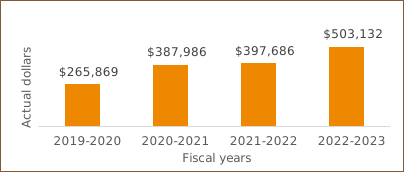
Figure 4: Financial resources, per FY – Text version
| Fiscal Year | Actual Dollars |
|---|---|
| 2019-20 | $265,869 |
| 2020-21 | $387,986 |
| 2021-22 | $397,686 |
| 2022-23 | $503,132 |
*The data included in Figure 3 and Figure 4 reflects the drafting and coordination work conducted by HRLS, along with the work undertaken by legislative drafters, jurilinguists and legistic revisors in the Legislative Services Branch (LSB), as well as the assistance provided by the Official Languages Directorate (OLAD) and the Constitutional, Administrative, and International Law Section (CAILS). Of note, 97% of the hours are associated to HRLS. The data does not reflect the work completed by other groups within Justice, such as legal counsel in LSUs. In addition, the data for FY 2019-2020 commences in December 2019, as this is the date Charter Statements came into force. Given only partial data was available for FY 2023-2024 this information has not been reflected in Figure 3 or Figure 4.
- Date modified: