
Exploring the Use of Restorative Justice Practices with Adult Offenders with Fetal Alcohol Spectrum Disorder
3. Findings
The purpose at the outset of the study was to explore the use of RJ in addressing the cycle of re-contact11 that is common for individuals with FASD. However, as the study progressed, the scope was expanded to look more broadly at how communities were responding to the challenges that individuals with FASD experience in the CJS and what alternative approaches address their needs. The information included in this section of the report comes from the interviews conducted during the five case studies.
3.1 Key Challenges for Individuals with FASD in the CJS
Prenatal alcohol exposure can lead to different types of effects on individuals: physically,12 cognitively, socially, and behaviourally. Interviewees indicated that the extent of an individual’s brain injury, the impairments they experience, and the types of behaviour they exhibit vary. Despite this broad spectrum, individuals with FASD often share characteristics that may lead them into contact with the CJS (e.g., impaired judgment, reduced impulse control, being impressionable). Once in the system, individuals with FASD can encounter a number of additional challenges because of their impairment.
Interviewees indicated that since individuals with FASD may have trouble predicting the consequences of their actions, this may impact their ability to follow instructions, manage their time, attend appointments, and adopt the kinds of repetitive behaviours that many people do as a matter of routine. Individuals with FASD may also have difficulty learning from mistakes due to challenges with short-term memory and attention. They may also have difficulty understanding the impact and consequences of their actions. Therefore, they may repeat the same or similar criminal or antisocial behaviour multiple times.
Interviewees indicated that individuals with FASD may have multiple re-contact incidents with the CJS. This is further compounded when they are given standard bail conditions such as attending court on a specific date for a pleading. Adhering to standard conditions can be challenging for individuals with FASD depending on their impairment(s) (e.g., difficulty thinking things through, limited short-term memory).
Some interviewees also noted that individuals with FASD are more likely to plead guilty. Due to anxiety over the court process or lack of understanding of the system, individuals with FASD may say whatever they believe is required of them to have the case over as quickly as possible. Interviewees noted that this means that Crown prosecutors and judges need to be vigilant to ensure that guilty pleas in cases involving individuals with FASD are genuine. The CJS process also tends to be slow, which is challenging for individuals with FASD because they may forget what they did to bring them into the system and the harm they caused.
Once identified, individuals with FASD in the CJS are usually referred to community-based programs or support services, which vary considerably across communities based on the resources available. However, as noted by interviewees, formal diagnoses are rare and difficult to obtain. When there is a formal diagnosis, it often happens in childhood, because the individual is in school or involved with other social systems. FASD becomes increasingly difficult to diagnose later in life due to the requirement to confirm the mother’s alcohol use during pregnancy. Some interviewees observed that parents might be hesitant to disclose exposure to alcohol during pregnancy due to the stigma associated with FASD and other cognitive impairments. Others noted the challenges in obtaining this information if the birth parents’ whereabouts are unknown. FASD can also be difficult to diagnose because of long waitlists and the hidden nature of FASD in the presence of other compounding issues, such as the individual’s own alcohol or substance use or mental health issues.
Without a formal diagnosis, CJS professionals need to rely on their observations of the individual’s behaviour to identify a possible impairment. Where staff turnover is low, they may encounter the same individuals repeatedly, which may in turn help them identify a possible impairment. CJS professionals may also learn about the impairment through their own personal and professional networks (e.g., knowing a family member, a caregiver, service providers), which is common in small communities. However, interviewees noted that in some communities, CJS professionals have a limited ability to connect with local health and social service providers. This is especially true in more remote locations where there is high staff turnover (e.g., RCMP detachments) or where the Crown prosecutor is part of a circuit court that comes to the community infrequently.
3.2 Integrated Courts
In two of the participating communities, an Integrated Court (IC) was established specifically to provide an alternative process for repeat offenders who have cognitive impairments or addictions.13 As described by interviewees, the IC courts were designed to mitigate the high cost of repeat contact with the CJS by individuals with cognitive impairments or addictions. Within the IC models, designated IC Crown prosecutors work in partnership with local agencies, police, and probation services to help address these individuals’ underlying needs. When the IC is in session, these partners meet with defence lawyers to discuss the cases on the docket and to develop a strategy for each case, subject to the agreement of the judge (who presides on a consistent basis). Cases brought to the IC typically result in a guilty plea, followed by a temporary release of the offender with a set of modified conditions. Offenders then work with the appropriate community services and receive ongoing monitoring of their progress. If, after an agreed upon period of time, the court is satisfied that the individual has been held accountable, the case is closed. The goal of ICs is for the individual to make positive connections with programs and services to help them improve their lives, successfully integrate into society, and ultimately, avoid re-contact with the CJS.
3.3 Restorative Justice Approaches
RJ programs and processes14 have been part of Canada’s CJS for over 40 years. It is valued as an effective approach for victims, offenders, and communities affected by a crime because it allows those affected by crime to communicate the causes, circumstances, and impact of that crime, and to address what they need.15 RJ programs are available at all stages of the CJS: pre- or post-charge; at the sentencing stage; post-sentencing, such as within a correctional setting; and as part of the reintegration process. The timing of when offenders enter a RJ process depends on how the program interacts with the CJS based on its mandate. These programs are guided by skilled facilitators and can take different forms. The models most often used in the Canadian CJS are restorative conferences, victim-offender mediation, and restorative circles.16
Although RJ is widely used within the CJS, interviewees indicated that there is a lack of consensus within the justice community as to whether RJ is appropriate for cases involving individuals with FASD. These concerns stem from questions about whether individuals with FASD have the capacity to take responsibility for the harm they may have caused, to learn from their mistakes, and to demonstrate empathy towards the victim/survivor, which is an essential component in addressing the harm in a RJ process. The justice community is also concerned with using a RJ process that focuses more on the offender than the victim. However, these concerns may reflect a limited understanding of the varying abilities of individuals with FASD and of the opportunities that a RJ process can offer to address harm.
In interviews, the program staff recognized that while not all individuals with FASD have the capacity to participate in a RJ process, the severity of the impairment and its related limitations vary considerably. Interviewees noted that many individuals with FASD are able to understand, to some degree, that what they did was wrong, how it harmed the victim, and are able to learn from their mistakes. Program staff shared multiple positive RJ experiences with cases involving individuals with FASD. They noted that victims who participate in these cases experience benefits similar to those that did not involve an offender with FASD. For example, they highlighted that RJ often alleviates victims’ safety concerns, such as understanding that the crime was not deliberately targeted towards them and is unlikely to be repeated. Program staff also noted that the RJ process provides an opportunity for victims to be involved and have a say in the outcome, which can help with their healing process and obtain a sense of closure. Finally, RJ processes can offer victims a better understanding of why the incident occurred.
A. Involving Victims
The needs of the victim are paramount in any RJ process. According to program staff, cases referred to RJ involving individuals with FASD were usually for minor offences (e.g., shoplifting, public mischief). In these types of cases, where a business may be involved, the victim may choose not to spend the time or resources to participate in a RJ process. When there is no victim willing or able toparticipate, the program may use a victim surrogate, such as a community member, who can speak to the broad harm and impact of the crime on the community. The offender is still required to acknowledge responsibility, and participate in a discussion about the impact and harm caused by their crime, as well as about a reasonable agreement to repair the harm. The difference, however, is that there is no restorative dialogue or communication between the offender and the direct victim.
Pre-conference meetings allow program staff to inform participants (both the victim(s) and the offender) about how the RJ conference would take place and understand what their expectations are for the process. These pre-meetings may also involve mock RJ conferences to help alleviate any anxieties about the process. It is also during these meetings that victims, victim surrogates, and other participants are informed about the offender’s impairment.17 In some circumstances, the victim may need additional time to prepare to take into consideration the unique abilities of the individual with FASD.
B. Accommodating the Unique Needs of Offenders with FASD
The four RJ programs in this study had extensive experience working with individuals with FASD given that a big proportion of their caseload involved offenders with FASD.
Although not a requirement for referral to RJ, the majority of cases involving these individuals did not include a formal diagnosis of the impairment. Program staff and CJS professionals have learned to work without a formal diagnosis by recognizing the signs of possible cognitive impairments among offenders. These signs may include extraordinary fidgeting, lack of eye contact, memory problems, challenges in cognitive reasoning (e.g., difficulty understanding the links between action and consequence), difficulty in understanding what is happening, or apparent lack of empathy for what has happened.
Program staff noted the importance of adapting their approach to meet the unique needs of individuals with FASD. To do so, program staff begin by completing an assessment of the case to identify individuals’ needs and expectations, which may require multiple meetings. Then they identify what approaches and strategies may be needed to achieve a successful RJ process.
Although each RJ process is unique and tailored to the individual needs of those involved, the following are some common approaches that were highlighted during the study.
Increasing number of pre-conference meetings
Cases involving individuals with FASD may require an increased number of pre-conference meetings. This would ensure that the offender fully understands the process, and that program staff understand the individual’s needs and can determine how to adapt the process to increase the likelihood of a successful outcome.
Repeating and reviewing information
Slowing down the RJ process is usually a best practice for individuals with FASD. The key is to repeat the information multiple times and conduct frequent reviews to make it easier for individuals with FASD to better understand both the harm they have caused, the RJ process and expectations. This may require multiple pre-conference meetings, ultimately prolonging the RJ process.
Using clear and simple language
Using clear and simple language, rather than complicated words or legal jargon is also essential for individuals with FASD. This helps them understand the process and facilitates better dialogue.
Adapting the length of pre-conference meetings
The length of pre-conference meetings may be adapted to accommodate the particular needs of the individual with FASD. This could mean having shorter pre-conference meetings if the individual is uncomfortable sitting for any length of time or if they have a short attention span. Alternatively, the pre-conference meetings could be extended to repeat and review information, and provide additional support and explanations.
Being consistent
A key component of working with individuals with FASD is consistency. Although program staff or caregiver turnover may occur, it is crucial to have a consistent and stable support system. Consistency enables staff, especially those facilitating the conference or dialogue, to get to know the individual and understand their unique needs. Consistency also reduces the risk of losing pertinent information, such as successful strategies implemented with the individual; preparation practices; and routine tasks, such as scheduling.
Increasing use of visual aids
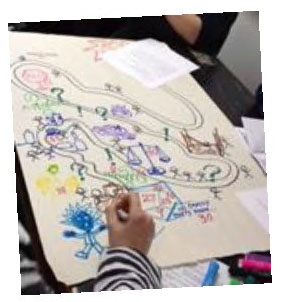
Using visual images or props rather than relying solely on written or verbal communication helps increase individuals’ understanding of the sequence of events and how harm was caused. One interviewee described using mapping exercises to create a story in drawings (see Image 1). First, the client determines the starting point, for example at school if the event occurred after school. Then the program staff asks prompting questions such as “where did you go next” or “what happened next.” Together, the program staff and client also add drawings to represent the objects, people encountered, or events that occurred along the way, while connecting the various points in time with a line. These maps can act as memory aids and visual cues if needed when the individual has to tell their story during the RJ process.
Image 1. Example of Event Mapping Exercise.
Using disclosure and FASD education
In most cases, individuals with FASD give their consent to disclose their impairment to the victim and other RJ participants. Once consent is obtained, program staff take additional time to meet with the victim and other participants to disclose and discuss this information. Educating participants about FASD and its related challenges and limitations is an essential part of preparation for the RJ process. Program staff also go over any specific accommodations or strategies that are already in place to address these unique needs. It is important to note that all parties must be comfortable with the accommodations put in place for the RJ session to proceed.
Modifying the meeting space and conference
To increase the likelihood of a successful RJ process, various adaptations to the meeting space can be made. For example, making the meeting space brighter or darker to address light sensitivity can help make an individual be more receptive and attentive during the conference. Decorating the meeting space can also increase an individual’s attentiveness and focus during a RJ conference by removing possible triggers and increasing the sense of comfort and safety. Other approaches and strategies may focus on the individual, such as enabling them to wear headphones throughout the conference to reduce ambient noise or allowing the individual to stand and walk around the room rather than sit in a chair to reduce anxieties. Other examples provided by interviewees to help facilitate the conference included allowing additional support people be present or reducing the number of participants in the room to help reduce anxieties, as well as taking extra breaks to allow the individual to maintain focus and attention.
Modifying agreements
Another adaptation of the RJ process for Individuals with FASD is to prepare realistic agreements on how the individuals will address the harm they caused. For example, 100 community service hours might not be realistic for an individual with FASD, while 20 hours may be possible. During the pre-conference meetings, program staff usually discuss the need for realistic expectations about how an individual with FASD can address the harm they caused.
C. RJ Outcomes
Although this study did not systematically examine or assess program outcomes, interviewees stated that RJ processes involving offenders with FASD have achieved a high degree of success of completion of their agreements.
Program staff also reported a high degree of satisfaction among victims during their follow-up, usually three to six months after the conference. In some cases, the victim even reported maintaining a relationship with the offender. For example, in one case where the offender had broken the hood of the victim’s car, the offender would regularly wash the victim’s car even after fulfilling the RJ agreement.
After participating in the RJ process, victims also reported having a better understanding of the circumstances that led to the harm, and subsequently felt a greater sense of security knowing that the offender had not intentionally targeted them. Victims also reported empathizing with the offender’s circumstances and appreciating their genuine participation in the process.
3.4 Collaboration with Other Community Services
Interviewees from all five programs noted that involving and collaborating with other community supports and services is important when working with offenders with FASD. Although some communities have a distinct and established RJ program, others offer RJ processes through a community organization that offers a range of services, such as probation offices and the John Howard Society. One of the programs that participated in the study is part of a FASD network that offers a range of services for adults with FASD, including RJ processes with individuals in contact with the CJS.
In addition to RJ programming, other community supports and services include a range of health, mental health, and social service agencies such as clinics (including residential facilities); detox and rehabilitation centres; community outreach programs; and harm reduction programs. These supports are usually best equipped to address the unmet needs of individuals with FASD that may increase their likelihood of contact with the CJS. Some supports and services are also able to offer alternatives to incarceration or unsupervised release back into the community. For example, Community Living chapters,18 where available, offer services tailored to people with cognitive impairments, including FASD. The number, variety, and availability of services vary across communities. Although some communities have considerable resources and services, others need to refer individuals to services in nearby communities.
Interviewees indicated that some of the organizations in their communities have formalized referral protocols, which outline referral criteria and appropriate entry points to provide support for offenders with FASD. An interviewee noted that their inter-agency FASD network is closely connected with the CJS so the program coordinator is informed whenever someone with FASD enters the system. This connection also means that the Crown prosecutor can consult with the program coordinator when deciding on charges and diversion, and in making recommendations to the court on sentencing and release conditions.
In another community, a multidisciplinary team called the Assertive Community Treatment (ACT) team provides various supports and services to people living on the street who come into repeated contact with the CJS, emergency medical services, or hospitals. One of ACT’s goals is to provide individuals with FASD appropriate supports and services to prevent future contact with the CJS. The ACT team includes psychologists, nurses, and social workers who work with police, and probation and welfare officers.
Some communities with specialized integrated court models offer offenders the appropriate supports and services to help them meet the terms of their conditional release, provide alternatives to incarceration, and help them establish a sustainable life outside of the CJS.
Footnotes
11 Statistics Canada defines “re-contact” as a subsequent contact with the police, such as a new charge/charge cleared otherwise, following the individual’s first completed pathway through the system. For the purposes of this report, re-contact can include any contact with the police, courts or corrections for the same or different offence.
12 Although, some individuals may have physical characteristics, FASD is often described as a “hidden disability” because most of the time it cannot be detected by looking at an individual.
13 Another community established an FASD court in 2019 that is similar to the IC model. The court ensures that they are linked with appropriate services in the community to address their underlying needs in the same way as the ICs.
14 In this report, restorative justice also includes community-based Indigenous justice programs that use culturally appropriate restorative justice approaches.
16 For more information on different RJ processes see the United Nations Office on Drugs and Crime Handbook on Restorative Justice Programmes https://www.unodc.org/documents/justice-and-prison-reform/20-01146_Handbook_on_Restorative_Justice_Programmes.pdf.
17 Program staff request the individual’s permission to disclose such personal information (i.e., diagnosis or suspicion of FASD) to the victim(s) and other participants in pre-conference meetings.
18 Community Living is a community-based organization that supports people with intellectual disabilities together with their families, support networks, and community by promoting their full citizenship. It is part of the national Canadian Association for Community Living, which has chapters in more than 300 communities.
- Date modified: