
JustFacts
Police-reported youth crime statistics in Canada, 2024
November 2025
This fact sheet summarizes the latest available data on measures of police-reported youth crime from Statistics Canada’s Uniform Crime Reporting (UCR) Survey, which collects information on criminal incidents that have been reported to police services in Canada.
Measures of police-reported youth crime are based on the number of youth, aged 12 to 17, who came in contact with the police as a result of a reported criminal incident, and were either charged (or recommended for a charge), or were cleared by other means (including being diverted from the formal criminal justice system through the use of extrajudicial measures).Footnote 1 Two measures of police-reported youth crime were examined in this fact sheet:
- the police-reported youth crime rate (hereafter referred to as youth crime rate), which combines the per capita rate of youth charged with a criminal offenceFootnote 2 by police (or recommended for a charge) and the rate of youth cleared by other means (i.e., not charged); and,
- the Youth Crime Severity Index (CSI), which measures both the volume and severity of crime involving youth who come in contact with the police (charged and not charged).
Youth crime rate decreases in 2024, following two consecutive yearly increases in 2022 and 2023
From 2023 to 2024, the youth crime rate decreased 4%, from 2,914 per 100,000 youth population to 2,791 per 100,000. This is the first decrease following two consecutive yearly increases in the youth crime rate from 2021 to 2022 (+19%), and from 2022 to 2023 (+13%). Prior to the increases in 2022 and 2023, the youth crime rate had been generally trending downwards for almost two decades, from a rate of 7,280 per 100,000 youth population in 2003 to 2,163 per 100,000 in 2021, representing a 70% decrease over this time period (see Figure 1). This longstanding decrease occurred during the same period following the implementation of the Youth Criminal Justice Act (YCJA) in 2003.
Youth violent crimes, property crimes, other Criminal Code offences, and federal statute violations all decreased in 2024
From 2023 to 2024, decreases in the rate of youth crime were observed for violent crimes (-2%), property crimes (-9%), and other Criminal Code offences (-1%). The rate of youth crime for federal statute violationsFootnote 3 also decreased 28%.
Youth crime rate decreased in almost all provinces and territories in 2024, with the exception of an increase in Newfoundland and Labrador and Quebec
From 2023 to 2024, almost all provinces and territories saw decreases in their respective youth crime rates; Prince Edward Island (-38%), Yukon (-38%), Alberta (-13%), British Columbia (-12%) and New Brunswick (-10%) had the bigger decreases, while Northwest Territories (-9%), Manitoba (-8%), Nova Scotia (-5%), Ontario (-4%), Saskatchewan (-2%) and Nunavut (-2%) showed smaller decreases. Newfoundland and Labrador (+26%) and Quebec (+4%) were the only two jurisdictions that observed an increase.
Figure 1: Youth crime rate, Canada, 2003 to 2024

Figure 1: Youth crime rate, Canada, 2003 to 2024 – Text version
The chart is a line graph that tracks youth crime rates in Canada for individuals aged 12 to 17 years from 2003 to 2024. The horizontal axis (x-axis) represents the years, starting at 2003 and ending at 2024. The vertical axis (y-axis) represents the rate per 100,000 population, ranging from 0 to 8,000.
There are four lines on the graph:
- One line represents the total rate of all violations (excluding traffic).
- One line represents the rate of violent crimes.
- One line represents the rate of property crimes.
- One line represents the rate of other crimes.
At the beginning of the timeline in 2003, the total violations line is the highest, with property crimes being the second highest, followed by violent crimes and other crimes. Over time, all four categories decline, with the most significant decreases occurring between 2010 and 2020 and the sharpest drop for total violations happens between 2019 and 2020. Property crimes also show a major decline during this period. Violent crimes decrease more gradually, while other crimes remain the lowest throughout, declining slightly.
After 2021, all categories show a modest increase, with total violations rising in 2023 before slightly decreasing again in 2024. Property crimes and violent crimes also increase slightly after 2021, before slightly decreasing again in 2024, while other crimes remain relatively stable.
Youth CSI decreases in 2024 after two consecutive yearly increases
In 2024, the Youth CSI decreased by 3%, from 54.21 in 2023 to 52.46 in 2024. Similar to the youth crime rate, this is the first decrease in Youth CSI after two consecutive yearly increases from 2021 to 2022 (+22%) and from 2022 to 2023 (+8%). Prior to those two increases, the Youth CSI had generally been on a downward trajectory since 2003, when it was recorded at 106.03. The only exception to this decline occurred in 2017, when the index saw a 5% increase, rising from 59.85 in 2016 to 62.86 in 2017. This was followed by a return to a gradual decrease until the 2022 and 2023 increases (see Figure 2).
Decrease in Youth CSI driven by decreases in both violent and non-violent crimes
The 2024 decrease in the Youth CSI was attributed to the 4% decrease in Youth Violent CSI—from 86.82 in 2023 to 83.28 in 2024—which included decreases in, for example, attempted murder (-40%), sexual assault level 2Footnote 4 (-17%), sexual assault level 1Footnote 5 (-16%), sexual violation against children (-12%) and assault level 3 (aggravated; -10%). However, a few violent crimes recorded an increase among the youth population, such as increases in extortion (+10%), criminal harassment (+8%), assault against peace officer (+4%) and other violent violations (+4%). Homicide, which is the most serious offence in Canada, remained unchanged from 2023 to 2024.
To a slightly lesser extent, the Youth Non-Violent CSI decreased 2%—from 31.44 in 2023 to 30.94 in 2024. The Youth Non-Violent CSI recorded decreases in identity fraud (-32%), theft over $5,000 (-16%), theft of motor vehicle (-14%), mischief (-13%), arson (-9%), theft under $5,000 (-8%), possession of stolen property (-5%), trafficking in stolen property (-5%) and fraud (-4%). Meanwhile, altering, removing or destroying vehicle identification number (VIN; +125%) and identity theft (+92%) both saw increases, although these percentage changes are impacted by the small number of such reported incidents.
Figure 2: Youth CSI, Youth Violent CSI and Youth Non-Violent CSI, Canada, 2003 to 2024
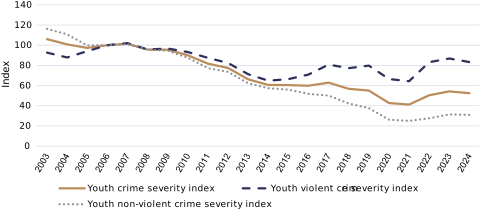
Figure 2: Youth CSI, Youth Violent CSI and Youth Non-Violent CSI, Canada, 2003 to 2024 – Text version
The chart is a line graph that tracks three crime severity indexes for youth in Canada from 2003 to 2024. The horizontal axis (x-axis) represents the years, starting at 2003 and ending at 2024. The vertical axis (y-axis) represents the index value, ranging from 0 to 140.
There are three lines on the graph:
- One line represents the overall Youth Crime Severity Index (CSI).
- One line represents the Youth Violent Crime Severity Index.
- One line represents the Youth Non-Violent Crime Severity Index.
At the beginning of the timeline in 2003, the Youth Non-Violent CSI is the highest, followed by the overall Youth CSI rate, then the Youth Violent CSI as the lowest. Over time, all three indexes decline, with the most significant decreases occurring between 2010 and 2021. The Youth Non-Violent CSI shows the steepest drop from 2003 to 2021. The overall Youth CSI also declines substantially, from 2003 to 2021. The Youth Violent CSI decreases more gradually with several increases and decreases between 2003 and 2021.
After 2021, the Youth Violent CSI rises, before slightly decreasing again in 2024. The overall Youth CSI also increases modestly after 2021, peaking in 2023 and then declining slightly in 2024. The Youth Non-Violent CSI remains relatively stable after 2021.
Most provinces and territories recorded decreases in their respective Youth CSI in 2024, with the exception of Newfoundland and Labrador, Quebec and Nova Scotia
From 2023 to 2024, almost all provinces and territories saw decreases in their respective Youth CSI: Yukon (-61%), Prince Edward Island (-57%), Northwest Territories (-32%), Alberta (-13%), Manitoba (-10%), New Brunswick (-6%), Saskatchewan (-4%), Nunavut (-3%) and Ontario (-2%). Meanwhile, Newfoundland and Labrador (+17%), Quebec (+6%) and Nova Scotia (+3%) all saw increases in their respective Youth CSI.
For the Youth Violent CSI, the largest decreases were observed in Yukon (-71%), Prince Edward Island (-60%), the Northwest Territories (-36%) and British Columbia (-19%). Increases were observed in Newfoundland and Labrador (+9%, which included increases in uttering threats, firearms-related offences, robbery, assault level 3 (aggravated) and other assaults for example), Nova Scotia (+9%, which included increases in homicide, extortion, firearms-related offences, criminal harassment, forcible confinement for example) and Quebec (+5%, which included increases in homicide, assault levels 1, 2 (use of weapons or caused bodily harm) and 3 (aggravated), uttering threats and robbery for example).
For the Youth Non-Violent CSI, the largest decreases were observed in Prince Edward Island (-51%), Yukon (-39%), the Northwest Territories (-28%), and Alberta (-14%). Increases were observed in Newfoundland and Labrador (+35%, which included increases in mischief, theft under $5,000 and fraud for example), Quebec (+9%, which included increases in identity theft and altering, removing or destroying VIN for example), New Brunswick (+7%, which included increases in breaking and entering, and arson for example), Saskatchewan (+2%, which included increases in theft in over $5,000 and arson for example) and Nunavut (+2%, which included increases in breaking and entering for example).
Youth crime rate and Youth CSI remain lower than pre-pandemic levels (2019)
The youth crime rate and the Youth CSI remain lower than pre-pandemic levels, and this despite the increases in volume and severity of youth crime in 2022 and in 2023. In 2019, the youth crime rate was 3,213 per 100,000 youth population compared to 2,791 per 100,000 in 2024 (see Figure 1). In 2019, the Youth CSI was 55.02 compared to 52.46 in 2024 (see Figure 2).
The changes in the volume and severity of crime in 2022 and 2023 may be partly explained by various factors such as social and economic contexts, events, and movements that may have impacted the number and types of crime being committed and/or reported.
- Date modified: