
Department of Justice Canada Client Feedback Survey
Survey Results – Cycle III (2016-2019)
Section 2 – performance against service standards
2.1 Survey Response
During the period of November 2016 through June 2019, client departments and agencies from the Aboriginal Affairs Portfolio, the Business and Regulatory Law Portfolio, the Central Agencies Portfolio, the Public Safety, Defence and Immigration Portfolio, and the Tax Law Services Portfolio were surveyed. Across all five portfolios, 53,230 potential users of Justice Canada legal services at the EX-minus-2 level and above in the National Capital Region (NCR) and the EX-minus-3 level and above in the Regions were invited to participate in the survey. In total, 17,729 respondentsFootnote 5 completed the questionnaire. Of these, 5,545 individualsFootnote 6 reported having used Justice Canada legal services in the twelve months preceding the survey.
Of the service users, 4,899 (88%) reported using Legal Advisory Services, 1,681 (30%) reported using Litigation Services, 347 (6%) reported using Legislative Drafting Services and 540 (10%) reported using Regulatory Drafting Services (Exhibit 1).
| All Service Users | Legal Advisory Services | Litigation Services | Legislative Drafting Services | Regulatory Drafting Services |
|---|---|---|---|---|
| 5,545 (100%) | 4,899 (88%) | 1,681 (30%) | 347 (6%) | 540 (10%) |
2.2 Understanding Performance Results
The Department has identified a performance target of 8.0 on a 10-point scale for each of the satisfaction elements for which client feedback was sought. Throughout the report, a colour-coding scheme for the presentation of results has been adopted (see coding scheme below).
| Coding of Results |
|---|
| Strong – surpassed target (mean ratings of 8.4 to 10) |
| Positive – met target (mean ratings of 8.0 to 8.3) |
| Moderate – slightly below target (mean ratings 7.3 to 7.9) |
| Opportunities for Improvement – target not met (mean ratings of 6.5 to 7.2) |
| Attention Required – significantly below target (mean ratings less than 6.5) |
In the subsections that follow, Justice Canada client satisfaction ratings are presented on the overall quality of legal services by service type, the Department’s performance on individual elements and their aggregation by service dimension, and client knowledge of the Department’s Service Standards for the Provision of Legal Services in Government. Finally, ratings on the importance of Service Standards, as well as selected illustrative comments on the legal services received, are also presented.
2.3 Overall Quality of Legal Services
As illustrated in Exhibit 2 below, client feedback on the overall qualityFootnote 7 of Legal Advisory Services (8.5), Litigation Services (8.4), Legislative Drafting Services (8.6) and Regulatory Drafting Services (8.4) was “strong”. Together, these results demonstrate the Department’s commitment to delivering high-quality legal services to its clients. The Annexes of this report provide a detailed comparison of ratings that have been administered to date for Justice Canada client organizations.
| Legal Advisory Services |
Litigation Services |
Legislative Drafting Services |
Regulatory Drafting Services |
|---|---|---|---|
| 8.5 (±0.0) Strong |
8.4 (±0.1) Strong |
8.6 (±0.1) Strong |
8.4 (±0.1) Strong |
2.4(i) Accessibility/Responsiveness Service Dimension
Client feedback pertaining to accessibility/responsiveness of Justice Canada legal services was “strong” overall, surpassing the departmental target of 8.0 with a rating of 8.7 (Annex C).Footnote 8 As presented below, notwithstanding the first element with a survey result of 7.8, the balance of client feedback suggests that the Department is performing at a high level across the other elements of accessibility/responsiveness (Exhibit 3).
| Cycle III (2016-2019) |
Cycle II (2009-2012) |
Cycle I (2006-2009) |
||
|---|---|---|---|---|
| Regularly provided ongoing feedback informing you of the status of your request(s) for servicesFootnote † of Exhibit 3 | 7.8 (±0.1) Moderate |
7.3 (±0.1) Moderate |
7.5 (±0.1) Moderate |
|
| Addressed your expectations for being kept informed of the status of your request(s) for services | 8.1 (±0.0) Positive |
n/a | n/a | |
| Official Languages: Please rate your overall level of satisfaction with the accessibility of legal services in the official language of your choiceFootnote † of Exhibit 3 | 9.4 (±0.0) Strong |
9.3 (±0.0) Strong |
9.4 (±0.0) Strong |
|
| Courteousness/Respectfulness: Please rate your overall level of satisfaction with the courteousness/respectfulness of legal service providersFootnote † of Exhibit 3 | 9.3 (±0.0) Strong |
9.1 (±0.0) Strong |
9.2 (±0.0) Strong |
|
| Service Provider: Please rate your level of satisfaction with the ease with which the correct service provider to meet your needs was identifiedFootnote † of Exhibit 3 | 8.9 (±0.0) Strong |
8.6 (±0.0) Strong |
n/a | |
| Access Modes | EmailFootnote † of Exhibit 3 | 8.9 (±0.0) Strong |
8.7 (±0.0) Strong |
n/a |
| TelephoneFootnote † of Exhibit 3 | 8.9 (±0.0) Strong |
8.7 (±0.0) Strong |
n/a | |
| In-PersonFootnote † of Exhibit 3 | 8.9 (±0.0) Strong |
8.7 (±0.0) Strong |
n/a | |
All elements of the accessibility/responsiveness service dimension were found to have exceeded the ratings observed in Cycle II, with the majority of elements receiving “strong” ratings. In addition, seven of the eight elements examined at a composite level were found to have improved by a statistically significant difference.Footnote 9 To view a breakdown of these composite ratings by service type, please refer to Annexes D through G.
2.4(ii) Legal Risk Management Service Dimension
As indicated below, results surpassed the departmental target of 8.0 on all three composite elements that fall under legal risk management (Exhibit 4). As presented in Annex C, feedback from respondents against the elements of this dimension was “strong” overall, receiving a composite rating of 8.5 out of 10.
| Cycle III (2016-2019) |
Cycle II (2009-2012) |
Cycle I (2006-2009) |
|
|---|---|---|---|
| Advised you of issues/developments which may impact your department/agencyFootnote † of TExhibit 4 | 8.5 (±0.0) Strong |
8.2 (±0.0) Positive |
8.4 (±0.0) Strong |
| Worked with you to identify legal risksFootnote † of Exhibit 4 | 8.5 (±0.0) Strong |
8.3 (±0.0) Positive |
8.2 (±0.1) Positive |
| Incorporated your instructions in the review and development of legal options to mitigate identified legal risksFootnote † of Exhibit 4 | 8.4 (±0.0) Strong |
8.0 (±0.0) Positive |
n/a |
When broken down by service type, results for all three elements of legal risk management exceeded the departmental target for all four service types, and a majority have improved by a statistically significant margin (Annexes D through G).
2.4(iii) Timeliness Service Dimension
As presented below (Exhibit 5), feedback for all three timeliness elements examined at a composite level either met or exceeded the departmental target of 8.0. As presented in Annex C, feedback on the timeliness of legal services was “positive” overall, receiving a rating of 8.2 out of 10.
| Cycle III (2016-2019) |
Cycle II (2009-2012) |
Cycle I (2006-2009) |
|
|---|---|---|---|
| Responded in a timely manner to requests for legal servicesFootnote † of Exhibit 5 | 8.1 (±0.0) Positive |
7.8 (±0.0) Moderate |
7.9 (±0.1) Moderate |
| Negotiated mutually acceptable deadlinesFootnote † of Exhibit 5 | 8.0 (±0.1) Positive |
7.8 (±0.1) Moderate |
7.9 (±0.1) Moderate |
| Met mutually acceptable deadlinesFootnote † of Exhibit 5 | 8.3 (±0.1) Positive |
7.9 (±0.1) Moderate |
8.0 (±0.1) Positive |
Composite ratings for individual elements of timeliness have all improved by a statistically significant margin since Cycle II.
2.4(iv) Usefulness Service Dimension
As depicted in the exhibit below, composite ratings for individual elements of the usefulness of legal services ranged from “positive” to “strong” (Exhibit 6). Client satisfaction on the usefulness of legal services was “strong” overall, receiving a rating of 8.4 out of 10 (Annex C).
| Cycle III (2016-2019) |
Cycle III (2009-2012) |
Cycle II (2006-2009) |
|
|---|---|---|---|
| Fully prepared you to give testimony in a proceeding | 8.7 (±0.2) Strong |
n/a | n/a |
| Fully understood the nature of the problem/issue for which you received assistanceFootnote † of Exhibit 6 | 8.6 (±0.0) Strong |
8.3 (±0.0) Positive |
8.5 (±0.0) Strong |
| Involved you in the development of legal strategy and positionsFootnote † of Exhibit 6 | 8.2 (±0.0) Positive |
7.8 (±0.1) Moderate |
7.8 (±0.1) Moderate |
| Identified means to prevent or resolve legal disputes at the earliest opportunityFootnote † of Exhibit 6 | 8.2 (±0.1) Positive |
7.9 (±0.1) Moderate |
8.1 (±0.1) Positive |
| Identified opportunities to use dispute resolution practices, where appropriateFootnote † of Exhibit 6 | 8.4 (±0.1) Strong |
7.7 (±0.1) Moderate |
8.0 (±0.1) Positive |
| Provided clear and practical guidance on resolving the legal issue(s)Footnote † of Exhibit 6 | 8.3 (±0.0) Positive |
8.1 (±0.0) Positive |
8.1 (±0.1) Positive |
| Provided consistent legal adviceFootnote † of Exhibit 6 | 8.5 (±0.0) Strong |
8.3 (±0.0) Positive |
n/a |
| Identified opportunities to implement policies or programs by administrative rather than legislative or regulatory means | 8.0 (±0.1) Positive |
n/a | n/a |
| Proposed appropriate solutions for legal and drafting issues raised | 8.3 (±0.1) Positive |
8.2 (±0.1) Positive |
8.0 (±0.1) Positive |
| Developed drafting options appropriate to your policy and program objectives | 8.3 (±0.1) Positive |
8.3 (±0.1) Positive |
8.1 (±0.1) Positive |
Across all elements of the usefulness service dimension, composite ratings have either increased or remained the same between surveys, with the majority having increased by a statistically significant margin. In addition, all elements either met or exceeded the departmental target of 8.0.
2.5 Importance of Service Standards
Questions about the importance of each of the Department of Justice Canada’s Service Standards for the Provision of Legal Services were added to the third cycle of the survey in order to provide additional insight into client satisfaction ratings. These questions help to gauge the relative value of each of the Service Standards from the client’s perspective. As shown in the following charts (Exhibits 7 through 10) and Annex H, every Service Standard received a high rating of importance (8.5 and above) across all service types. The Service Standards identified as most important by Legal Advisory and Litigation service users were: responded in a timely manner to requests for legal services, and provided clear and practical guidance on resolving the legal issue(s), with importance ratings of 9.4 (Legal Advisory) and 9.3 (Litigation) for each of these elements. For both Legislative Drafting and Regulatory Drafting service users, the Service Standard that was ranked most important was: proposed appropriate solutions for legal and drafting issues raised, with importance ratings of 9.3 and 9.2, respectively. Of note, the Legislative Drafting Services element: responded in a timely manner to requests for legal services, also received a rating of 9.3, and the Regulatory Drafting Services element: met mutually acceptable deadline(s), also received a rating of 9.2.
The extent of the disparity, or gap, between the rated importance of a Service Standard and a client’s satisfaction with the Department’s performance regarding that same standard may identify a potential opportunity for improvement. To improve legal services to clients, the Department may wish to focus its efforts on Service Standards featuring greatest disparity between importance and satisfaction ratings. The average disparity between importance and satisfaction ratings across all Service Standards was 1.0.The following sub-sections present both importance and satisfaction ratings by Service Standard to give the reader a visual representation of the disparities that were found. These disparities are displayed in order of largest to smallest disparity observed.
i. Legal Advisory Services
In examining importance and satisfaction ratings for Legal Advisory Services, the largest disparity observed was for the Service Standard: responded in a timely manner to requests for legal services. As observed in the chart below, this Service Standard featured a disparity of 1.3 between satisfaction and importance ratings (Exhibit 7).
Exhibit 7: Legal Advisory Services - Importance and Satisfaction Ratings

Exhibit 7: Legal Advisory Services - Importance and Satisfaction Ratings – Text version
Comparison of satisfaction and importance ratings on eight individual service standard elements of the legal advisory services. Ratings for each element are represented using columns (one for satisfaction and one for importance) lined up horizontally, with heights indicating the composite ratings given by service users.
| Service Standard Element | Satisfaction Rating | Importance Rating |
|---|---|---|
| Responded in a timely manner to requests for legal services. | 8.1 | 9.4 |
| Regularly provided ongoing feedback informing you of the status of your request(s) for services. | 7.8 | 9.0 |
| Provided clear and practical guidance on resolving the legal issue(s). | 8.3 | 9.4 |
| Negotiated mutually acceptable deadlines. | 8.0 | 9.1 |
| Met mutually acceptable deadlines. | 8.3 | 9.3 |
| Identified means to prevent or resolve legal disputes at the earliest opportunity. | 8.2 | 9.0 |
| Involved you in the development of legal strategy and positions. | 8.3 | 9.0 |
| Identified opportunities to implement policies and programs by administrative rather than legislative or regulatory means. | 8.0 | 8.6 |
There were five (out of eight) Service Standards for Legal Advisory Services that featured a large disparity of greater than or equal to 1.0. Also of note, the Service Standard identified opportunities to implement policies and programs by administrative rather than legislative or regulatory means received the lowest rating of importance for Legal Advisory Services.
ii. Litigation Services
In examining the results for Litigation Services, the largest disparity between importance and satisfaction ratings was found for the Service Standard: regularly provided ongoing feedback informing you of the status of your request(s) for services with a disparity of 1.1 (Exhibit 8). Importance ratings for Litigation Services were fairly similar to the ratings observed for Legal Advisory Services. In addition, only one Service Standard assessed for Litigation Services had a rating for importance lower than 9.0.
Exhibit 8: Litigation Services – Importance and Satisfaction Ratings

Exhibit 8: Litigation Services – Importance and Satisfaction Ratings – Text version
Comparison of satisfaction and importance ratings on eight individual elements of the litigation services. Ratings for each element are represented using columns (one for satisfaction and one for importance) lined up horizontally, with heights indicating the composite ratings given by service users.
| Service Standard Element | Satisfaction Rating | Importance Rating |
|---|---|---|
| Regularly provided ongoing feedback informing you of the status of your request(s) for services. | 8.0 | 9.1 |
| Responded in a timely manner to requests for legal services. | 8.3 | 9.3 |
| Provided clear and practical guidance on resolving the legal issue(s). | 8.3 | 9.3 |
| Involved you in the development of legal strategy and positions. | 8.2 | 9.1 |
| Negotiated mutually acceptable deadlines. | 8.2 | 9.1 |
| Identified means to prevent or resolve legal disputes at the earliest opportunity. | 8.1 | 9.0 |
| Met mutually acceptable deadlines. | 8.4 | 9.2 |
| Identified opportunities to implement policies and programs by administrative rather than legislative or regulatory means. | 7.8 | 8.5 |
As was the case with Legal Advisory service users, Litigation service users rated the Service Standard identified opportunities to implement policies and programs by administrative rather than legislative or regulatory means as least important.
iii. Legislative Drafting Services
For Legislative Drafting Services, the disparities observed between importance and satisfaction ratings across all Service Standards were less than 1.0 (Exhibit 9). Importance ratings for each Service Standard were found to be quite high between 9.1 and 9.3. Notably, all of the Service Standards for this service type received satisfaction ratings that exceeded the departmental target of 8.0.
Exhibit 9: Legislative Drafting Services – Importance and Satisfaction Ratings
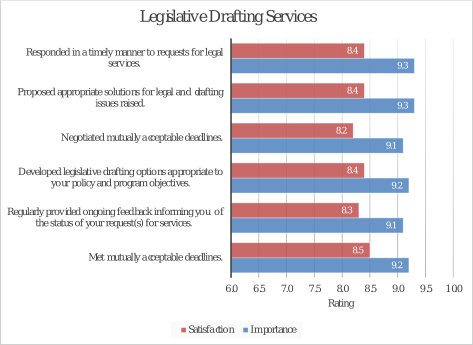
Exhibit 9: Legislative Drafting Services – Importance and Satisfaction Ratings – Text version
Comparison of satisfaction and importance ratings on six individual elements of the legislative drafting services. Ratings for each element are represented using columns (one for satisfaction and one for importance) lined up horizontally, with heights indicating the composite ratings given by service users.
| Service Standard Element | Satisfaction Rating | Importance Rating |
|---|---|---|
| Responded in a timely manner to requests for legal services. | 8.4 | 9.3 |
| Proposed appropriate solutions for legal and drafting issues raised. | 8.4 | 9.3 |
| Negotiated mutually acceptable deadlines. | 8.2 | 9.1 |
| Developed legislative drafting options appropriate to your policy and program objectives. | 8.4 | 9.2 |
| Regularly provided ongoing feedback informing you of the status of you request(s) for services. | 8.3 | 9.1 |
| Met mutually acceptable deadlines. | 8.5 | 9.2 |
iv. Regulatory Drafting Services
As observed in Exhibit 10, for Regulatory Drafting Services, large disparities (over 1.0) were observed between ratings of satisfaction and importance for most Service Standards that were surveyed. The largest disparities observed were for the Service Standards: responded in a timely manner to requests for legal services and negotiated mutually acceptable deadlines, with a disparities of 1.3 between ratings. Three of the Service Standards for this service type received satisfaction ratings lower than that of the departmental target and also featured high disparities.
Exhibit 10: Regulatory Drafting Services – Importance and Satisfaction Ratings

Exhibit 10: Regulatory Drafting Services – Importance and Satisfaction Ratings – Text version
Comparison of satisfaction and importance ratings on six individual elements of the regulatory drafting services. Ratings for each element are represented using columns (one for satisfaction and one for importance) lined up horizontally, with heights indicating the composite ratings given by service users.
| Service Standard Element | Satisfaction Rating | Importance Rating |
|---|---|---|
| Responded in a timely manner to requests for legal services. | 7.8 | 9.1 |
| Negotiated mutually acceptable deadlines. | 7.7 | 9.0 |
| Met mutually acceptable deadlines. | 8.0 | 9.2 |
| Regularly provided ongoing feedback informing you of the status of you request(s) for services. | 7.7 | 8.9 |
| Proposed appropriate solutions for legal and drafting issues raised. | 8.2 | 9.2 |
| Developed legislative drafting options appropriate to your policy and program objectives. | 8.2 | 9.1 |
2.6 Knowledge of the Service Standards for Legal Services
In April 2009, Standardized Legal Service Agreements with client departments and agencies began to incorporate the Service Standards for the Provision of Legal Services in Government. To gain a sense of the degree to which users of legal services are familiar with the Service Standards, users were asked to rate their knowledge of the Service Standards. Of the 5,545 service users, 1,833 (33%) rated their knowledge of the Service Standards as “good” or “very good” while 3,030 (55%) rated their knowledge of the Standards as “fair” or “poor”. The remaining 682 (12%) service users were “unable to assess” or did not rate their knowledge of the Standards (Exhibit 11a).
| Very Good | Good | Fair | Poor | Unable to Assess/ Not Stated |
|---|---|---|---|---|
| 977 (18%) | 856 (15%) | 1,151 (21%) | 1,879 (34%) | 682 (12%) |
In turn, service user knowledge of Justice Canada Service Standards was found to coincide with service user ratings of satisfaction. As illustrated below, across Justice Canada client organizations, service users who rated their knowledge of the Service Standards as “good” or “very good” provided more positive satisfaction ratings than those who rated their knowledge as “poor” or “fair”. Of note, differences between these two knowledge groups were found to be statistically significant for the overall quality ratings of Legal Advisory and Litigation Services (Exhibit 11b).
| Good or Very Good | Poor or Fair | |
|---|---|---|
| Legal Advisory ServicesFootnote † of Exhibit 11b | 8.9 (±0.1) Strong |
8.4 (±0.1) Strong |
| Litigation ServicesFootnote † of Exhibit 11b | 8.8 (±0.1) Strong |
8.2 (±0.1) Strong |
| Legislative Drafting Services | 8.7 (±0.2) Strong |
8.5 (±0.2) Strong |
| Regulatory Drafting Services | 8.6 (±0.2) Strong |
8.3 (±0.2) Positive |
2.7 Comments on Legal Services Provided
New to the survey for this cycle is the ability for legal service users to provide feedback by way of open-ended comment boxes.Footnote 10 Of the 5,545 service users, 1,357 (24%) provided comments on the services that they had received. Although there were comments received that expressed dissatisfaction with the legal services received, many of the comments were positive and reflected the "strong" overall ratings observed across service dimensions, with clients indicating that these services were important and helpful. Selected illustrative commentsFootnote 11 (presented in the language received)Footnote 12 are as follows:
“Nous recevons un excellent service de la part de l’unité des services juridiques dédié à notre groupe. Ce service est offert en français et tous les textes rédigés sont précis, clairs et répondent aux demandes du client et des parties aux tables de négociation. Le travail effectué respecte les échéances souvent très courtes. La relation de travail est courtoise, professionnelle et basée sur un respect mutuel des expertises des différents intervenants.”
“The service we receive on an ongoing basis is always excellent and very professional. As we have a very effective legal team of people as well as the leader of this team as in depth knowledge of our legislation and operation, we are very pleased with the ongoing support we have from them.”
“The value provided to our work cannot be understated. We are truly fortunate to have this service available in support of our work.”
“I have had the opportunity to work with different lawyers during the last 11 years and they have all been very professional and always keen to help. I am currently working regularly with litigation lawyers on two court cases and their services are excellent. Current advisory services from our lawyers are outstanding.”
“Excellent people with great knowledge commitment and work ethic. Very understaffed and over worked - that is a real issue that needs to be resolved.”
The following presents selected comments categorized by service dimension across all service types.
i. Accessibility/Responsiveness Service Dimension
Legal service providers were mostly commended across all elements that fall under this service dimension, predominantly for the courtesy, respect and professionalism that clients had experienced. Comments varied regarding the extent of regular and ongoing feedback, and some concerns were raised over delayed progress reports and staff availability. A few comments spoke to the provision of legal services in either official language, and legal services providers were generally accessed with ease.
“There is a wealth of corporate knowledge available to our department that JUS advisory lawyers have built up over the years. Most are very responsive to urgent issues and very willing to provide real-time oral advice. We are working on better coordination of planning priorities so routine transactions requiring legal advisory support can have realistic timelines that we can use with our communication with First Nation clients… Similarly, we ask that when court appearances and other JUS tasks impact availability of the assigned legal counsel to our deliverables these are flagged to us as soon as possible, with coverage solutions.”
“I do not often need legal input, but when I do I find the DLSU personnel assigned to our work unit are exceptionally positive and helpful. Their care in making me understand how to use the legal advice I receive is often just as important as understanding the advice itself as I normally am seeking their input into an advisory process. Their open attitude and willingness to listen is amazing considering how many demands there are on their time and I am sure that it encourages people in my organization to seek legal advice and input more proactively than we would if we were facing grumpy, over worked legal advisors. This is a difficult factor to quantify but an advisor who no one wants to approach, isn’t able to provide a particularly useful service.”
“We are very satisfied with the work done. On the other hand, we are constantly inquiring about the status of our file as long periods of time pass where nothing seems to progress…possibly caused by the lawyers’ workload.”
“Working on the complex regulatory issues over the past two years, I have been constantly impressed by the detail and speed of our counsel at LSU. They negotiate timelines in an open and transparent manner that allows policy teams to balance demands on their time. When urgent issues are flagged, they adjust quickly and are always available. I’ve never felt like urgent issues were held up waiting for legal advice. Most importantly, LSU staff have regularly taken the extra time needed to explain complex legal/regulatory issues to policy staff, flag risks, and support the development of mitigation strategies. While the number of comments in draft policy documents or communications can be a short-term frustration, the end result is a policy group better informed of their legal environment.”
“Justice personnel act professionally at all times, respectful of clients’ many competing pressures, while dealing with a very heavy workload themselves. Personnel are courteous and friendly and truly have a positive impact in their interactions with clients. Hats off to a very dedicated group of personnel - job well done!”
ii. Legal Risk Management Service Dimension
For the most part, the services received were portrayed as being appreciated towards minimizing risk and contributing to effective decisions. However, there was some concern about Justice Canada legal staff being too risk averse or the need to have more client consultation.
“Justice has always been very helpful and participated in difficult conversations and discussions with client departments to resolve disputes and difference in opinions in resolving high legal risk submissions.”
“J’ai toujours eu une grande facilité à obtenir avis et conseils en droit du travail. Les avis qui m’ont été fournis offrent une valeur ajoutée et nous permettent de bien aviser les gestionnaires-clients et d’ajouter des informations pertinentes au sujet des risques associés aux diverses décisions.”
“In several circumstances I feel that Justice would not move forward unless they felt there was no chance of losing. There may be times that we as the Government of Canada needs to be more aggressive.”
“Justice was very good at letting us know what the legal risk was but offered very little advice on ways to mitigate the risk. Simply said, there was a lot of “you can’t do that” and very little “here’s another way to achieve the intent”.”
“Advice and recommendations received were well researched and sound. Timelines were reasonable and the advice received was very helpful in minimizing risks and contributing to effective decisions.”
iii. Timeliness Service Dimension
Feedback regarding the timeliness of legal services was fairly mixed. There were a number of comments indicating an appreciation for work being completed in a timely manner; however, there were also many comments indicating dissatisfaction. Specifically, a number of service users voiced their concern over a shortage of legal staff, as well as the heavy workloads and competing priorities of legal service providers, as having impacted the timely delivery of legal services. A sample of comments are below:
“The Legal Service Unit legal advisors my team and I work with provide fantastic service; often on very short timelines. They have been very helpful in untangling a number of complex policy-legal issues my team has had to grapple with. Their advice has been strengthened by several long serving members who provide invaluable corporate memory, which has served us very well on a number of our key files.”
“Our counsel are very good but are overtasked and there are not enough of them to deliver timely support. Advice is good but often requires us to wait too long. Counsel are very dedicated.”
“Legal services in themselves are excellent when they are provided. However delays in obtaining responses to key issues have often taken significant time. This is by no means the fault of the lawyers involved in these issues as they are making every effort to resolve these issues on a timely basis but are being pulled in various directions as a result of increasing workload and conflicting priorities.”
“Overall I and my staff are happy with the quality of advice received. However, our major concern is the timeliness of the advice. Many of our legal advice requests pertain to private sector agreements and often the delay in receiving advice is a source of friction with the clients because we cannot predict when we will receive a response. Also generally we are not afforded a timeline as to when we may receive a response. I understand that the Justice employees assigned to our department carry a heavy workload so perhaps additional resources should be made available.”
“In some cases it seems as though too much workload and not enough litigation JUS staff which often means getting things done only at very end of deadlines which puts resourcing pressures/problems on clients end hard to manage.”
vi. Usefulness Service Dimension
For elements pertaining to the usefulness of legal services, comments were largely positive. Many comments praised service providers as being knowledgeable and understanding, with gratitude for the guidance and solutions provided. Overall, the services received by service users were depicted as having been very useful, despite some comments of perceived inconsistent advice from the Department.
“JUS within my department has provided exceptional service to me over several years. I had almost daily need for advice from JUS. This could be any hour of the day or night, 7 days a week, and questions, were intensely time sensitive. JUS was always there with fast, intelligent, helpful advice. They were also very easy to work with and made it a pleasure - even during periods of extreme stress and pressure JUS in my department has been extremely supportive and helpful in briefing me, preparing me for discovery and supporting me during these periods. My support from the LSU during this process has been terrific. The work of the LSU in my department is invaluable.”
“I consistently receive excellent service from Legal Services. The lawyers I deal with are quick to understand the situations/questions that I present, and to provide me with the information or opinions that I need in a timely fashion, or to work with me to develop a solution that meets my timeline.”
“In the case at hand, Litigation Services had one client but had to seek input from various departments. Most of the communications from/to Litigation Services were done through the Legal Services of the respective departments involved, so maybe this meant that communications on progress of the case were not as regular as expected. Still, Litigation Services did a really good job overall. The main litigator and his team from Litigation Services were able to quickly understand the technical issues related to the case, and to identify and provide directions on the most salient arguments to make to the court, which helped us when developing input for and comments on factums, and which eventually ensured that the Government prevailed.”
« Les stratégies légales doivent être mieux développé avec les clients et être plus proactive qu’elles le sont actuellement. L’aversion au risque paralyse parfois le système et crée des précédents avec lesquels les gouvernements actuels et futurs devront composer. Les stratégies de communications doivent aussi être plus avant-gardistes afin de communiquer en langage clair les raisons pour certains litiges et les fondements mêmes de ceux-ci. Les stratégies légales et la mise en œuvre de celles-ci doivent être faites par des avocats compétents en la matière et non par les analystes de programmes et de politiques responsable de la gestion courante des opérations. »
“Comments were generally practical and straight forward. Consistency has been an issue, in particular with past advice: we will evolve an organizational position based on a body of legal opinions, only to find that some have fallen out of favour. Counsel worked hard to master extremely complex subjects of a technical nature, and generally succeeded to a reasonable degree. Counsel asks the right questions and gives appropriate level of caution. Counsel operates at a pace appropriate for the operational nature of the business, and is willing to provide general views in a fluid context, rather than insist on formal legal opinions.”
- Date modified: