
Central Agencies Portfolio Evaluation
4. Evaluation Findings
This section combines information from all lines of evidence and presents the findings according to the broad evaluation issues of relevance, design and performance.
4.1. Relevance
The evaluation considered the relevance of the CAP with respect to the continued need for the Portfolio’s services; the responsiveness of the Portfolio to federal government priorities, roles and responsibilities; and the Portfolio’s support of the Department’s strategic outcomes.
4.1.1. Continued Need
The evaluation confirmed the continued need for the Portfolio based on the role it serves within the federal government, the type of expertise it offers, and the ongoing demand for its services.
The Rationale for Centralized Legal Services and the Portfolio Structure
Under the Department of Justice Act, the Minister of Justice serves as the legal advisor to all federal departments and agencies and, as Attorney General of Canada, is responsible for all litigation for and against the Crown.Footnote 17 The centralization of legal services within the Department of Justice and the organization of those services into the various portfolios help ensure that the Minister of Justice can fulfill this dual role and meet the legal service needs of the federal government.
The rationale for the centralization of legal services was articulated in the early 1960s, when the Royal Commission on Government Organization(commonly referred to as the Glassco Commission) recommended that legal services, with few exceptions, be centralized in the Department of Justice. The Commission believed that integrated legal services through the Department of Justice would reduce duplication of effort and better ensure the independence of legal services from the operations of specific departments.Footnote 18 This rationale remains tightly bound to Justice’s continued commitment to consistency (i.e., the Department speaks with one voice), a whole-of-government approach, and the protection of the best interests of the Crown.Footnote 19
The portfolio organization of the Department is based on business lines and creates a structure where departments and agencies with common legal issues are grouped together. This structure assists with consistency in approach and can facilitate information sharing and collaboration, as appropriate, so that legal services are integrated and responsive to the needs of client departments and agencies, and of the government as a whole. Based on interviews and documents, the evaluation found that the legal services (advisory, legislative, litigation) provided by CAP LSUs provide meaningful support to the ongoing operations of their respective departments and agencies. As will be discussed further in Section 4.2, interviewees believe that the Portfolio structure helps organize Justice’s legal resources so that client departments and agencies have counsel with the necessary expertise. In particular, the CAP offers legal expertise in relevant areas, such as financial institutions, public service employment law, labour law, tax law, Crown law, financial law, money laundering, terrorist financing, federal budget, and machinery of government.
Demand for CAP Services
The evaluation found that the legal services (advisory, legislative, litigation) provided by LSUs and regional offices provide meaningful support to the ongoing operations of their respective departments and agencies served by the Portfolio. The CAP’s work is primarily conducted by LSUs and constitutes advisory work. In 2014-2015, the Portfolio managed 4,148 files. Footnote 20 Of those files, 4,009 (or 97%) involved work of the LSUs, and 3,138 (or 77%) were advisory files.
Overall, demand, as reflected in the hours on actively managed files, has declined slightly during the time period covered by the evaluation. The decline is related primarily to legislative files (almost 50% since 2010-11) and general files (31%).Footnote 21 There is a slight decline in litigation as well (9%). Advisory, which represents the majority of the Portfolio’s work, has increased slightly (up 3% since 2010-11). The decline in hours mirrors the reduction of approximately four FTEs in the LSUs from 2010-11 to 2014-15.
Figure 1: Total Number of Hours for Actively Managed Files by Type of Legal Activity: 2010-11 to 2014-15

Source: iCase
Text Version: Figure 1: Total Number of Hours for Actively Managed Files by Type of Legal Activity: 2010-11 to 2014-15
QA line graph is showing the total number of hours for actively managed files by type of legal activity.
For advisory services:
- In 2010-11, 70,706 hours
- In 2011-12, a slight increase to 71,785 hours
- In 2012-13, a decrease to 65,504 hours
- In 2013-14, a slight increase to 67,288 hours
- In 2014-15, an increase to 72,533 hours
For litigation services:
- In 2010-11, 35,589 hours
- In 2011-12, an increase to 39,593 hours
- In 2012-13, a decrease to 34,953 hours
- In 2013-14, an increase to 40,474 hours
- In 2014-15, a decrease to 32,560 hours
For legislative services:
- In 2010-11, 14,424 hours
- In 2011-12, a decrease to 12,850 hours
- In 2012-13, approximately the same at 12,873 hours
- In 2013-14, a slight decrease to 12,220 hours
- In 2014-15, a decrease to 7,346 hours
For general services:
- In 2010-11, 15,305 hours
- In 2011-12, a slight increase to 15,928 hours
- In 2012-13, a decrease to 8,926 hours
- In 2013-14, an increase to 10,937 hours
- In 2014-15, approximately the same at 10,585 hours
Key informant interviews confirm the iCase results that the volume of work has not changed substantially in the last five years, although the volume of work is still considered heavy. The volume of work is also not uniform across the Portfolio, but has varied dependent on the LSU and even legal areas within the LSU. The modest decline in hours should also not be interpreted as a decline in need for CAP legal services. Some key informants noted that when the client agency was itself new or had new legislation, the demands for legal services were greater, not only in terms of legislative files, but also advice files. For example, when legislation is new, clients typically have more requests for legal advice concerning interpretation or application. In addition, newer agencies are often more risk-averse, which creates greater demand for legal services. Another example is client interactions with new independent tribunals or boards. PSC reported that requests for legal advice declined with respect to cases before the Public Service Staffing Tribunal and the Public Service Labour Relations Board (now merged into the PSLREB), as over the last decade the PSC has become more familiar with the legal issues given their experience with earlier cases. That said, any time clients embark on legislative changes, policy reviews and similar initiatives, or when major litigation arises, the demand for legal services will increase.
Based on the key informant interviews, whether the level of legal risk and complexity of the Portfolio’s work has changed during the period of the evaluation also varies by LSU. Examples of files with high legal risk and/or complexity included Charter challenges to new legislation (e.g., litigation arising from the Expenditure Restraint Act), and major new policy initiatives in complex legal areas (e.g., venture capital investment) or that required extensive legislative amendments (e.g., 2013 changes to the Public Service Labour Relations Act). The evaluation cannot confirm these perceptions of key informants as most advisory, legislative and litigation files handled by LSUs do not have a numeric legal risk or complexity rating in iCase.
4.1.2. Alignment with Federal Priorities, and Roles and Responsibilities
The CAP has an ongoing role in supporting and upholding government priorities. Evidence indicates close alignment between the work of the Portfolio and documented federal priorities and commitments. Speeches from the Throne and Budgets released during the time period covered by the evaluation highlight goals and commitments that are directly relevant to the Portfolio’s work. In particular, the areas of tax policy, efforts to combat terrorism, legislation related to pension plans, as well as initiatives related to “good governance and sound stewardship to enable efficient and effective services to Canadians”, which is the TB’s strategic outcome, all require legal service support from CAP. The following are examples of government commitments in these and other areas that relate to the work of the Portfolio:
- In the 2015 Speech from the Throne, the government identified among its priorities a tax cut for the middle class, enhancement of the Canada Pension Plan, and an emphasis on open and transparent government — areas that would involve TBS and Finance LSUs. In addition, the government noted its commitment to continue to work with allies to combat terrorism — an area that would involve FINTRAC (through legislation related to money laundering and terrorist financing).
- In the 2013 Speech from the Throne, the government committed to balanced budgets and reduced government cost, which would entail (among other things), reforming the way the government manages spending, reforming government pension plans, amending the Public Service Labour Relations Act,and increasing accountability of public service. A government priority was also “defending Canadian consumers”, which would involve Portfolio LSUs such as FCAC and OSFI, as the specific commitments that were made involved the banking and financial sector.
- In the 2011 Speech from the Throne, government priorities included balancing the budget and establishing new tax credits. The law and order agenda of the government also included crime and terrorism. Public service modernization, which is related to the government’s “integrity and accountability” priority, also directly relates to the work of the Portfolio’s departments/agencies.
- The Portfolio supports the development of the budget, which means its legal advice is part of every budget tabled during the time period covered by the evaluation.
According to key informants (CAP, clients, and other areas of Justice) and internal documents, CAP has responded to its clients’ evolving legal service needs, which shift in order to be responsive to government priorities. Specific examples that demonstrated the responsiveness of the Portfolio to client needs were provided in interviews and internal documents, and included:
- assisting with the development and implementation of a comprehensive federal regulatory regime governing securities, which had a major impact on the type and volume of services provided by Finance – GLS LSU;
- responding to the financial crisis in 2008 through work to support FCAC’s new objectives related to financial literacy and with OSFI counsel’s provision to the client of training on new legislation and insolvency law;
- working on the implementation of harmonized sales tax and other tax agreements with provinces, territories and indigenous governments;
- responding to constitutional challenges related to the public service collective bargaining regime, the Expenditure Restraint Act, and the Public Sector Equitable Compensation Act;
- working through the government’s Deficit Reduction Action Plan and its impact on human resources across the federal government;
- drafting and support for the Public Sector Equitable Compensation Act;
- working on the expansion of the Canada Pension Plan, which involved the TBS and Finance LSUs working with other government departments’ LSUs; and
- supporting the five-year reviews of various acts relevant to the work of the Portfolio, including the PSEA, the Public Service Labour Relations Act, the Proceeds of Crime (Money Laundering) and Terrorist Financing Act (concerns FINTRAC), and the Lobbying Act.
4.1.3. Alignment with Departmental Strategic Priorities
Evaluation results indicate that the CAP supports the Department of Justice Canada in meeting its strategic priorities.Footnote 22
The Department has the mandate to support the roles of the Minister of Justice and Attorney General of Canada under the Department of Justice Act. By providing legal advice, the Portfolio helps to fulfill Justice’s mandate to advise federal department heads on all matters of law connected to their departments (s. 5(b)). The Portfolio works to “see that the administration of public affairs is in accordance with the law” (s. 4). By representing the Crown in litigation, the Portfolio fulfills the responsibilities under the Department of Justice Act to conduct all litigation for or against the Crown or any department (s. 5(d)).
In addition, CAP supports Justice’s two strategic outcomes. The Portfolio supports the first strategic outcome of “A fair, relevant and accessible Canadian justice system” through exercising its responsibilities under the Department of Justice Act to ensure that the federal government acts in accordance with the law. The Portfolio contributes to the Department’s fulfillment of its second strategic outcome – “A federal government that is supported by high-quality legal services” – through its provision of legal advisory, litigation and legislative services to its client departments and agencies.
4.2. Design of the Portfolio
As described in earlier sections, every portfolio in the Department of Justice is organized similarly in that it is based on lines of business and, in addition to having a senior management position (for CAP, the ADM), each portfolio has LSUs that are co-located with client departments and agencies, as well as regional counsel who work on portfolio files. Generally speaking, the CAP is organized in this same way, although there are a few key differences. First, the ADM has a dual role as head of the CAP and ADM of the Finance Canada Law Branch, which means that the ADM reports directly to two deputy ministers: that of Finance and Justice.Footnote 23 In addition, the CAP does not have counsel in regional offices of the Department of Justice designated to work exclusively on its files, as is the case for other portfolios. While regional counsel work on CAP files, they are assigned to other portfolios, such as the Business and Regulatory Law Portfolio or the Public Safety, Defence and Immigration Portfolio.
The design of the CAP was considered in the evaluation in order to assess whether its structure supported the achievement of its objectives. Overall, the evaluation evidence indicates that the CAP structure is appropriate and supports its objective of high-quality legal services, while indicating a few areas of potential improvement.
Portfolio Structure Strengths
As mentioned in Section 4.1.1, the approach of structuring the Department of Justice by portfolios is considered a strength by key informants. The Portfolio structure aligns LSUs with client departments and agencies and ensures that appropriate expertise is available within each LSU, according to both Portfolio and client key informants.
Dual Role of ADM
Almost all CAP counsel key informants considered the unique, dual role of the ADM to be beneficial. The dual role is thought to give the ADM a broader perspective that can inform the Portfolio’s work. The ADM attends executive committee meetings in Finance, and so is privy to information and has insights that can be either shared or, at least, used to guide the work of the Portfolio. In addition, some of the other agencies in the Portfolio provide recommendations to Finance (OSFI, for one), so having a Portfolio head who brings a unique understanding of Finance is helpful. The ADM also works directly with a client department and, therefore, has a clear understanding of the challenges of LSUs, which a few key informants in the Portfolio considered an added benefit.
The implementation of the Deficit Reduction Action Plan (DRAP) provided an example of the importance of the dual role and how well it serves the central agency functions. Finance was responsible for the DRAP and, as manager of internal government operations, the TB was to put in place the processes for departments and agencies to implement and report on DRAP activities. The ADM’s dual role meant that she was well-versed on the intended impact of the DRAP on the government’s fiscal framework through her ADM position in Finance, and her role as head of the Portfolio meant that she was involved in the TB work on the DRAP. Without that dual role, it was thought that the DRAP exercise would not have been as smooth.
Appropriate Mix of Departments and Agencies
There was a consensus among the CAP key informants that the Portfolio has the appropriate mix of departments and agencies. Two central agencies (Finance and the TB) are in the Portfolio,Footnote 24 and the other units are natural associates. More specifically, FINTRAC, FCAC and OSFI all report directly to Finance, and PSC and the TB also have a link to Finance as they both deal with budgetary matters. In addition, the LSUs in the Portfolio have related mandates and, therefore, experience common legal issues. To give a few examples, the Finance – GLS LSU deals with financial institutions and terrorist financing issues; FINTRAC is also involved with that issue, and the PSC and the TB both deal with employment issues related to the public service. Although some LSUs do not interact with many others in the Portfolio, the commonality of issues was thought to serve as an appropriate link.
While the linkages between the different LSUs’ clients validate the LSUs being united within one portfolio, the importance of the LSUs remaining distinct units was also noted. In particular, when the clients have different roles, such as policy-maker and regulator, key informants emphasized that having separate LSUs was important to avoid conflicts of interest. For example, the FCAC and Finance – GLS LSUs need to be separate to leave the policy-maker (GLS) free to make policy and the regulator (FCAC) free to promote compliance and sanction non-compliance without any conflict of interest. The separation of the LSUs matches the structure of the clients and serves their interests, while having them in the same portfolio ensures that Justice speaks with one voice.
No Duplication or Overlap
Portfolio key informants noted that there is no duplication or overlap with programs or services delivered by other LSUs within Justice. They considered their involvement with other areas of Justice, particularly the specialized sections of the Public Law Sector (PLS), as bringing in needed expertise when the issue was novel or complex and in an area of law in which the PLS specializes, such as administrative or constitutional law. Involving the PLS when appropriate is considered the best use of Justice resources, and not as resulting in duplication/overlap of efforts. Portfolio key informants also noted that the legal issues clients experienced might overlap, but not the legal services provided by the Portfolio LSUs. For example, the Financial Administration Act (FAA) is part of both Finance’s and TB’s mandates, so both LSUs are involved with interpreting the FAA, but they do so from the perspective of their clients, while also recognizing the importance of consistency in interpreting the FAA provisions. To reduce any duplication of efforts or inconsistencies in interpretation, Justice has prepared an annotated FAA,an FAApractice group exists, and the two LSUs consult with each other as appropriate.
Potential Limitation
The only potential limitation is the information flow from the Portfolio to counsel in the LSUs. Documentation indicates that there are mechanisms within the Portfolio intended to support information sharing. In particular, there are the CAP Directors meetings, which are weekly conference call and quarterly in-person meetings that are chaired by the CAP ADM and attended by LSU Directors, Deputy Directors and ADMO Senior Counsel. At these meetings, the attendees receive updates and report on current and upcoming Portfolio/departmental and client activities. There is also an annual meeting chaired by the ADM for all staff in the Portfolio. The annual meeting is intended to strengthen interactions across the Portfolio and discuss matters that relate to the CAP and Justice.
Though not specifically asked about these meetings, some Portfolio key informants noted that the sharing of information within the Portfolio could be improved. In particular, the annual meeting was considered too infrequent by these key informants and, as a result, the quality of information sharing became very dependent on the environment within the individual LSU. These concerns with information sharing in the Portfolio were supported by results from the PSES, which indicate a potential downward trend with regard to perceptions of information sharing within the CAP. When asked whether essential information flows effectively from senior management to staff, the percentage of CAP respondents who agreed that this is the case decreased over the three survey years (from 66% in 2008, to 49% in 2011, to 46% in 2014), while the percentage who disagreed with this statement increased (from 19% in 2008, to 25% in 2011, to 33% in 2014). The PSES results appear to reflect that communication is more of an issue between senior managers in Justice or between the Portfolio and LSU counsel. Communications within the LSU do not appear to be the issue as survey results indicate that CAP respondents are more positive about communications with immediate supervisors; in all three survey years, the majority (over 75%) agreed that their immediate supervisors inform employees about issues affecting their work.Footnote 25
4.3. Performance – Effectiveness
4.3.1. Management of Legal Risk
Managing legal risk is an essential and integral part of legal practice. In giving legal advice and determining litigation strategies, lawyers are always weighing the legal risks and trying to reduce the frequency and severity of legal problems that might adversely affect their clients. Justice has a more formalized approach to legal risk management, which requires counsel to assess and, when appropriate, reassess legal risk using a legal risk grid.Footnote 26 Legal risk management is applicable to litigation, advisory and legislative files.
Ongoing Legal Risk Management
The evaluation findings indicate that legal risk management is occurring in the CAP, although whether the Portfolio is fully compliant with all aspects of the formal process for documenting legal risk assessments in iCase is less clear. Key informant and survey results indicate that legal risk assessments are occurring and are effective. In the counsel survey, in particular:
- 37 of 39 respondents (95%) reported that legal risk assessments were occurring in a timely manner on most files in which they were involved; and
- 33 of 39 respondents (85%) reported that legal risk was reassessed on files when appropriate.
These survey results included counsel who work on litigation, advisory, and legislative files. Interview findings (key informant and case study) confirm that legal risk assessments are occurring on all types of files.
Involvement of and Collaboration with Clients
As part of assessing and managing legal risk, counsel are expected to involve and work with their clients. Interviewees (clients and those representing the CAP) generally believe that there is strong and effective collaboration on assessing and managing legal risk between clients and counsel. Most clients commented that counsel were valuable in identifying risks they had not considered and providing them with options. A few clients disagreed and expressed frustration with counsel, noting that counsel always recommended the lower-risk option and then were less open to any discussion of mitigation strategies when a client wanted to accept the legal risk, but this was a minority view.
The generally positive perceptions of clients related to legal risk management are confirmed by the 2012 client feedback survey results,Footnote 27 where clients rated the CAP highly on its contributions to legal risk management. The Portfolio received an overall score of 8.5 out of 10 for legal risk management. Moreover, each legal service type (advisory, litigation and legislation) was rated above the departmental target of 8.0 out of 10 for almost all of the individual elements of legal risk management included in the survey, namely advising clients on issues and developments that may impact their department or agency; working with clients to identify legal risks; and involving clients in the review or development of legal options to mitigate identified legal risks. The exceptions were legal advisory and litigation services, which received a 7.9 on “involving clients in the review or development of legal options to mitigate identified legal risks.”
CAP counsel survey respondents were somewhat less positive, although they did indicate that clients are involved in legal risk management. Most respondents reported that they frequently (n=28, or 72%) or regularly (n=6, or 15%) worked with the client department to identify legal risks, their impact, and/or options to manage them.Footnote 28 While the majority also agree that there are processes in place to support collaboration with clients to identify and assess legal risks (n=22, or 56%), and that clients are actively engaged in developing options to manage legal risks (n=23, or 59%), about one-fifth disagree (see Table 5 for complete results).
Q15. Please read each statement below regarding the identification, assessment, and management of legal risks on your CAP files, and select the response that best represents your opinion.
| Agreement | Strongly agree | Somewhat agree | Neutral (neither agree nor disagree) |
Somewhat disagree | Strongly disagree | Don't know | ||||||
|---|---|---|---|---|---|---|---|---|---|---|---|---|
| # | % | # | % | # | % | # | % | # | % | # | % | |
| Clients are actively engaged in developing options to manage legal risks | 13 | 33% | 10 | 26% | 6 | 15% | 4 | 10% | 3 | 8% | 3 | 8% |
| The Portfolio and client have processes in place that support their collaboration on identification and assessment of risk | 8 | 21% | 14 | 36% | 2 | 5% | 4 | 10% | 3 | 8% | 8 | 21% |
Source: Survey of CAP legal counsel.
Note: Row totals may not sum to 100%, due to rounding.
Increasing Client Awareness and Understanding of Legal Risks
By working with clients on legal risk management, the CAP expects to improve client awareness and understanding of its legal risks. According to key informants, the extent of that improvement depends on the client. Clients who are experienced and sophisticated consumers of legal advice understand their legal risks already. The potential effect of counsel in increasing client awareness and knowledge of its legal risks is greater for newer agencies that are working within recently developed legal frameworks where legal issues are not yet tested. The client feedback survey results indicate that increasing client understanding of legal risks is a potential area for improvement for the Portfolio. While the majority of client respondents (61%) considered their understanding of their legal risks to be good or very good, almost one-third (31%) consider their understanding to be fair or poor.
Working with Regional Offices on Legal Risk
CAP LSU counsel also work with regional counsel to assess and manage legal risk on CAP files where regional counsel are the lead. Generally, when regional counsel are leading CAP files, they will obtain information from LSU counsel related to the clients’ legal risk, which they then use to determine the legal risk assessment. The evaluation found that experiences of regional counsel working with LSU counsel varied. Some regional counsel expressed concern that LSUs do not consult with them before giving advice to clients related to the legal risk assessment or prior to submitting briefing notes. Others, however, reported open communication and a productive, collaborative process where regional and LSU counsel work together to ensure that clients understand the potential implications of various courses of action. The different experiences do not point to any systemic faults in how CAP approaches legal risk management, but rather are indicative of differences in counsel working styles. That said, it may be beneficial for LSU managers to ensure that regional counsel who are leading a CAP file are consulted prior to and/or are informed of advice being given to the client that relates to legal risk.
Formal Assessments of Legal Risk in iCase
The Department has recently undertaken a review of legal risk management and developed a new protocol and grid for assessing legal risk. Use of the new legal risk management framework became mandatory for litigation files on April 14, 2013, and for advisory and legislative files on September 13, 2013. The expectation was that advisory and legislative files opened on or before September 2013 with timekeeping entered in the previous 12 months were to have their legal risk assessed using the new framework and entered into iCase by May 1, 2014.
Based on the iCase data provided to the evaluation, it is difficult to assess whether the target for inputting legal risk assessments is being met. Few actively managed advisory and legislative files in 2013-14 and 2014-15 have received a numeric risk rating. In 2014-15, 3% of advisory files and 2% of legislative files had a numeric risk rating. Instead, the assessment of “risks are too remote to materialize in the near future” is used for most non-litigation files.Footnote 29 In 2014-15, 83% of legislative files and 84% of advisory files have a risk rating of “too remote”, with most of the remaining files being “not yet evaluated”. A few key informants questioned whether the approach to assessing legal risk in advisory and legislative files was working, as counsel defaulted to “too remote” in many files. It was pointed out that until the client decides to take an action on the advice given, it can be difficult to attach a numeric risk rating. Whether the use of “too remote” for almost all advisory and legislative files is a legitimate application of the new legal risk management protocol is an issue for the Department to determine.
4.3.2. Provision of High-Quality Legal Services
The CAP is guided by the Departmental Service Standards. These standards demonstrate the Department’s commitment to delivering high-quality (i.e., timely, responsive and useful) services to government departments and agencies. The evaluation found a high level of satisfaction with the overall quality, as well as the responsiveness and timeliness of CAP services. Findings with regard to service quality, as well as the supports (e.g., tools, training) that CAP counsel receive to assist them in providing high-quality legal services, are discussed in more detail below.
Quality of Legal Services
In the 2012 client feedback survey,Footnote 30 the CAP scored above the departmental target of 8.0 on all areas of service delivery, indicating that clients are generally satisfied with the overall quality, responsiveness, usefulness and timeliness of CAP services, and that satisfaction with the quality of services generally increased among clients since 2008 when the previous client feedback survey was conducted. Specific results are as follows:
- Overall quality: The CAP scored above the departmental target of 8.0 out of 10 with regard to the overall quality of each type of legal service that the Portfolio provides; the CAP received a rating of 8.6 for the overall quality of its litigation and regulatory drafting services, and 8.7 for the overall quality of its legal advisory and legislative drafting services. These scores were mostly higher than the 2008 scores for the overall quality of these services, with the exception of litigation services, which received an overall quality rating of 8.7 in 2008.
- Treatment of clients: The Portfolio received a score of 9.3 out of 10 for treating clients with courtesy and respect.
- Usefulness: The CAP received an overall score of 8.5 out of 10 regarding the usefulness of legal services. Survey results also indicate that CAP counsel have a good understanding of clients’ legal issues; with regard to “understanding the nature of the issue for which assistance was sought”, the CAP received ratings of 8.7, 8.6, 8.5, and 8.4 out of 10 respectively for its legal advisory, litigation, legislative drafting, and regulatory drafting services.
- Timeliness: The CAP received an overall rating of 8.6 out of 10 regarding the timeliness of legal services. For all legal service types, the Portfolio scored 8.5 or higher for “[responding] in a timely manner to requests for legal services”. Similarly, all CAP legal service types were scored 8.5 or higher for meeting mutually agreed-upon deadlines. Scores for negotiating mutually agreed-upon deadlines were slightly lower, but still above the departmental target for all CAP legal service types (with a rating of 8.1 out of 10, legislative drafting services were rated lowest among legal service types for this element).
- Responsiveness and accessibility: The CAP generally received very high scores for the accessibility and responsiveness of its legal services. The Portfolio received a rating of 9.0 out of 10 overall for accessibility and responsiveness, and specific legal service types were rated similarly.
The one area for potential improvement based on the client feedback survey was in providing updates or progress reports to clients on advisory files. While overall scores for responsiveness were very high, the CAP received a score of 7.9 (just below the departmental target) for regularly providing “informative progress reports or ongoing feedback on the status of requests” for legal advisory services. All other legal service types received scores above 8.0 for this element.
Key informant and case study interviews with clients confirmed the client feedback survey results. Clients were uniformly satisfied with the quality of the legal services they had received. They specifically noted the responsiveness of counsel to their requests, counsel’s understanding of their legal issues, and counsel’s ability, despite resource pressures, to provide high-quality, timely legal services.
Clients reflected on their experiences with CAP LSU counsel and noted that the expertise and the stability of personnel in the LSUs were key strengths. Together, these qualities have supported the LSUs’ abilities to respond to the complex and evolving legal environment of their central agency clients. Clients placed a high importance on stability of personnel as enabling the LSUs to respond quickly to the legal needs of their clients because of their depth of understanding of the client and of the legal issues. The importance of stability of personnel also points to a potential future risk as concerns were expressed about the ability to retain counsel in the LSUs. Results from the PSES indicate a higher level of uncertainty among CAP counsel about remaining in their current position, compared to Justice counsel generally. Almost one-sixth (14%) of CAP LSU counsel reported that they are likely to leave their current position in the next two years, and half (50%) were unsure. Just over one-third (35%) reported that they do not plan to leave their position in the next two years, which is lower than for Justice generally (40%).Footnote 31
A few clients provided suggestions for how the LSUs in the Portfolio could improve their legal services:
- more written opinions so that institutional memory is not lost when counsel leave/retire;
- more willingness to discuss options/mitigation strategies;
- provision of broader context in opinions on the potential impact to government as a whole;
- more segregation of duties so that the lawyer who advises on issuing penalty does not advise on appeal of penalty;
- more counsel with administrative law and litigation experience in LSUs; and
- greater clarity on when the client can or should involve counsel.
Tools and Supports for Providing Legal Services
CAP counsel believe they have the structures and tools to provide high-quality legal advice, although training is a potential area for improvement.
According to counsel survey respondents, the most useful tools were Justipedia and practice groups, followed by the legal risk assessment grid. However, the view of tools was relatively muted as for most tools, less than one-quarter of respondents consider them to be very useful (see Figure 2 below). Key informants also identified some issues with the tools; for example, they noted that the search engine in Justipedia was not user-friendly as it doesn't filter well for relevance of materials based on search results. Other custom tools of the Portfolio or the LSUs that were considered helpful by key informants included the annotated FAA; the Budget Implementation Act Manual, which was drafted to guide the preparation of that legislation each year; and the guide on Sections 21(1) (a) and (b) of the Access to Information Act.
Figure 2: Usefulness of Tools, Structures, and ProcessesFootnote 32

Text Version: Figure 2: Usefulness of Tools, Structures, and Processes
Q12 from the survey of counsel (n=39): To what extent do you find the following tools, structures, and processes to be useful to your work?
A stacked bar graph shows the proportion of responses.
Justipedia:
- 39% of respondents indicated ‘very useful’
- 33% indicated ‘somewhat useful’
- 18% indicated ‘neutral’
- 10% indicated ‘not very useful’
For practice groups:
- 23% of respondents indicated ‘very useful’
- 41% indicated ‘somewhat useful’
- 15% indicated ‘neutral’
- 3% indicated ‘not very useful’
- 3% indicated ‘not at all useful’
- 15% indicated ‘not applicable – do not use’
For internal mentoring practices:
- 18% of respondents indicated ‘very useful’
- 18% indicated ‘somewhat useful’
- 23% indicated ‘neutral’
- 10% indicated ‘not very useful’
- 31% indicated ‘not applicable – do not use’
For legal risk management assessment grid:
- 15% of respondents indicated ‘very useful’
- 39% indicated ‘somewhat useful’
- 21% indicated ‘neutral’
- 21% indicated ‘not very useful’
- 5% indicated ‘not at all useful’
For drafting protocols, procedures, and tools:
- 15% of respondents indicated ‘very useful’
- 21% indicated ‘somewhat useful’
- 18% indicated ‘neutral’
- 13% indicated ‘not very useful’
- 5% indicated ‘not at all useful’
- 28% indicated ‘not applicable – do not use’
For practice directives:
- 8% of respondents indicated ‘very useful’
- 31% indicated ‘somewhat useful’
- 31% indicated ‘neutral’
- 18% indicated ‘not very useful’
- 3% indicated ‘not at all useful’
- 10% indicated ‘not applicable – do not use’
For departmental policies:
- 3% of respondents indicated ‘very useful’
- 21% indicated ‘somewhat useful’
- 39% indicated ‘neutral’
- 23% indicated ‘not very useful’
- 3% indicated ‘not at all useful’
- 13% indicated ‘not applicable – do not use’
The results of the PSES also indicate general satisfaction among CAP employees about the materials and equipment available to them. In all three survey years, a large majority (over 85%) of Portfolio respondents agreed that they have the materials and equipment needed to do their jobs (roughly 85% in 2014, 88% in 2011, and 86% in 2008 agreed). However, it is worth noting that the percentage of those who strongly agreed that they have the materials and equipment they need to do their jobs has decreased each survey year — from 44% in 2008, to 39% in 2011, to 28% in 2014 — which may point to a decline in satisfaction with materials and equipment.Footnote 33
Training Opportunities
Results from the PSES indicate general satisfaction with the training opportunities available to CAP employees. The majority of CAP employees who responded to the PSES in 2008 (75%), 2011 (76%), and 2014 (71%) agreed that they receive the training needed to do their jobs.Footnote 34 However, “training to do your job” may be a rather low bar, given the evaluation survey results. About one-third of counsel describe the relevance of training opportunities to their jobs or the amount of training available as very good or excellent. About the same proportion of counsel rate them as fair or poor. When asked to provide further details, a few respondents commented that they would like more specialized training relevant to their positions and more variety of training (they felt the same training was offered year to year). Respondents also cited budget constraints as reducing opportunities for training, particularly for external training, which might require travel.
Figure 3: Training OpportunitiesFootnote 35

Text Version: Figure 3: Training Opportunities
Q13 from the survey of counsel (n=39): How would you describe the training opportunities available to counsel in your LSU?
A stacked bar graph shows the proportion of responses.
For the amount of training available:
- 10% of respondents indicated ‘excellent’
- 26% indicated very good
- 33% indicated adequate
- 21% indicated fair
- 10% indicated poor
For the relevance of training opportunities to work:
- 15% of respondents indicated excellent
- 23% indicated very good
- 23% indicated adequate
- 15% indicated fair
- 23% indicated poor
4.3.3. Contribution to Clients’ Program and Policy Development
While counsel provide their clients with legal advice to support their program and policy development, the determination on the course of action is the clients’ decision. Clients weigh legal advice against other considerations, such as operational objectives or financial considerations, but relevant, high-quality legal advice should at least be considered in the clients’ decision making.
The evaluation found that the Portfolio LSUs contribute to program and policy development by making their client department officials aware of legal risks, legal issues, and legal options. As discussed in Section 4.3.1, the Portfolio engages with clients to make them aware of legal risks and how to mitigate those risks. The ability to contribute to program and policy development also requires that counsel have detailed knowledge of the clients’ legal issues. Client feedback survey results from 2012 indicate that clients are satisfied with the extent to which CAP counsel fully understand the nature of their legal issues (the Portfolio received a score of 8.7 out of 10 for this indicator) and advise them of issues or developments that may impact their work (the Portfolio scored 8.5).Footnote 36 However, as mentioned earlier, some key informants raised factors that made the legal advice less helpful. In particular, client department interviewees noted the lack of broader perspective or context for the legal advice and its potential impacts, and their desire that counsel be more willing to consider mitigation strategies if the client chooses to accept the legal risk. In addition, a few key informants commented that inexperience of some counsel meant that the legal advice did not add much value to the decision-making process. The concerns raised were definitely the minority view, and most key informants said that the Portfolio made positive contributions to program and policy development.
The level of counsel engagement and consultation with the client is an important factor in whether clients consider counsel’s legal advice in their program and policy development. Key informants (representing the CAP LSU counsel, regional counsel and clients) reported that the Portfolio adequately involves clients in the development of legal strategy and positions. Client feedback survey results indicate satisfaction with the level of consultation. The CAP legal advisory services scored above the departmental target of 8.0 for involving the client in the development of legal strategies and positions (8.2 out of 10), and for involving the client in the review/development of legal options to mitigate identified legal risks (8.3 out of 10). Footnote 37
4.3.4. Support of Clients’ Legislative Needs
The Portfolio is primarily involved in assisting clients with their legislative needs through the provision of legal advice on existing or proposed legislation. Most of the Portfolio LSUs are not directly involved in drafting legislation or regulations; Finance – TCD is the one exception. Instead, the LSU counsel primarily assist their clients by drafting the clients’ instructions and liaising with the Legislative Services Branch (LSB), which drafts the legislation or regulations.
Interviewees and client feedback survey results also indicated that the Portfolio’s role is more of translating policy into legislative instruments than in helping to frame or develop the policy. This perspective exists both for CAP LSUs that assist with legislative drafting by liaising with the LSB as well as for the Finance – TCD, which directly provides legislative and regulatory drafting services. In the client feedback survey, most users of legislative and regulatory drafting services reported that they required ‘to a moderate extent’ Justice’s services in developing policy that would be expressed in legislation or regulations. Among the other respondents, more said they did not need Justice’s assistance at all than those who needed it to a great extent.
As a result, when clients described how their LSU has contributed to their department/agency’s ability to meet its legislative goals and objectives, they primarily focused on counsel’s assistance with managing legal risk rather than assistance with the drafting of legislation. Legal risk management is discussed in Section 4.3.1.
When clients did consider the Portfolio’s role in supporting drafting legislation, regulations, and other statutory instruments, their comments were positive and reflected a close working relationship with counsel. For example, LSU counsel often sit on client legislative/regulatory working groups. For LSUs that are not directly providing legislative and regulatory drafting services, their clients reported that LSU counsel who are working with the LSB have kept them well informed and have ensured that appropriate questions or concerns of drafters were brought back to the client for consideration. Clients of Finance – TCD, which directly provides legislative and regulatory drafting services, were also satisfied. In the 2012 survey, the results for these services exceeded the departmental target of 8.0 for legislative drafting (8.7) and for regulatory drafting (8.6)Footnote 38.
In interviews, CAP counsel mentioned one potential area for improvement in working with the LSB: the timeliness of regulatory work can be an issue. The difficulty is that regulatory drafters do not have a way to prioritize their work as legislative drafters do (the Privy Council Office is involved in determining priorities). A few CAP counsel believe it would be helpful to have more coordination in terms of priority setting between the legislative and regulatory drafters since regulations are sometimes required to implement legislation.
4.3.5. Effective Resolution of Litigation
Justice has had a long-standing commitment to pursuing early resolution strategies for litigation files when appropriate. This commitment is also reflected in the 2012 Process Optimization Initiative, which includes seeking settlement mandates from clients early in litigation files as a method of ensuring that clients’ desired outcomes are achieved in an affordable manner. Of course, pursuing litigation and obtaining a court decision may be preferred in some files, such as cases that involve constitutional or public law issues, significant questions of government policy, rights or principles that require court affirmation, or issues requiring consistency in the application of the law. Therefore, while early dispute resolution (DR) is encouraged, it should not be pursued in every case.
Most lines of evidence indicate that the Portfolio appropriately uses DR processes to resolve litigation cases. The client feedback survey results provide evidence that the CAP identifies appropriate DR options to address client needs; in 2012, CAP legal advisory and litigation services were rated 8.5 and 8.6 out of 10 respectively with regard to “[identifying] opportunities to use DR practices, where appropriate”.Footnote 39 CAP counsel survey respondents also reported that DR is adequately utilized (12 of 16 staff who could comment). Interviews (client, CAP, other Justice) confirmed these findings. According to clients interviewed, the Portfolio counsel suggest mediation when appropriate and represent clients effectively in negotiations or mediation. In particular, key informants noted that voluntary mediation is available in some boards or tribunals with which the CAP’s clients are involved, such as the PSLREB or the Human Rights Tribunal. One limitation that makes it difficult to use DR on cases before these boards or tribunals is the inability to conduct a complete risk assessment until more information is available, which is usually later in the case. Sometimes the opportunity to engage in effective DR has then passed. This situation was not considered to be the fault of the Portfolio, but rather is the nature of the litigation process.
Based on iCase data from 2010-11 to 2014-15, it appears that DR is rarely appropriate for Portfolio files. DR was indicated as not applicable in 45% of closed LSU files and in 63% of closed files by regional offices. The CAP is below the departmental average for settlement of litigation files. The available iCase data indicate that while regional offices settle about 15% of their closed CAP litigation files each year, the 2011-12 Departmental Performance Report indicates that 23% of litigation files were settled.Footnote 40 The LSUs also close a large number of litigation files each year. According to iCase, they use DR in less than 1% of their closed litigation files. LSUs and regional offices tend to use negotiation, followed by voluntary mediation. It should also be noted that for LSUs, iCase data are not complete, as for over half of the files, there was no indication of whether DR was used. That said, it is possible that a large complement of labour and employment litigation was the subject of attempts to settle by Treasury Board, Separate Agencies or Deputy Heads prior to their assignment to the TBS LSU.
4.3.6. Protection of the Interests of the Crown
This outcome is considered from the perspective of developing legal strategies with a whole-of-government perspective. A key feature of that approach is ensuring consistent legal advice, and part of being able to do that is effective coordination across government.
Many of the clients of the Portfolio did not have direct experience with multi-departmental coordination, as they rarely have files that involve more than their department (e.g., TB) or are not part of government (PSC reports directly to Parliament). Other departments in the Portfolio experience working frequently with multiple departments. For example, the Canada Pension Plan is a shared responsibility with Finance, the Canada Revenue Agency, and Employment and Social Development Canada. The three ministers are responsible for different parts of the Canada Pension Plan legislation, resulting in the need for a high level of collaboration and coordination among the departments.
In most situations that require multi-departmental coordination, clients (in key informant interviews and case studies) reported that the Justice LSUs involved spoke with one voice and advice was consistent. Coordination was considered a strength of Justice. If potential conflicts arose, Justice has internal processes for determining what the legal advice should be and ensuring consistency. For example, the National Litigation Committee provides a forum to discuss legal positions in high profile cases before they are taken in court to ensure that the positions are nationally consistent and take due consideration of government policies. The Portfolio structure also provides a platform for discussion of legal issues that cut across several client departments and agencies.
CAP counsel also mentioned tools that assist with consistency, such as the annotated FAA,which is on Justipedia and available to counsel across the country; practice groups, that allow counsel who practice in similar areas of the law to meet and discuss issues; and practice notes, which provide counsel with guidance on legal issues. In addition, within the Portfolio, it is common for working groups to be formed on high profile files to ensure the necessary coordination occurs with other affected departments and agencies.
In addition, counsel in the survey and interviews reported that the Portfolio consults specialized sections of Justice and other LSUs outside the Portfolio as appropriate. Clients concurred that this consultation occurs when appropriate. From the CAP counsel and client perspective, involving other affected departments is considered essential to ensuring that the Crown’s interests are protected and that consistent advice is given nationally. Similarly, the engagement of the specialized sections of Justice that have expertise in legal areas, such as administrative law, constitutional law and privacy law, provides the Portfolio with a method to ensure its legal advice in these core legal areas is consistent and considers the whole of government.
The evaluation found potential for improvement in CAP structures to manage conflicts and support consistency in legal advice and positions. A few key informants noted that some LSU counsel become protective of their clients’ interests (particularly in the case of the central agencies of Finance and the TB), which made it difficult for open communication with litigators and other LSUs. These key informants commented that the central agencies appear to assume that they will have the final say on instructions even when they are not the lead on the files, which has created delays in some cases as well as tension among counsel. More open communication was suggested as a way to improve these situations, although it was noted that this particular situation had improved in recent years.
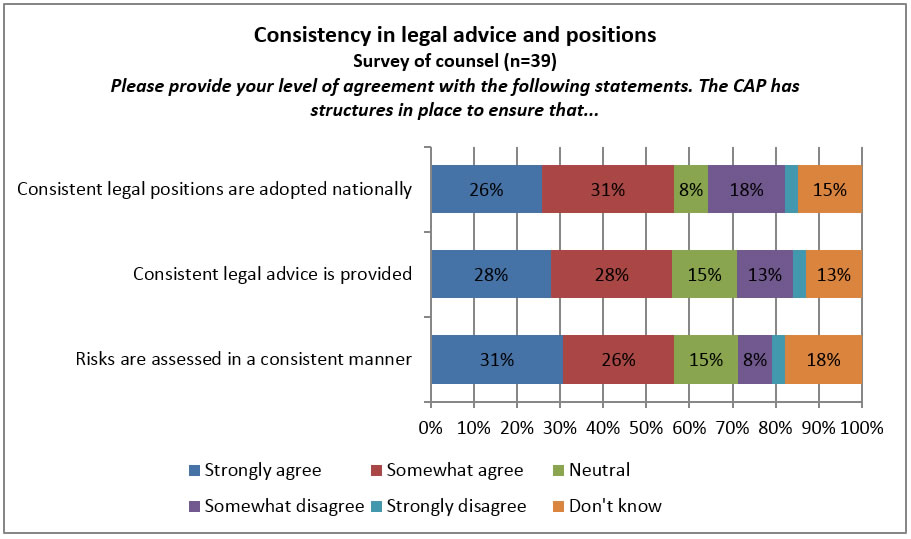
The survey with counsel conducted for the evaluation also indicates a somewhat muted view of the CAP structures for promoting consistency. While the majority (56%) believe the Portfolio has structures in place to ensure that risks are assessed in a consistent manner, that Justice provides consistent advice, and that consistent legal positions are adopted nationally, less than one-third strongly agreed and approximately one-sixth could not offer an opinion. Respondents disagreeing ranged from 10% (related to legal risks assessed consistently) to 21% (related to consistent national positions taken).
Figure 4: Consistency in Legal Advice and PositionsFootnote 41
Text Version: Figure 4: Consistency in Legal Advice and Positions
From the survey of counsel (n=39): Please provide your level of agreement with the following statements. The CAP has structures in place to ensure that...
A stacked bar graph shows the proportion of responses.
For the statement that consistent legal positions are adopted nationally:
- 26% of respondents strongly agree
- 31% somewhat agree
- 8% are neutral
- 18% somewhat disagree
- 3% strongly disagree
- 15% don’t know
For the statement that consistent legal advice is provided:
- 28% of respondents strongly agree
- 28% somewhat agree
- 15% are neutral
- 13% somewhat disagree
- 3% strongly disagree
- 15% don’t know
For the statement that risks are assessed in a consistent manner:
- 31% say strongly agree
- 26% somewhat agree
- 15% are neutral
- 8% somewhat disagree
- 3% strongly disagree
- 18% don’t know
4.4. Performance – Efficiency and Economy
This section considers the ability of the CAP to manage the cost and demand for legal services and the degree to which legal services provided are cost efficient.
Process Optimization Initiative
As part of the DRAP in 2012 and the Legal Services Review in 2014, the Department made commitments to manage the cost and demand for legal services, while still ensuring that the quality of legal services was maintained. Several process optimization measures were adopted to achieve the desired savings. These measures applied to both advisory and litigation services and were expected to result in a reduction of 72 FTE positions across the Department by fiscal year 2014-15. The CAP was initially expected to contribute with a reduction of five FTEs (four LP FTEs and one AS FTE) between 2012-13 and November 2014. However, with the need for additional human resources for the CLEL, the expectations for the CAP were revised to a reduction of four FTEs (three LP FTEs and one AS FTE).
The reduction of these positions was expected to be supported by the other process optimization initiatives — in particular, increased reliance on paralegals (estimated to account for 30% of savings) and more screening and prioritizing of client requests (estimated to account for 70% of savings). Table 6 provides a listing of the process optimization measures that are most relevant to the CAP.
Table 6: Process Optimization Measures (2012)
Advisory Services
- Screen and prioritize client requests
- Monitor files with more than two LPs
- Monitor files exceeding 75 hours
- Apply project management principles to major files
- Increase reliance on paralegals
Litigation Services
- Reduction of 4.5% in the average number of hours spent on files
- Use benchmarks for certain categories of files
- Apply project management approach to major files
- Negotiate level of services with clients early on
- Monitor files exceeding two LPs or 100 hours (reduce by 4.5% time spent on litigation files)
- Increase reliance on paralegals
Based on internal Portfolio reports and interviews, the Portfolio has done the following to meet its obligations under Process Optimization. While some of the efficiencies realized through the process optimization measures are quantifiable as detailed below, key informants specified that for some measures, quantifying the progress that has been made is challenging. Concerns also exist about how applicable the optimization strategies are in a largely non-litigation environment, and with central agencies where many issues are complex or where the number of lawyers in a LSU is small to begin with.
- Screen and prioritize client requests: In general, the Portfolio LSUs have begun screening requests to ensure that they relate to legal issues and that urgent requests are identified so they can be dealt with immediately. For example, the PSC LSU established a generic inbox for all client requests to allow for vetting and prioritizing. Approaches to screening requests are discussed at the CAP Directors meetings, which allow sharing of approaches and best practices. The Portfolio has also restricted its work in non-core legal areas to providing advice on Memoranda to Cabinet, TB submissions, and Budget matters. A few clients commented that they would like more clarity on when it is appropriate to involve the LSU, perhaps because of having work screened out as not a legal matter.
- Monitor files: Based on CAP documentation completed as part of the process optimization reporting exercises, the Portfolio actively monitored files with more than two LPs and with more than the set threshold in hoursFootnote 42. iCase reports of such files were prepared to allow LSU heads to confirm with their counsel that in these cases, roles were clear and counsel were making efficient use of their time. These reports were also discussed at CAP Directors’ meetings. In addition, the Portfolio’s monitoring of the level of effort spent on CAP files has resulted in efforts to reduce duplication of effort on litigation files and ensure that advisory time recorded on litigation files is limited to essential advice to support litigation counsel in conducting court actions efficiently. Portfolio iCase reports show a 3-5% reduction in average hours per file in the first two quarters in 2013-14 compared to the same period in the previous fiscal year.
- Use benchmarks for certain categories of litigation files: The Portfolio has begun to use benchmarking to examine the administration of financial transactions, such as assessing the time spent and costs of new transactions compared to previous similar transactions. CAP reports indicate that there may be some additional types of files that could benefit from benchmarking, such as applications for judicial review from the PSC. Counsel indicate that in most instances, benchmarking would be difficult to implement widely in the Portfolio due to the specificity of the litigation before administrative tribunals such as PSLREB and of labour and employment litigation.
- Apply project management to files: Using project management on files aligns with the Department’s Law Practice Model, where low-risk, low-complexity work is to be assigned to more junior counsel as a method to achieve cost savings. The Portfolio reports that it has assigned work based on seniority and expertise of counsel and the nature and complexity of the issue. This includes efforts to transfer lower-complexity files to more junior counsel and to give counsel at all levels increased independence (i.e., less supervision) in managing their files. The evaluation had difficulty verifying this with iCase data as most advisory, litigation and legislative files of CAP LSUs did not include a numeric risk or complexity level.
In addition, the Portfolio has undertaken other project management activities. It has made efforts to consolidate services for clients under specific counsel – to allow counsel to become more specialized in addressing requests for particular clients/issues and provide faster and more coherent services (e.g., on pensions, social policy, economic development, aspects of the FAA, etc.). The Department has provided project management training that CAP counsel have attended. According to Portfolio reporting, it has increased the number of files with project management plans in place. It has also increased its focus on best practices, including its creation of FAQs and reference documents for Justipedia and other databases and its efforts to standardize responses to client requests and to respond electronically to such requests.
Reflective of project management efforts to focus lawyers on legal work rather than non-legal services for clients, the non-legal time devoted to client files has declined by 31% over the time period covered by the evaluation. - Negotiate service levels with clients early on: Negotiating service expectations and seeking settlement mandates from clients early in litigation files is a method of ensuring that clients’ desired outcomes are achieved in an affordable manner. This process optimization measure aligns with a long-standing Justice Canada commitment to pursuing early resolution strategies that has included policy development, a commitment to training on effective DR processes, and tools to assist counsel (e.g., templates, toolkits, checklists). Portfolio reporting indicates that discussions are held with clients and/or opposing counsel to examine the possibility of early out of court settlement, when appropriate. For example, in all litigation matters dealing with human resources issues and administrative monetary penalties, when legal action is begun in a court or tribunal, the legal risks and likelihood of success as assessed by the litigation counsel are shared with the client. Given limited DR data in iCase, the evaluation could not confirm that this process improvement was occurring.
- Increase use of paralegals: The Portfolio reports efforts to increase reliance on paralegals. In particular, one paralegal position was created in the PSC LSU, two LSUs are discussing proposals to hire paralegals with clients, and other LSUs are making greater efforts to make “maximum use” of client-funded paralegal support – conducting preliminary research in advisory files and taking on preparatory tasks for litigation files. The evaluation could not confirm any increase in the use of paralegals because paralegals, as employees of the client departments and agencies, did not record their time in iCase prior to the coming into force of the revised National Timekeeping Protocol in July 2015. However, based on the survey with counsel, this remains an area for improvement. Counsel who had worked with paralegals were evenly divided between those who reported that paralegals were used to their full potential in at least half of the files they had been involved with in the last two years (n=14) and those who reported this occurred in less than half of their files (n=12).
As indicated above, the CAP’s target was to reduce its FTE complement by four (three LP FTEs and one AS FTE).Footnote 43 This was achieved through the process optimization measures taken by the Portfolio. Further, as noted in Section 2.3, the Portfolio realized a net reduction of an additional 0.8 LP FTE over the entire period covered by the evaluation.
Staffing and Ability to Meet Demand
The decrease in staff has not compromised the Portfolio’s ability to meet its demand. Generally, key informants thought that the Portfolio has the capacity to meet demand, but some of the LSUs that had experienced decrease in staffing were thought to be stretched thin (e.g., the TB). That being said, the CAP and client key informants believe that the stability of staff has countered the slightly lower staffing levels. However, a potential future risk is losing this stability as counsel perceived opportunities for promotion as limited. Results from the PSES indicate potential issues regarding promotional opportunities and appropriate compensation of employees. In all three survey years, a much greater percentage of CAP respondents disagreed than agreed that they had opportunities for promotion within their department or agency, given their education, skills and experience. More specifically:
- in 2014, 30% agreed, whereas 57% disagreed;
- in 2011, 27% agreed while 54% disagreed; and
- in 2008, 31% agreed while 55% disagreed.Footnote 44
The Centre of Labour and Employment Law
The creation of the CLEL was part of the DRAP, and while the operations of the CLEL itself are beyond the scope of this evaluation, it is important for the evaluation to recognize the CAP responsibility and results for this initiative. As mentioned in Section 2.2.2, the CLEL is co-located with the TBS LSU. Reports on CLEL operations indicate that regular collaboration is maintained between the CLEL and the TBS LSU, and that this collaboration helps to ensure that consistent advice is provided, duplication of work is avoided, and appropriate resources are identified to address labour and employment law (LEL) issues. In addition, CAP undertook the development and establishment of the CLEL in a number of ways, including: consideration of model options for the CLEL; establishment of protocols detailing the role and work of the CLEL; and development of guidelines for LSUs on when to consult the CLEL.
The CLEL is intended to facilitate work being carried out related to LEL, and to achieve efficiencies in this work. Efficiencies are expected to result from the following CLEL activities:
- developing practice directives and position papers on emerging trends and Justice-wide issues;
- assisting counsel across Justice on specific files by providing expertise on LEL (the CLEL primarily supports LEL work carried out by “excluded” practitioners across Justice, which include counsel from LSUs, regional offices, and other areas of Justice) to better enable counsel to advise clients on matters stemming from the “employer” function carried out by deputy heads;
- providing training and development opportunities on recurring issues and trends in LEL; and
- developing information tools, knowledge-sharing tools and resources (including enhancing LEL material available through Justipedia), and practice tools related to recurring LEL issues.
As of March 31, 2015, the CLEL had succeeded in:
- assisting Justice counsel on requests above estimated targets for this activity;
- updating tools, resources and opinions, and reorganizing areas of Justipedia related to LEL (with links to LEL practice tools);
- hosting an LEL Forum involving over 90 participants;
- developing a process for identifying emerging issues and achieving collaboration among those practicing LEL; and
- reducing time spent on LEL issues by counsel outside the TBS LSU.
The next evaluation of the CAP should be able to include a more detailed assessment of the CLEL’s contribution to efficiency and economy for the Department when it comes to work on LEL issues.
Overall Achievements
While some of the process optimization measures cannot yet be measured for their impact, evaluation findings indicate that the Portfolio has taken several steps to maximize the achievement of results while minimizing the use of resources.
- Date modified: