
Overview of the centres of expertise
2.1 Background of the Centres
Throughout the history of Justice, Centres have been established to adapt to the ever-evolving needs of the Department and to respond to client demand. As part of the legal advisory services function, the Centres are intended to provide integrated services, new ways of working, and a whole-of-Justice approach as part of the Department’s vision. This single-window approach to service brings together talent to maximize expertise in a specific area of the law and provides consistent and effective legal advice to client departments and agencies.
There are different historical origins and timelines of the Centres, such as HRLS, OLAD, and CAILS, which have roots that span more than 30 years, while other Centres like ALC, CLS, and CIPL have been established in the more medium term. The two newest Centres, CoEPL and CLEL, were recently established in FY 2017-2018.2
While each Centre has a unique design and service delivery model, they all share the goal of providing a high-level of legal expertise in specific areas of the law. The fundamental rationale behind these Centres is that certain areas of the law can reasonably be expected to affect every client department and agency. For instance, regardless of their specific mandate, all client departments and agencies may face legal issues related to procurement and commercial activities, labour and employment, access to information and privacy, human rights, or official languages. All client departments and agencies must also operate within the parameters set by the Constitution, and they must consider Aboriginal law. Some Centres also offer expertise that supports the policy work that is directly undertaken by Justice or in collaboration with other federal partners as applicable. The Centres are therefore expected to provide a single-window approach to service, which brings together talent to maximize expertise in these areas of the law and to deliver services more efficiently and consistently.
2.2 Mandate and Areas of Expertise
Each Centre has a specific mandate, which outlines its areas of expertise and the types of services that it provides to its various stakeholders. It acts as a guide for when to engage with a Centre when it is determined that a need exists. Table 3 briefly describes the mandates and areas of expertise of the eight Centres, although it is important to emphasize that these descriptions are not exhaustive as a series of exceptions may apply in some cases.3
Mandate |
Areas of expertise |
|---|---|
CLEL |
|
The Centre provides legal advice, including legal policy advice, related to labour and employment law directly to client departments and agencies on matters stemming from their deputy head’s direct or delegated functions as employer. Its role relates to legal advice prior to the referral of a complaint or grievance for hearing or prior to the filing of an action. In addition, the CLEL provides litigation support as needed. It also focuses on providing whole-of-government expert legal advice by engaging in a variety of knowledge management and outreach activities, identifying issues and trends, cross government opinions, training, and presentation events for clients and Justice sectors. |
|
CLS |
|
The Centre focuses on providing whole-of-government expert legal advice in corporate and commercial law, intellectual property (IP), information technology, and federal real property, including federal immovables. It also prepares professional development resources, such as guidance documents, practice tools, training events, informally collaborates with other Justice units on various files; and assists counsel on horizontal issues, as available resources allow. |
|
ALC |
|
The Centre focuses on providing whole-of-government expert legal advice related to the interpretation and application of Section 35 of the Constitution Act, 1982 and Subsection 91(24) of the Constitution Act, 1867. It takes into consideration the intersection of Indigenous and international law and works on Indigenous legal policy files representing the most significant risks and opportunities to the federal government. Its mandate recently expanded to include the negotiation of administration of justice as part of self-governance agreements with Indigenous groups. The Centre also provides litigation support as needed and engages in a variety of knowledge management and outreach activities. |
|
CIPL |
|
The Centre provides expertise related to the interpretation of the Access to Information Act (ATIA) and the Privacy Act (PA). It is responsible for supporting the Minister’s statutory obligations under these two legislation, including legislative and regulatory reforms. In fulfilling this mandate, the CIPL is expected to provide legal advice on complex issues related to Access to Information and Privacy (ATIP) law, play an enhanced role in litigation support (i.e., assist in the development of the Attorney General of Canada’s position in all litigation involving the ATIA and the PA), and provide a policy role with respect to ATIP law and policy reform. The Centre also promotes tools, training and supports practice groups, in addition to monitoring and reporting on trends in ATIP legal work. |
|
CAILS |
|
The Centre provides expertise in constitutional, administrative, Crown, public international, and international private law. Its work covers legal advice, including legal policy advice and litigation support, as well as policy development work involving international private law in four broad areas: international commercial law, judicial cooperation and enforcement of judgements, family law and child protection, and protection of property. |
|
HRLS |
|
The Centre provides specialized legal advice, including legal policy advice and litigation support, on matters related to the Canadian Charter of Rights and Freedoms (the Charter), the Canadian Human Rights Act, and the Canadian Bill of Rights, as well as Canada’s international human rights obligations. It also has a unique role, with the Legislative Branch, in advising the Minister of Justice in the exercise of his statutory responsibilities to examine government bills and proposed regulations for consistency with the Charter and the Canadian Bill of Rights. The HRLS is also responsible for preparing Charter statements for government bills. A Charter statement is a document that identifies the provisions of a bill that may potentially affect rights and freedoms guaranteed by the Charter. The Minister of Justice has a statutory obligation to table in Parliament a Charter statement for every government bill introduced in the House of Commons or the Senate. In addition, the Centre covers a broad range of human rights policy issues, including matters relating to the Canadian Human Rights Act, such as mandatory retirement, hate speech, genetic discrimination, and religious accommodation. Finally, the Centre is responsible for international human rights law, primarily the domestic implications of treaty obligations, and responds to individual petitions to international bodies. |
|
OLAD |
|
The Centre provides legal advisory services with respect to language rights and policy, international Francophonie, and access to justice in official languages. Its work covers legal advice, including legal policy advice and litigation support, as well as policy development work involving official languages in accordance with the Canadian Constitution, the Official Languages Act, other legislation covering official language rights, and any other program or initiative related to official languages in Canada or the international Francophonie. |
|
CoEPL |
|
The Centre provides procurement legal advice related to the process of acquiring goods, services or construction, generally related to the pre-contractual, contracting, or contract administration phases. It also provides legal advice in the context of litigation for claims and Judicial Review applications brought before the court as they relate to procurement; the conduct of procurement complaints before the Canadian International Trade Tribunal, excluding oral hearings; and legal advice in the context of Reviews and Investigations conducted by the Office of the Procurement Ombudsman, the Office of the Auditor General, the Parliamentary Budget Officer or other overseeing bodies. |
|
2.3 Nature of Work
2.3.1 Types of Work
The Centres provide a range of services to client departments and agencies, legal services units (LSUs), National Litigation Sector (NLS), and other areas within Justice based on their specific mandates and service delivery models. The following are types of work the Centres may offer:
Legal advice: The most common element of the work undertaken by all Centres concerns the provision of legal advice. This legal advice may relate to specific cases or circumstances faced by a client department or agency (e.g., potential lawsuit, complaint, contractual issues, etc.). In addition to providing legal advice in general, Centres may also provide:
- Legal policy advice: Many Centres (ALC, CAILS, CIPL, CLEL, HRLS, and OLAD) provide legal policy advice in the context of policy support when a new policy or program is under development, or work related to a new regulatory or legislative initiative. This may involve, for example, legal policy advice in areas such as workplace harassment or violence, cross-cutting Indigenous issues (e.g., United Nations Declaration on the Rights of Indigenous Peoples, Section 35, etc.) or key human rights issues such as discrimination on the grounds of age, gender, or religion.
- Litigation support: Another important function of the Centres is to support legal counsel conducting litigation activities, by providing the expertise required to address specific legal issues. Some Centres, namely CoEPL and CAILS, also engage in some form of direct litigation activities, in accordance with their specific mandate. Finally, OLAD is responsible for coordinating the position of the Attorney General on all litigation issues involving official languages.
Policy work: Five of the Centres (ALC, OLAD, HRLS, CAILS, and CIPL) also engage in some form of policy work. This may include policy development related to government-wide initiatives (e.g., responses to the Truth and Reconciliation Committee’s Calls to Action), legislative reforms led by Justice (e.g., amendments to the PA, or where Justice plays a central role along with other client departments or agencies (e.g., modernization of the Official Languages Act).
Knowledge management and outreach activities: As part of their ongoing activities and mandates, each Centre contributes to knowledge transfer and sharing of information. To maximize the benefits and impact of this work, the Centres develop various knowledge sharing products (new entries in Justipedia, newsletters, one-pagers, etc.) and engage in outreach activities (conferences, practice groups, training sessions, etc.).
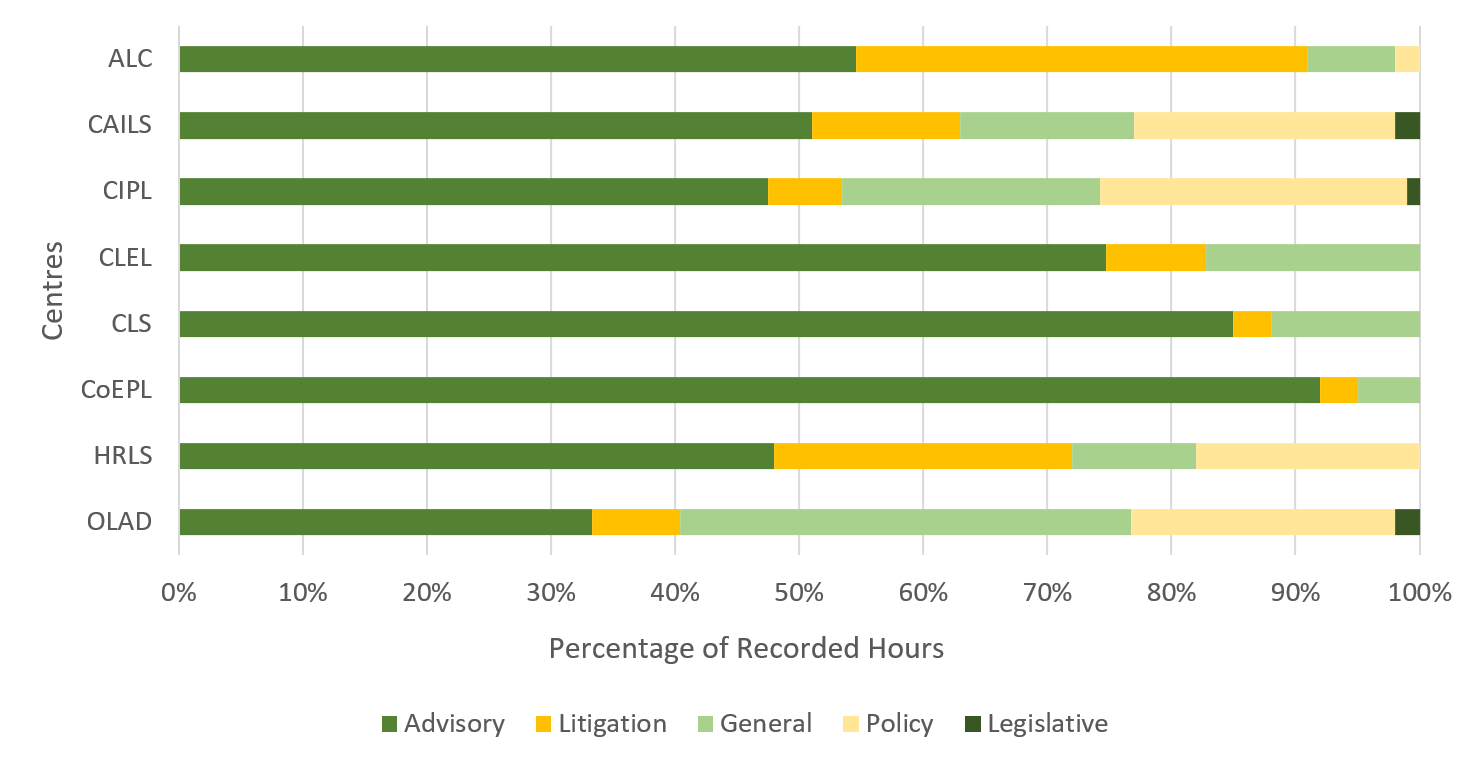
Figure 1 provides an overview of the percentage of time that the eight Centres dedicated to different types of work (excluding corporate files)4 between FY 2015-2016 and FY 2019-2020. Note that the manner in which time is recorded in iCASE/LEX does not align exactly with the categories of work provided above. For instance, although litigation support may reflect a form of legal advice, it is coded separately in iCASE/LEX, and legal advice related to legislative work provided by Centres (which might be considered an aspect of legal policy advice) is recorded to legislative files in iCASE/LEX. However, Figure 1 provides a broad overview, in approximate terms, of the percentage of time that the Centres dedicated to different types of work.5
In general, the types of work for which Centre support is sought may vary based on their mandates and the specific areas of law covered. As illustrated in Figure 1, the mandates of CLEL, CLS, and CoEPL exclude policy work. As a result, their work is highly concentrated in providing legal advice. ALC and HRLS spend a greater proportion of their time in the context of litigation support, relative to other Centres. As for the general category, it is largely assigned to various knowledge sharing and outreach activities (e.g., training, publications, practice groups, etc.).
Figure 1: Distribution of recorded hours, per type of service, FY 2015-2016 to FY 2019-2020
Text version
| Centre of Expertise | Advisory | Litigation | General | Policy | Legislative | Total |
|---|---|---|---|---|---|---|
| OLAD | 33% | 7% | 36% | 21% | 2% | 99% |
| HRLS | 48% | 24% | 10% | 18% | 0% | 100% |
| CoEPL | 92% | 3% | 5% | 0% | 0% | 100% |
| CLS | 85% | 3% | 12% | 0% | 0% | 100% |
| CLEL | 74% | 8% | 17% | 0% | 0% | 99% |
| CIPL | 48% | 6% | 21% | 25% | 1% | 101% |
| CAILS | 51% | 12% | 14% | 21% | 2% | 100% |
| ALC | 54% | 36% | 7% | 2% | 0% | 99% |
Note: Data for CoEPL and CLEL cover three FYs, whereas the data for all other Centres over five FYs.
Notes:
- CLEL and CoEPL were not established until FY 2017-2018 and are therefore excluded from the first two FYs of the evaluation period.
- The source of this data is iCASE/LEX.
While the overall trends reported in Figure 1 appear largely accurate, the evaluation confirmed that a number of challenges persist in monitoring the type of work undertaken by the Centres. The parameters of iCASE/LEX, the inconsistencies within and among the Centres in how hours were recorded, and gaps in file-related information provided by LSUs or other areas within Justice all contributed to some of the shortcomings in the accuracy of the data reported6.
2.3.2 Service Delivery Models
The Centres typically undertake a series of work processes when a request is received. The following phases outline these work processes from intake to the completion and dissemination of the legal advice (see Appendix A for each Centre’s process maps). This description does not cover policy work, which follows standard policy development processes.
Phase 1 - Request is made to the Centre: When there is a need to seek legal advice from a Centre, requests can be made from various stakeholders, which may include legal counsel in LSUs, NLS or other areas within Justice as well as client departments or agencies. Requests can be made through a variety of ways but most commonly by email or telephone call. The one exception is CoEPL whereby a specific request form must be completed and submitted to a generic mailbox. Based on the specific service delivery model, requests can be submitted either to the management of the Centre or directly to legal counsel.
Phase 2 - Request is reviewed and work is assigned: Once a request is received, the information is reviewed to determine whether the request falls within the mandate of the Centre and clarifications may be sought as required. In cases where legal counsel received a request directly, they will often handle it themselves, although they may refer the file to a colleague or to management to assign as necessary. In cases where management receives the request, they will assign and allocate work to legal counsel within the Centre based on various factors such as expertise, availability, complexity of legal advice, timelines, etc.
Phase 3 - Work processes for completing a request: The work involved in responding to a request for legal advice varies, but may include: fact-finding (through a document review or discussions with the requester), legal research, consultations with colleagues and/or other areas of Justice, review of legal advice/work from stakeholders (e.g., LSUs), drafting legal advice, including legal transactions, and where appropriate a legal risk assessment or likelihood assessment.
Phase 4 - Quality assurance: Various quality assurance activities are used to support the consistency and high-quality legal advice provided. Particularly for more complex or higher risk files, the legal advice may be reviewed by senior counsel, management of the Centre, LSU heads or the Assistant Deputy Minister responsible for the Centre.
Phase 5 - Communication, storage, and knowledge sharing: Once completed, the legal advice is provided to the requesters (i.e., legal counsel in LSUs, NLS or other areas within Justice as well as client departments or agencies). Some legal advice is formal in nature; however, it is typically communicated more informally through an email, or verbally. In the latter case, a follow-up email or memo is normally sent to confirm what has been communicated verbally. The information is then stored within the Centre, and may also be saved in other tools such as Justipedia or LEX.
2.4 Structure of the Centres
The manner in which a Centre is organized provides a framework for how it operates. Among the eight Centres, each structure is unique given their individual governance, reporting, funding model, capacity, and location. The structure can have an impact on how stakeholders engage with the Centre, work is distributed, and how decisions are made; however, all Centres strive to achieve the same goal of providing timely, high-quality, and consistent legal advice.
The following highlights some of the key features that shape the organizational structure of each Centre:
Portfolios and Sectors
Four of the Centres (i.e., CAILS, HRLS, CIPL, and OLAD) fall under PLLSS, two of the Centres (i.e., CLEL and CoEPL) fall under the BRLP, while the ALC is located under AAP, and the CLEL is located under CAP.
Co-location with LSUs
Two Centres are co-located with a LSU. The CLEL is co-located with the LSU assigned to the Treasury Board Secretariat and the CoEPL is co-located with the LSU assigned to Public Services and Procurement Canada (PSPC) and Shared Services Canada (SSC). All other Centres operate without being co-located with a LSU.
Financial Models
Two Centres (CLEL and CoEPL) operate with a cost-recovery funding model, while all other Centres operate with an A-Base funding model.
Human Resources
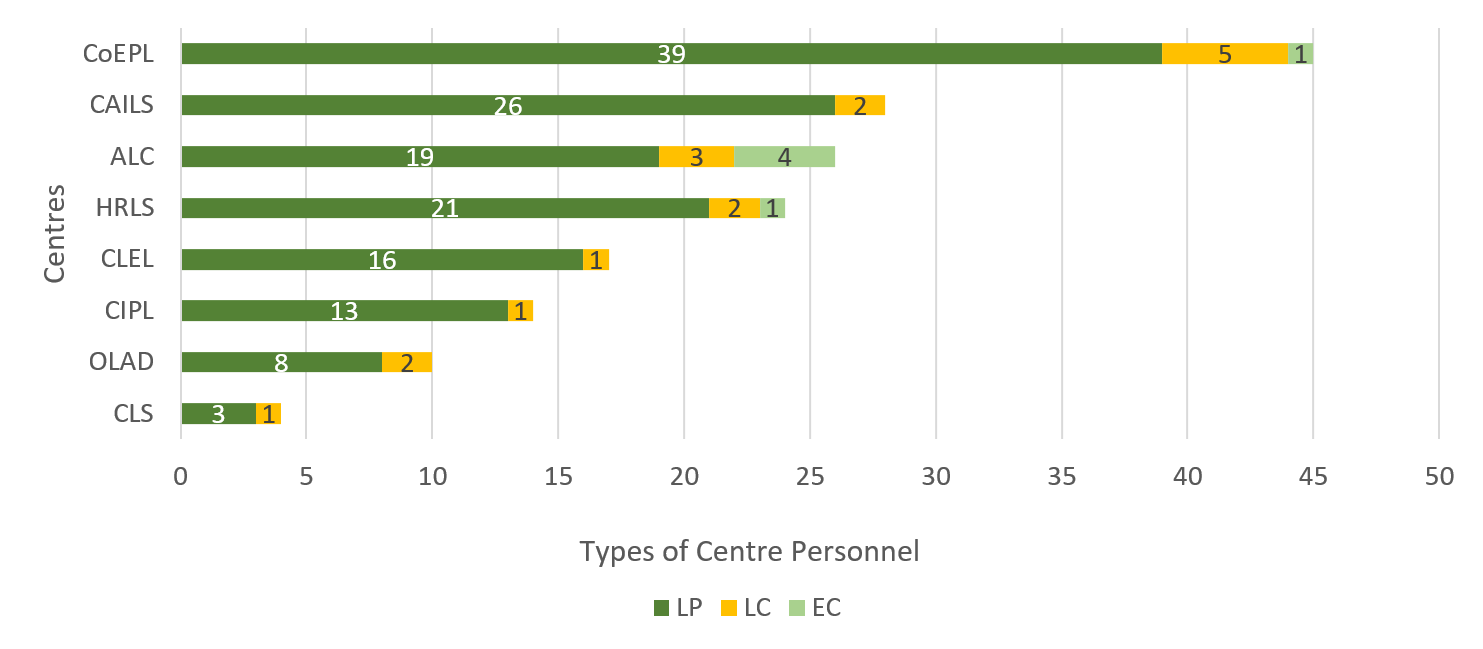
Centres vary in size, with CoEPL being the largest and CLS the smallest in FY 2019-2020 (see Figure 2). The staffing models and overall organization of personnel also differ among Centres with some organized based on type of work (i.e., advisory, litigation support, and/or policy), while others are based on areas of expertise, client department or agency portfolio, or other factors.
Figure 2: Number of legal counsel and paralegals in the Centres FY 2019-2020
Text version
| LP | LC | EC | Total | |
|---|---|---|---|---|
| CLS | 3 | 1 | 4 | |
| OLAD | 8 | 2 | 10 | |
| CIPL | 13 | 1 | 14 | |
| CLEL | 16 | 1 | 17 | |
| HRLS | 21 | 2 | 1 | 24 |
| ALC | 19 | 3 | 4 | 26 |
| CAILS | 26 | 2 | 28 | |
| CoEPL | 39 | 5 | 1 | 45 |
Notes:
- Figure 2 includes LP, LC, and EC personnel only. Some Centres also have other administrative and support personnel who reflect a small portion of their overall full time equivalents (FTEs); however, they are not reflected here.
- The source of this data is Integrated Financial Management System (IFMS)/PeopleSoft.
2.4.1 Financial Resources
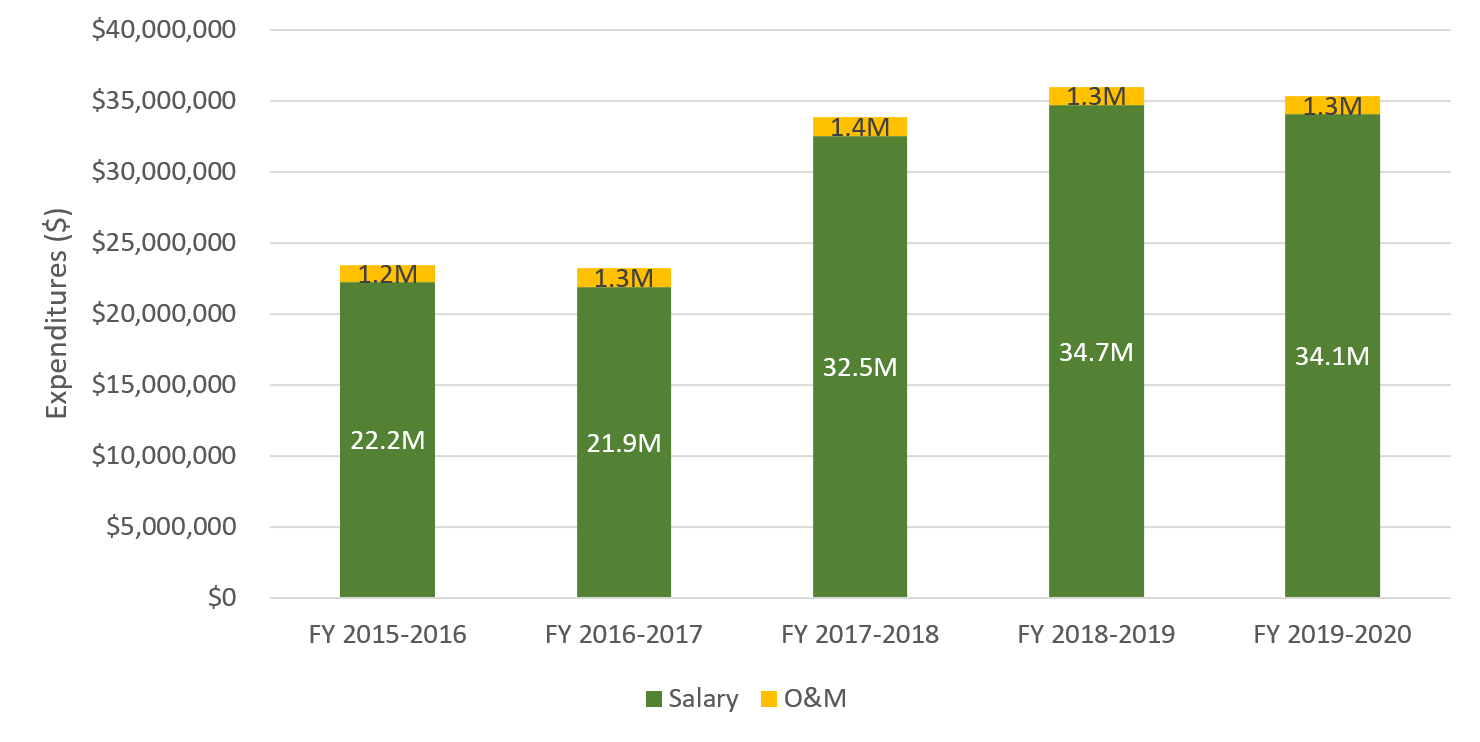
During the period covered by the evaluation, the total amount of resources that Justice invested in the Centres has increased, in large part to accommodate for the creation of two new Centres in FY 2017-2018 (i.e., CoEPL and CLEL). Overall expenditures (salary and operations and maintenance [O&M]) have remained relatively stable over the last three FYs of the evaluation period. Figure 3 provides further details on the allocation of these resources. In FY 2019-2020, the total salaries for all Centres came to $34.1 million, representing approximately 5.4% of what Justice spent that FY on personnel.7
Figure 3: Total Centre expenditures, FY 2015-2016 to FY 2019-2020
Text version
| FY 2015-2016 | FY 2016-2017 | FY 2017-2018 | FY 2018-2019 | FY 2019-2020 | |
|---|---|---|---|---|---|
| Salary | $ 22,227,328.39 | $ 21,890,389.08 | $ 32,520,086.42 | $ 34,734,339.80 | $ 34,074,461.53 |
| O&M | $ 1,214,615.58 | $ 1,319,762.94 | $ 1,374,632.00 | $ 1,251,990.13 | $ 1,289,807.96 |
| Grand Total | $ 23,441,943.97 | $ 23,210,152.02 | $ 33,894,718.42 | $ 35,986,329.93 | $ 35,364,269.49 |
Notes:
- Expenditures represent direct operating costs for the Centres (i.e., internal services and other costs are excluded).
- Salary includes 20% Employee Benefit Plan rates.
- CLEL & CoEPL were not established until FY 2017-2018 and are therefore excluded from the first two years of the evaluation period.
- CoEPL O&M expenditures are not included in Figure 3 given CoEPL’s O&M funds are centrally managed by PSPC LSU. Each FTE is allocated $2,200 in O&M. However, specific expenditures for PSPC LSU and CoEPL are not tracked separately and, as such, cannot be represented here.
- The source of expenditures is from IFMS.
Footnotes
2 Centres may have existed in other forms prior to being established as the Centres they are now within Justice.
3 CoEPL, CLEL, and OLAD have exceptions included within their mandates for specific client departments and agencies.
4 Note that Figure 1 excludes time spent on corporate files (e.g., administrative, personal training, other ‘non-legal’ time), which was not included as part of this analysis.
5 The National Timekeeping Protocol provides definitions on the following file types: (1) ‘advisory’ refers to recorded time spent responding to a request for advice, excludes advice provided on litigation and/or legislative/regulatory drafting activities; (2) ‘litigation’ refers to recorded time spent on matters relating to the conduct of litigation of any kind, with an anticipated or actual appearance before a court, tribunal or board. This type also comprises files opened for litigation support work; (3) ‘general’ refers to recorded time spent on non-legal matters; and, (4) ‘legislative’ and ‘policy’ refers to recorded time spent on legislative/regulatory activities, the development and implementation of policies, programs, special initiatives and projects in support of Justice mandate and objectives. This type also comprises files opened for drafting support work.
6 Several Centres have identified that some aspects of their work might be under-represented as a result of coding issues in iCASE/LEX. For example, OLAD indicated that their policy and advisory work may have been under-represented in the data (being coded as general work instead). In addition, several Centres (ALC, CIPL, and HRLS) indicated that there may be an under-representation of policy work that may have been coded in other categories. Finally, CLS and CAILS suggested that there may have been some under-representation of the knowledge management activities, which should generally be coded under the general file, but may have been coded elsewhere.
7 The total amount spent by Justice on personnel comes from the GC InfoBase found at https://www.tbs-sct.gc.ca/ems-sgd/edb-bdd/index-eng.html
- Date modified: