
VI Child forensic interviewing
6.1 Evidence-based child forensic interviewing
Since the last writing of this report, an abundance of interview protocols, frameworks, and guidelines have been developed to respond to the understanding that what children are willing and able to tell us is profoundly influenced by how we elicit their information (Brubacher, Peterson, La Rooy, Dickinson, & Poole, 2019; Lyon, 2014; Poole, 2016; Poole & Lamb, 1998; Saywitz, Lyon, & Goodman, 2017; Wilson & Powell, 2012). These guidance documents have also been created in an attempt to minimize the wide disparities in how children are questioned across jurisdictions (e.g., Brubacher et al., 2018) and because the use of an interview structure is associated with better legal outcomes (Pipe et al., 2013).
When questioners provide children with the socioemotional support and the opportunity to share what they remember at their own pace, in their own words, children’s testimony can be accurate and informative. Despite different origins, most contemporary interview guidance has converged on some key interview phases and principles–those that are most supported by the research literature (i.e., evidence-based; Brubacher & Powell, 2024; Korkman et al., 2024; Steele et al., 2025). An evidence-based child forensic interview typically consists of the following components: introductory phase (with brief explanation of roles and room set up, ground rules, and narrative practice), transition to the topic of concern, substantive phase where children are encouraged to provide a narrative of the event in response to predominantly open-ended questions, a break, follow-up questions to allow interviewers to ask for any specific information that may have been omitted during the narrative account, and a respectful closure.
Some of the most widely adopted child interview guidelines include the American Professional Society on the Abuse of Children (APSAC) Guidelines (2023); Achieving Best Evidence (ABE) in Criminal Proceedings (Ministry of Justice, United Kingdom, 2022); the standard National Institute of Child Health and Human Development (NICHD) protocol and revised version (Orbach et al., 2000; Lamb et al., 2007, 2018), the Ten Step Investigative Interview (Lyon, 2005); the National Children’s Advocacy Center’s Forensic Interview Structure (2019); The SIM (Powell & Brubacher, 2020); The Step-Wise guidelines (Yuille, Cooper, & Hervé, 2009); RADAR (Everson et al., 2022); and Developmental Narrative Elaboration (Saywitz & Camparo, 2014). The Cognitive Interview (CI) also includes some guidance for interviewing children, although it was initially developed for adults (see Cyr, 2022).
In advance of describing the interview phases, it is necessary to outline the various question types that are used in interviews because they have different effects on the accuracy and completeness of children’s responses.
Question types. Definitions and terminology for question types vary across research literatures and guidance documents. As such, we outline the definitions and terminology that we have adopted. With respect to interviewing children, questions are commonly grouped into three categories: open-ended, wh-, and closed. Any question type can be leading if it includes information not previously provided by the child.
Open-Ended Prompts
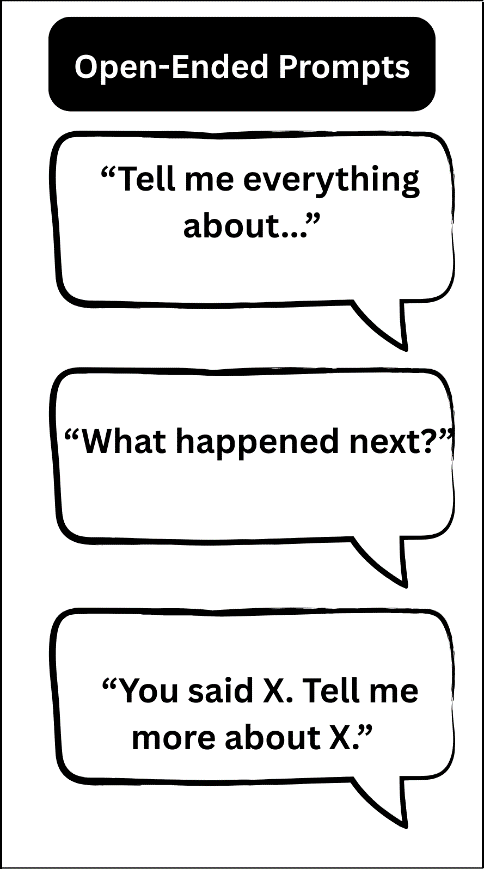
Text version
The image provides examples of the three types of open-ended prompts to be used by interviewers when interviewing children. The questions can either be 1) Initial/First, 2) General/Follow up, or 3) Cued invitations. The image is in the shape of a rectangle in a vertical position. Under the title, it contains three speech bubbles. The first bubble says, “Tell me everything about…” The second bubble says, "What happened next?” The last bubble says, “You said X. Tell me more about X.”
Questions categorized as open-ended encourage elaborate and flexible responses, allowing the interviewee to choose what information to report (Powell & Snow, 2007). There are three main types of open-ended questions. Initial (or first) invitations are the first prompt to invite the child’s narrative of an event or instance of a repeated event, such as “Tell me everything that happened at the dance, start from the beginning.” Breadth prompts invite children to provide more event components (e.g., “What happened next?”, “What else happened?”). They are also known as General (or Follow-up) invitations (Lamb et al., 2003), although this term also encompasses a wider variety of open-ended questions. Depth prompts invite children to elaborate on details they have already mentioned (e.g., “You said X. Tell me more about X”, “What happened when X?”); also known as cued invitations (Lamb et al., 2003). These subtypes have different functions and elicit different kinds of information (Danby, Sharman, Brubacher, Powell, & Roberts, 2017; Feltis et al., 2010; Lamb et al., 2003).
Wh- questions have the longest list of varying terminology (e.g., direct, directive, focused, cued recall, interrogative) and are perhaps the most contested of the question types in terms of their value. While open-ended and closed questions comfortably occupy the “ideal” and “non-ideal” ends of the question type spectrum, wh- questions fall in the middle, but experts disagree on whether they are more like open-ended or more like closed questions. The wh- questions include who, when, where, why, how, and narrow “what” questions like “What colour was the man’s hair?” Like open-ended questions, wh- questions need to be answered with recall rather than recognition memory. This means that children must produce a response to answer wh- questions, making children less likely to guess compared to recognition questions that present options from which to choose (Waterman et al., 2000). However, recent research demonstrated that if children possess the domain knowledge queried by a wh- question, there is a greater risk they will guess (McWilliams et al., 2021). For example, children would be more likely to guess the answer to, “What colour was the man’s car?” than “What was the model of the man’s car?” (further discussed in Section 3.2).
Closed questions are ones that do not invite lengthy responses, narrowly restrict the content of children’s responses, and are prone to guessing (Brown et al., 2013; Klemfuss, Quas, & Lyon, 2014; Lamb et al., 2003; Powell & Snow, 2007; Waterman et al., 2001). Yes/no and other option posing questions (which present two or more options other than yes/no) are closed questions. They are also considered recognition questions because they offer answers from which children can pick rather than requiring memory retrieval. Although yes/no and option-posing are both types of closed recognition questions, research has illuminated different responses patterns between the types. For example, researchers have identified biased “yes” responding (Peterson & Grant, 2001) and biased “no” responding (Peterson & Biggs, 1997) among preschoolers asked yes/no questions. There is some evidence that young children are less likely to say “I don’t know” to yes/no compared to option posing questions; however, this may rely on whether or not any presented option is true. Peterson and Grant (2001) found that 3- to 5-year-olds rarely said, “I don’t know” to yes/no questions, but did sometimes use this response to option-posing questions where neither choice was correct (e.g., “Did the woman wear a baseball hat or a flowered hat?” when a straw hat was worn). In this same age group, a recency-tendency was observed to option-posing questions (i.e., choosing the last-presented option), although this tendency decreased with age (Mehrani & Peterson, 2015). Forensic interviewers sometimes use a “something else” option to account for the possibility that neither presented option was correct (e.g., “A baseball hat, a flowered hat, or something else?”). Although this addition does reduce the chance that the question is misleading, it does not enhance preschool children’s accuracy (London et al., 2017; Stolzenberg et al., 2017). In general, when the “something else” option is the correct choice, children choose it only around one-third of the time (i.e., at chance levels). And when they do choose it, they are then presented with a follow-up wh- question (e.g., What kind of hat?”), which they may succeed in answering only about half the time (London et al., 2017).
Open-ended questions are widely considered the best question type for all interviews because, compared to other types, these questions tend to elicit longer and more accurate responses, reduce opportunity for interviewer bias, maximize credibility, and make interviewees feel heard (Brubacher, Timms, Powell, & Bearman, 2019; Powell, 2013). Children’s ability to answer open-ended questions improves with age (Poole & Lindsay, 2001), but even preschoolers can provide narrative details in responses to such questions (Lamb et al., 2003).
Benefits of open-ended questions
Open ended questions…
- improve the quality and informativeness of children’s information.
- tend to elicit more accurate responses because they allow the interviewee to choose what to report.
- minimize the influence of interviewer bias, compared to specific questions (wh- and closed) that seek what the interviewer wants to know.
- allow interviewees to report in their own words, at their own pace, and in the order in which they feel most comfortable or remember best.
- maximize credibility because the responses are primarily interviewee-driven.
- make interviewees feel heard and valued.
- make transparent the interviewee’s communication level (compared to closed questions, which can hide miscomprehension).
- create opportunities for the interviewee to provide a narrative account of their experiences and reveal information the interviewer may not think to ask about.
- put less cognitive strain on interviewers, who can focus on listening instead of thinking about the next question they need to ask.
(Brown & Lamb, 2015; Brubacher et al., 2019; Lamb et al., 2007; Powell, 2013, 2020)
Wh- questions are less desirable than open-ended questions because they do not encourage narrative detail, and they constrain the child’s report to what the interviewer wants to know rather than supporting the child to provide an account in their own words. In general, interviewers should try to minimize these questions until the child’s narrative has been exhausted; an exception may include when interviewing very young children (Hershkowitz et al., 2012). Preschoolers may struggle with very broad open-ended questions, such as invitations. Interviewing experts have recommended that concrete wh- questions (who, what, where) may be paired with open-ended requests for elaboration when interviewing the very young (e.g., Interviewer: “Where did you go first?” Child: “The toy store.” Interviewer: “Tell me what happened at the toy store.”). Closed questions are the least desirable question type because of the ease with which they lend themselves to guessing and thoughtless responding, but they may be needed to verify information (e.g., “I heard you told your mom something bad happened. Did you tell your mom…?; Brubacher & Powell, 2024).
Another way that interviewers can encourage more information while remaining as input-free as possible is to use minimal encouragers (also known as facilitators, backchannel utterances, and “still-your-turn” responses). These are verbalizations such as, “Uh-huh,” “mmm-hmm,” repetition of the child’s last few words, and non-verbal encouragements such as head nodding (Hershkowitz, 2002; Poole, 2016). Minimal encouragers communicate to the child that the interviewer is listening, and the child should continue speaking. To be used effectively, they should occur alone (i.e., not coupled with a question, such as, “Mmm-hmm, then what happened?,” as they are no longer “minimal”), and following open-ended questions but not other types (Hershkowitz, 2002). Silence (or “wait time”) is also an effective method to encourage children to keep narrating. In a laboratory study with 105 4- to 8-year-olds, interviewers paused up to 10 seconds after a child’s response and before asking the next question (Rezmer et al., 2020). Doing so yielded new information during the period of silence from 90% of the children. Silence is highly effective during the interview because children need increased time to process questions and retrieve memories. Among maltreated children, it is also likely that they may spend time weighing the consequences before providing an answer.
Providing socioemotional support. Socioemotional support from the interviewer can include non-verbal behaviours such as non-intrusive eye contact, open seating posture, warm tone of voice, casual dress, comfortable environment (soft rooms), and smiling when appropriate. Socioemotional support is also delivered through verbal and para-verbal behaviours, including minimal encouragers, occasional use of the child’s name, and praising the child for effort (not content of responses).
From the beginning to the end of the interview, interviewers should provide socioemotional support to build and maintain rapport, and to repair it when it breaks down (Blasbalg et al., 2021). Rapport has been defined in many ways in forensic and clinical interviewing literatures. It can be conceptualized as creating a comfortable atmosphere for the child and interviewer, such that children are willing to cooperate, trust the interviewer, and share their experiences (Saywitz et al., 2015). Rapport should be established early, through a series of preparatory activities described in the next section. Supportive behaviours should be present in these early phases and continue throughout the interview. While it was once believed that providing socioemotional support could increase children’s suggestibility and desire to please the interviewer, it is now understood that non-contingent support is unlikely to have negative effects (Saywitz et al., 2019). Non-contingent support is that which is delivered continuously, regardless of children’s responses and behaviours. Socioemotional support may improve accuracy; however, its effects appear to be greatest on specific and leading questions (Saywitz et al., 2019). In a laboratory study where children were interviewed twice by the same (familiar) or different interviewers, the provision of socioemotional support was more important to children’s disclosures of adult wrongdoing than interviewer familiarity (Brubacher, Poole et al., 2019).
In recognition of the importance of socioemotional support, the NICHD protocol underwent a revision to incorporate more guidance for interviewers to deliver these behaviours (Ahern, Hershkowitz, Lamb, Blasbalg, & Winstanley, 2014; Ahern, Hershkowitz, Lamb, Blasbalg, & Karni-Visel, 2019; Hershkowitz et al., 2017). This guidance for interviewers appears to aid children in making true disclosures of abuse: In a sample of 426 4- to 13-year-olds whose abuse allegations were corroborated by independent evidence, those children interviewed with the more supportive protocol were significantly more likely to disclose abuse than the children interviewed with the standard NICHD protocol (Hershkowitz, Lamb, & Katz, 2014; see also Blasbalg et al., 2021). This field research provides further confirmation that delivering non-contingent socioemotional support to children is appropriate and results in better evidence.
Interview phases
Introductory phase. At the start of the interview, interviewers typically introduce themselves and explain their role in a developmentally appropriate way (e.g., “My job is to listen to children and today I’m going to listen to you.”). They orient the child to the room features (e.g., audio recorder, two-way mirror with monitor behind) and explain their purpose. Next come two critical components that set the stage for the interview: ground rules and narrative practice. Some protocols, like the revised NICHD protocol offer narrative practice first, before ground rules, while the others use the reverse order. There are pros and cons to each order and currently no evidence to favour one over the other.
Ground rules are conversational expectations that are aimed at empowering children to feel like the experts in the interview, reduce the authority imbalance by giving children permission to correct any interviewer errors, and heighten children’s awareness that some questions could be problematic (e.g., the question might contain language the child does not understand or requests information the child does not possess). The most frequently used ground rules are instructions for the child not to guess (say “I don’t know/remember”), to communicate miscomprehension (“I don’t understand”), and to correct interviewer mistakes (Brubacher et al., 2015). It is also common to remind children that the interviewer is naïve about the child’s experience. The evidence for the efficacy of ground rules in helping children identify problematic questions is somewhat mixed as discussed earlier (Brubacher & Brown, 2025). Giving children a practice example (e.g., for reminding children not to guess, “Let’s say I asked you what’s my dog’s name, what would you say?”) will enhance the likelihood that children will remember and apply the rule. There are developmental differences in children’s abilities to understand and apply the ground rules (Dickinson et al., 2015). Most interview protocols will also elicit a promise to tell the truth at some point during this phase (see discussion of promises in Section 5.5).
Narrative practice, as it is colloquially known, has its origins in narrative elaboration training (Saywitz & Snyder, 1993). It is included as an interview preparatory activity in most contemporary interview guidance. In the NICHD protocol, it is called episodic memory training because one of its key functions is to train children to recall specific event memories, such as what happened at one’s last birthday party or what took place yesterday (Orbach et al., 2000; Sternberg et al., 1997). Indeed, one study showed that practicing 5- to 8-year-old children in reporting memories of specific episodes of repeated events led the younger children (5- to 6-year-olds) to describe episodes of an unrelated repeated event with more specificity, compared to other younger children who practiced giving generic information or talked about a one-time event (Brubacher et al., 2011). The older children’s reports were less affected by the type of event they practiced.
Research has shown that engaging in narrative practice has a wide variety of benefits (Price, Roberts, & Collins, 2013; Roberts, Brubacher, Powell, & Price, 2011). These benefits include children providing more complete responses to open-ended questions (particularly the first invitation, Sternberg et al., 1997) and interviewers asking proportionally more open-ended questions and fewer questions overall (Price et al., 2013). There is not an agreed-upon length for narrative practice, although guidance documents suggest somewhere between 3 to 7 minutes. Even just two minutes of practice talking about an unrelated event conferred benefits to 6- to 10-year-old children’s reports of a magic show compared to no practice (Whiting & Price, 2017). This phase can also give clues about children’s willingness to continue with the interview. Forensic interviews with 4- to 13-year-old children showed that children who did not disclose abuse (when there was good reason to suspect it) were uncooperative even at the very beginning of the interview (Hershkowitz, Orbach, Lamb, Sternberg & Horowitz, 2006). The researchers in this study suggested that interviewers may need to spend more time building rapport and engaging in narrative practice with children who appear reluctant in these early interview stages.
Transition and substantive phase. Once children have received ground rules and narrative practice, interviewers will transition to the substantive (allegation) phase. This should be done with an open-ended invitation for the child to report the purpose of the interview (Lamb, Brown, Hershkowitz, Orbach, & Esplin, 2018; Powell & Snow, 2007). Two studies have investigated the most suitable wording for this invitation; a laboratory study with 5- to 9-year-olds and a field study of 4- to 16-year-olds alleging sexual abuse (Earhart et al., 2018; Garcia et al., 2022). Both concluded that phrasing including the word what elicited relevant details from children more quickly than phrasing with the word why (e.g., “Tell me what you came to talk to me about today” vs “Tell me why you came to see me today”). In the field study, which considered a more diverse range of prompts than the laboratory study, indirect phrasing (e.g., “Do you know what/why…”) was identified as the least productive way to phrase the invitation (see Section 3.2 for more information about children’s comprehension of direct and indirect requests and the ambiguity of “Do you know” questions).
After a child has disclosed some potentially relevant information (e.g., “The thing that happened at after-care”), interviewers should follow up with action-based open-ended prompts to elicit a narrative account. Open-ended questions that query actions (e.g., “Tell me what happened with the bad man”), rather than objects (e.g., “Tell me about the bad man”), tend to elicit more narrative information from children (Ahern, Andrews, Stolzenberg, & Lyon, 2018; Andrews, Ahern, Stolzenberg, & Lyon, 2016; Guadagno & Powell, 2008). In the context of a forensic interview, a “narrative account” is a coherent description of an experienced event presented largely in chronological order from beginning to end. Interviewers should try to obtain as much narrative information as possible, through the use of open-ended prompts, before moving to a break and specific follow-up questions (Brubacher & Powell, 2024; Lamb et al., 2018).
Follow-up questions. Interviewers will need to follow up on what children have said during the narrative portion of the interview because children will not report every detail that is needed for investigation. Interviewers should be thoughtful about what details need to be followed up (Burrows & Powell, 2013). Specific wh- and closed questions may be required during this phase, which can enhance the completeness of children’s reports without decreasing their accuracy (Poole & Lindsay, 1995). Interviewers are recommended to pair specific questions with open-ended prompts for further elaboration if warranted (Lamb et al., 2018). For example, an interviewer may need to follow up an initial report of touch with a question as to whether the touch was “over or under your pants” (see also Section 3.2 for questions about touch). Once the child provides a response to this option posing question, the interviewer can invite more elaboration (e.g., “Ok, you said under your pants. Help me understand more about that part”).
Wh- questions are useful in this stage of the interview to obtain missing details such as body location (e.g., “You said he put his hand inside your bathing suit. I need to understand exactly where on your body he put his hand.”) and clothing placement (e.g., “where [or how] were your clothes when Uncle Jay took your picture?”). Indeed, research on children’s descriptions of clothing placement has shown that asking a wh- question can result in a more accurate response than an option posing question when clothing placement is intermediate (partway on or off; Stolzenberg & Lyon, 2017 See Section 3.2 Spatial Language). Regarding body part identification, Australian prosecutors have suggested that wh- questions such as, “Where is your…” and “What is [that part] used for?” can be effective in obtaining body location details from children (Burrows & Powell, 2015). Similar findings have been observed in US attorneys’ questions to 5- to 10-year-old children (Szojka, Moussavi, Burditt, & Lyon, 2023). Wh- questions about perpetrator actions may also be helpful during the specific questioning phase. For example, when 197 5- to 17-year-olds (who had already disclosed sexual abuse during their interview) were asked follow-up questions regarding the suspect’s hand actions (e.g., “What did [Suspect] do with his hands?”), over half of the children’s responses resulted in new information (Friend, Nogalska, & Lyon, 2024). Yet, the more interviewers had previously prompted children with open-ended questions, the less likely these questions were to generate any more new details. This is another reminder of the value of exhausting the child’s narrative before moving to specific questions.
Closure. After the interviewer has all of the information that is required, or has decided to terminate the interview for other reasons (child fatigue, extreme reluctance, etc.), the interviewer should ensure the child has their contact information, explain next steps, thank the child for sharing their experience, ask if the child has any questions, and switch to a brief discussion of a neutral or pleasant topic. The latter action is taken to move the child’s attention away from the abuse-related topics.
Sample flow chart of steps to eliciting information about specific episodes (reproduced with permission from the Centre for Investigative Interviewing, Griffith Criminology Institute, Griffith University; see Powell & Brubacher, 2020).
Sample flow chart of steps to eliciting information about specific episodes

Text version
The image shows a vertically oriented flow chart. This flow chart shows the steps to follow to gather information concerning a specific episode from children during interviewing. The diagram illustrates the different situations and provides examples of questions to apply. There is a note under the title that indicates the flow chart has been reproduced with permission from the Centre for Investigative Interviewing, Griffith Criminology Institute, Griffith University; see Powell & Brubacher, 2020).
The first box, box 1, in the flow chart spans the width of the chart. Box 1 says, “Tell me what happened the last time”. The instructions under this sentence are: “Use open-ended prompts to exhaust recall for the last time. Once the narrative is exhausted and the interviewee has been taken to a point where there is nothing more to tell of that time…” An arrow underneath box 1 connects it to box 2, which also spans the width of the flow chart. The text in box 2 says, “Tell me what happened the first time (if recent enough)”. The words, “if recent enough” are emphasized with italics. The instructions under this sentence are: “Use open-ended prompts to exhaust recall for the first time. Once the interviewee cannot report any more narrative information, ask…”
The arrow underneath box 2 connects it to box 3. Box 3 asks, “Can you tell me what happened another time? Is there another time you can tell me about?” There are two arrows underneath box 3. We will start with option 1 and come back to option 2 further on in this description.
Option 1 is box 4 which says, “If yes: Tell me what happened [that/X] time.” From box 4 there are two options: options A and B. Option A is box 6 which says, “If the interviewee has already provided a label (a “name” for the occurrence indicated by the terms “the time X/the day X/there was one time X”): Instead of “that time”, use the interviewee’s words. (e.g., Tell me what happened the time when…/the day when… [he did it in the car/he wouldn’t let you escape/she told you to keep quiet]).”
From box 4, there is also option B in box 7, which says, “If the interviewee has not previously provided a label: Use the prompt ‘tell me what happened that time’ but you will later choose something the interviewee has said that happened in that time that sounds to be unique, to be the label for future prompting, for example, ‘the time in the car’.”
Going back to box 3’s option 2 mentioned earlier, the second arrow brings us to box 5, which says, “If the interviewee says ‘no’, but has spontaneously mentioned another time, use the prompt: ‘Earlier you said there was a time X (e.g., in the basement). Tell me what happened the time X’.”
Box 5, 6, and 7 all connect to the next box in the flow chart, box 8, which spans the width of the chart. Box 8 says, “Continue to use open-ended prompts to elicit narrative detail about this time until recall has been exhausted. Then ask: ‘Can you tell me what happened another time? / Is there another time you can tell me about?’”
There are two arrows under box 8. The first box says, “If yes, repeat steps above.” The second box says, “If no: Move to the break.”
6.2 Missteps in child forensic interviewing
Even when following the guidance provided earlier, there are still common ways in which interviewers may inadvertently have a negative impact on children’s narratives. Below, we highlight several of these common missteps and provide a caution to interviewers to be mindful of these tendencies.
Stopping the narrative too soon. A major challenge for interviewers is to have the time and patience to collect a narrative account from children. Interviewers may have other interviews later that day or worries about preservation of evidence, or there might be pressing safety concerns for the child or other children. They may also be triggered by the need to obtain certain specific details (Guadagno, Hughes-Scholes, & Powell, 2013; Wright & Powell, 2006). There are numerous reasons for the desire to find out what happened as quickly as possible, but children (and many other witnesses, including traumatized adults, for that matter) require and deserve ample time to let their story come out in their own words and at their own pace. Constructing this communicative space for children means engaging in preparatory activities like narrative practice and trying to fully exhaust a narrative account before moving to specific questions. Interviewers commonly abandon the narrative too soon (Guadagno & Powell, 2008; Guadagno et al., 2013). This can be due to inadequate training, time pressure, and the perception that open-ended questions are not productive. In our experience as interview trainers and evaluators, we have found that interviewers who perceive open-ended questions to be ineffective are not using them effectively. Effective use of open-ended questions means using breadth and depth prompts to ensure that a range of sub-events from the beginning to the end of the experience have been identified and deeply explored, a variety of question stems have been employed (e.g., “then what happened?”, “what happened next?”) to ensure that questions do not sound repetitive, and that the interviewer keeps in mind the evidential information needed in order to craft purposeful prompts (Brubacher & Powell, 2024). In contrast, interviewers who use predominantly one type of open-ended prompt, employ repetitive stems (e.g., “Tell me more. Tell me more. Tell me more.”), and do not guide the interview with intentionality (i.e., with awareness of what information to seek in a hypothesis testing approach) will–correctly–feel that their open-ended prompts have little value (Brubacher, Benson, Powell, Goodman-Delahunty, & Westera, 2020; Guadagno & Powell, 2008).
Allowing bias to creep in. Interviewers and fact finders should make sure that they keep an open-minded, hypothesis testing approach. When interviewers have a preconceived idea about what happened and allow that to guide their questioning, children’s reports are shaped (see Bruck & Ceci, 1995, for review). For example, in one study, 5- and 6-year-olds were interviewed about an event in which a “janitor” played with some dolls (Thompson et al., 1997). Children were questioned by interviewers who suggested the janitor was just cleaning the dolls, behaving inappropriately with the dolls, or were neutral in their approach. Children were interviewed three times, by two interviewers with the same or different approach, and then by their parents. When interviewed by one of the biased interviewers, children’s responses matched the bias, and if interviewed by the other biased interviewer next, they changed to that story. These findings suggest that an innocuous touch could evolve into a report of sexual abuse if the interviewer believes it to be so. In three experiments, when interviewers did not have bias about some or all of the event, children were accurate. When the interviewers had expectations about what happened, children’s reports increasingly matched interviewers’ expectations.
Asking repeated specific questions and repeating misinformation across interviews. When young children are asked leading or specific questions repeatedly (especially yes/no questions), they have a tendency to change their responses (Poole & White, 1991; see Bruck & Ceci, 1995 for review). This is not the case for repeated open-ended questions such as, “Tell me what happened”, or “what happened next”. Laboratory studies have shown that when interviewers implant incorrect and leading information into their questions over successive interviews, children will accept and report these suggestions (e.g., Bruck & Ceci, 1995; Leichtman & Ceci, 1995; Thompson et al., 1997). Repeated interviews are only problematic, however, when interviews are poor (dominated by specific questions or incorporating misinformation). When they provide further opportunity for recall (“reminiscence”) in the absence of contamination, they can yield new and accurate details (see La Rooy, Lamb, & Pipe, 2009 for review).
Using aids inappropriately. A variety of interview aids and props have been used in interviews and tested in empirical research, such as anatomical dolls and human figure drawings (body diagrams). While these aids can increase the amount of information children report, they come with risks (Poole & Bruck, 2012). The majority of memory and interviewing experts agree that exploratory play with dolls should not be taken as indicative of abuse; dolls and body diagrams should be used sparingly, only to clarify (not elicit) touch reports; and only if absolutely needed after a child’s narrative account has been fully exhausted (Lytle, Dickinson, & Poole, 2019).
6.3 What to watch for when evaluating a child forensic interview
Ongoing evaluation of the quality of forensic interviews assists in ensuring continued adherence to interviewing best practices. Initially, to ensure that skills are deeply learned, interviewers should receive high quality training that employs elements of human learning, such as spaced exposure (learning over time with rest intervals), repetitive practice and application of concepts (e.g., as in role plays; see Powell, Brubacher, & Baugerud, 2022), and actionable feedback (Benson & Powell, 2015; Brubacher, Shulman et al., 2022; Cederborg et al., 2021; Price & Roberts, 2011). High quality training as a foundation reduces the need for ongoing evaluation of interviews as a teaching process. Instead, reviews of interviews can be conducted to assist in the maintenance of good skills and as part of continued professional development (Brubacher, Kirkland-Burke, Gates, & Powell, 2024; Brubacher, Powell, Steele, & Boud, 2022).
Interview evaluations can take several formats. Interviews might be evaluated by a superior (in-house), an external expert such as a forensic interview trainer or academic, peers (other interviewers in the organization), or the interviewer may self-review their own interview (Brubacher et al., 2022, 2024; Stolzenberg & Lyon, 2015; Wolfman et al., 2016). The effectiveness of the evaluation rests not on the format but rather on the ability of the person evaluating the interview to give feedback that is accurate, appropriate, actionable, and accepted. Interview evaluators must be skilled enough themselves that they can accurately judge the quality of the interview and adherence to recommended guidelines (Brubacher et al., 2022; Cyr, Dion, McDuff, & Trotier-Sylvain, 2012; Wolfman et al., 2016). The feedback should also be appropriate to the interviewer’s level. Interviewers who have just conducted their first few forensic interviews may only be able to process feedback about basic interview principles, whereas experienced interviewers may welcome nuanced advice or discussion of complex challenges (Steele, 2018; Steele et al., 2025). Feedback on any skill must be actionable; vague praise or criticism does not give the interviewer insight about how to improve (Brubacher et al., 2022). Finally, the receiver has to accept the feedback in order to engage with it and attempt to make changes. If the feedback is delivered in a manner that makes the receiver feel defensive, performance will not improve (see Cannon & Witherspoon, 2005 for a review on giving useful feedback).
Typical elements of the interview that are evaluated include whether the interviewer executed key interview phases (e.g., delivering ground rules, engaging in narrative practice) and an estimation of the proportion of open-ended compared to specific questions (a crude measure of the quality of the interview). Evaluations often go deeper than these surface features and may consider many other factors such as whether interviewers used facilitators effectively (backchannel utterances such as “Uh-huh”, “mmm-hmm” used alone to invite further narrative from the child without an additional question being asked; Section 6.1 Question Types), adopted children’s words (e.g., for body parts or occurrences of repeated abuse), included or avoided questions beyond children’s developmental level, and so on (e.g., Brubacher et al., 2024; Lawrie et al., 2021).
6.4 Tele-forensic interviewing
The evidence is clear that a skilled forensic interviewer will have a positive outcome on the child’s experience and the quality of their statement. However, many jurisdictions in Canada (and around the world) do not have ready access to a skilled child forensic interviewer. Those living in rural and remote communities may not have a large enough police presence to ensure a skilled interviewer is available, which can be a disservice to the children in these communities and create an imbalance in the experience of children from different communities. Children who have difficulties attending an in-person interview for other reasons (e.g., resource limitations, scheduling difficulties, anxiety) may also have restrictions on their ability to travel to a standard interview location. Tele-forensic interviews–those interviews in which an interviewer and child communicate over a video platform–provide a potential solution that can bring a skilled interviewer to a distant child. The recent experience with the COVID-19 pandemic highlights another circumstance in which access to in-person child forensic interviews may be a challenge. Taking these scenarios together, researchers and practitioners have shown an increased interest in conducting some child forensic interviews using tele-forensic technology. Because movement towards tele-forensic interviews is relatively new as of this writing, there is little research specifically assessing this approach. However, the lab-based research on the use of video-based interviews has generally shown no difference in the accuracy of children’s statements between video-based and in-person interviews (Dickinson, Lytle, & Poole, 2021; Hamilton, Whiting, Brubacher, & Powell, 2017; Johnstone, Martin, & Blades, 2024). Further, there is some evidence that children’s anxiety may be decreased in a tele-forensic interview (Fängström, Salari, Eriksson, & Sarkadi, 2017; Westera, Powell, Goodman-Delahunty, & Zajac, 2020), which may result in increased quality of evidence. Thus, the extant evidence supports continued consideration of tele-forensic interviews as a viable option.
Several recent published guideline documents (Brown, Walker, & Godden, 2021; Lundon, Sargent, Henderson, Gongola, & Lyon, 2020; Vieth, Farrell, Johnson, & Peters, 2020) have addressed the unique challenges posed by tele-forensic interviews. As Brown and colleagues (2021) highlight, a key feature of a successful tele-forensic interview will be intensive preparation to plan for the many ways in which technology and non-standardized environments (e.g., school, doctor’s office) can create unexpected situations. In some cases, when only physical distance is required and there are no additional barriers to an in-person interview (e.g., pandemic), the child may be interviewed in a room adjacent to the interviewer in an appropriate facility and few new practices are needed. However, in other cases, like those involving rural and remote communities, there are many environmental conditions that must be accounted for. Generally, tele-forensic interviewers should:
- Conduct the interview in accord with existing best-practice guidelines for child forensic interviews (see above).
- Pay particular attention to supportive interviewer behaviours and rapport-building, and the challenges that video conversations may pose to maintaining rapport.
- Address additional practical requirements, including: reliable internet connection and technology with high quality audio and video capabilities; quiet, private room; and professional supervision of the interview environment to ensure no coaching is possible and to assist with technical difficulties.
Despite the helpful guidance, a more robust evidence base for precisely how to set-up and conduct a tele-forensic interview is needed (e.g., Klassen, Price, & Connolly, 2025). We expect rapid growth in this research area in the near future.
- Date modified: