
Appendix A: One page summary reports and process maps
Centre for Labour and Employment Law
Central Agencies Portfolio
Overview of the centre
The Centre for Labour and Employment Law (the CLEL) was established as a centre of expertise (hereafter Centre) within Justice in 2014, with significant expansion in 2017.
The CLEL has the exclusive mandate to provide legal advice, including legal policy advice, related to labour and employment law directly to client departments and agencies on matters stemming from their deputy head’s direct or delegated functions as employer (barring some exceptions). The CLEL’s role relates to legal advice prior to the referral of a complaint or grievance for hearing or prior to the filing of an action and the provision of litigation support as needed. It also engages in a variety of knowledge management activities.
The CLEL can be engaged by client departments and agencies, the National Litigation Sector (NLS)/Treasury Board Secretariat Legal Services Unit (LSU), and other areas within Justice to provide services (see Table 1).
|
|
What was found
Areas of Success:
- Structure of Centre. The benefits of the CLEL’s staff model and team structure include more efficient distribution of work among counsel and the development and sharing of expertise between counsel. The review of legal products by team leads, senior counsel, and management ensures greater consistency and quality of legal advice. Each CLEL counsel is assigned to specific client departments or agencies, which provides the opportunity to develop a deeper understanding of the client department or agency’s operational context, and the ability to establish strong working relationships.
- Collaboration. The CLEL collaborates with its stakeholders by proactively building strong working relationships through various outreach activities. Having the CLEL counsel assigned to client department and agency portfolios creates a network of counsel across the federal government that supports information sharing and continuity of service.
- Knowledge management. The CLEL regularly monitors issues and trends, proactively shares various knowledge products, and provides training to its stakeholders. The knowledge products help ensure consistency in approach across the federal government and can be used to anticipate or mitigate risks.
Opportunities for Improvement:
- Clarification of mandate. Further work is required to clarify the mandate of the CLEL, particularly with respect to the type and extent of services that the Centre provides. Increased information sharing and providing examples of appropriate requests would be beneficial.
- Protocols and processes. There is room for improvement with respect to adherence to the protocol among some client departments and LSUs. Additional clarification may be required regarding the role of LSUs, the CLEL and NLS on litigation files.
- Funding model. Challenges related to CLEL’s cost-recovery funding model are associated with knowledge management products that are shared with multiple client departments and agencies. There may also be confusion about the model given most Centres have A-base funding. These challenges are reflected in a trend of operating losses, which questions the viability of the CLEL being funded by cost-recovery.
- Strategic partnerships. There is an opportunity to enhance strategic partnerships through continued communication with LSUs to promote greater involvement and awareness of ongoing work, particularly on large or complex files.

Text version
This process map details a series of work process when a request for legal advice, including legal policy advice and litigation support is received by the Centre for Labour and Employment Law. In general, the following steps outline these work processes from pre-intake to the completion and dissemination of the legal advice.
Pre-Intake
Step 1: There is a need for legal advice in the area of labour and employment law.
Step 2: Requesters include:
- Client departments for legal advice, including legal policy advice and litigation support;
- National Litigation Sector/Treasury Board Secretariat legal service unit for legal advice and litigation support generally; and,
- Other areas of Justice for legal advice in general.
Step 3: Requesters determine whether to make the request to CLEL who has an exclusive mandate, with some exceptions.
Step 4a: If the request falls within the exclusive mandate of CLEL, the request is typically made by telephone call or email and then moves onto step 5.
Step 4b: If the request is an exception or is not a labour and employment issue, the request is handled outside the CLEL and the work process ends.
Intake
Step 5: Request is received by CLEL counsel or management.
Step 6: Request is reviewed by CLEL counsel or management to determine if it falls within CLEL mandate.
Step 7: CLEL counsel or management determine whether CLEL will work on the request. If no (i.e., exception or not a labour and employment issue) it will be handled outside the CLEL and the work process ends. If yes, then moves onto step 8.
Assignment
Step 8: If CLEL counsel or management determines the request falls within the exclusive mandate of CLEL then the request is assigned and work is allocated based on identification of designated counsel, priorities, expertise, workload, complexity, urgency, and professional development.
Step 9: CLEL counsel or management determine who request is assigned to.
Work Process
Step 10: Work process for completing request can involve drafting of legal advice, including legal policy advice or litigation support. CLEL works directly with the client department to complete legal advice requests.
Step 11: Responding to a request may include fact-finding, legal research, consultations within CLEL, consultations with other areas of Justice, consultations with TBS and/or TBS LSU, drafting legal advice, and legal risk assessment.
Completed Request
Step 12a: Draft legal advice is completed, which can be in the form of a legal opinion, email, telephone call, or meeting.
- If the quality assurance process is not needed, then step 12b and 13 are skipped and the request moves to step 14.
Step 12b (Quality Assurance): If CLEL quality assurance process is needed, it can involve review by CLEL senior counsel or management or counsel with subject matter expertise.
- If additional work is needed, the request goes back to step 10.
Step 13: If the quality assurance process is completed, CLEL management determine whether to approve.
Step 14: Final legal advice is completed.
Step 15: Recipients include:
- Client department for legal advice, including legal policy advice and litigation support. LSUs are updated on key files;
- National Litigation Sector/Treasury Board Secretariat legal service unit for legal advice and litigation support generally. Client department are copied and LSUs are updated on key files; and,
- Other Areas of Justice for legal advice in general.
Review
Step 16: Review and follow-up questions that can include a verbal performance review.
- If additional work is needed, then the request goes back to step 10.
Billing
Step 17: Billing is approved monthly and tracked in iCASE/LEX.
Knowledge Management
Step 18: Final legal advice from step 14 informs knowledge management on various platforms, such as LEX, Justipedia, Sharepoint, client training and presentations, and communication of key advice to CLEL team.
Ongoing activities: Upon completion of the request, CLEL tracks it’s workload through weekly team and practice management meetings, meetings with client departments and LSUs, internal tracker. CLEL monitors requests by preparing issues and trends notes/opinions for cross-department/agency distribution, with copies to Justice portfolios for LSU heads.
Commercial Law Section
Business and Regulatory Law Portfolio
Overview of the centre
The Commercial Law Section (the CLS) was established as a centre of expertise (hereafter Centre) within Justice during fiscal year 2011-2012. It was created to enhance Justice’s ability to address complex commercial law issues and to strengthen and coordinate the services being offered to client departments and agencies.
The mandate of the CLS is to provide whole-of-government expert legal advice in the following areas of expertise: corporate and commercial, intellectual property, information technology, and federal real property, including federal immovables. The Centre also engages in knowledge management and outreach activities (e.g., developing guidance documents, practice tools and organizing training events), collaborates informally with other areas of Justice, and assists counsel on horizontal issues.
The CLS can be engaged by legal service units, the National Litigation Sector, and other areas within Justice to provide services when a need exists (see Table 1).
|
|
What was found
Areas of Success:
- Protocols and processes. The informal and discretionary nature of the CLS were found to be effective aspects of the Centre’s service delivery model. These protocols and processes provide flexibility to stakeholders to engage with the Centre as needed.
- Knowledge management - quality. The quality of knowledge products that the CLS shares (e.g. guides and templates) and the training it offers are seen as valuable. The information that is provided responds to stakeholder needs by increasing their awareness of the latest developments in the various practice areas of the Centre.
- Collaboration. The CLS effectively collaborates with a network of Justice colleagues and regularly engages its stakeholders by attending meetings and proactively sharing information. This has allowed the CLS to establish a community of practice and the ability to integrate a whole-of-Justice perspective on emerging issues.
Opportunities for Improvement:
- Clarification of mandate. There is a lack of clarity regarding the mandate of the CLS. Increased communication about the type and extent of services that the CLS provides and outreach in the form of presentations and information sessions would be beneficial, where possible, given the limited resource capacity of the Centre.
- Structure of the Centre. The CLS has a limited capacity, which creates challenges with workload allocation, coverage, and career advancement.
- Knowledge management - coverage. Although the knowledge products developed by the Centre are highly valued, there are opportunities to provide additional guidance on whole-of-government issues and positions in various CLS practice areas, as well as ensuring periodic updates of templates and tools. The capacity to provide additional strategic knowledge products and outreach activities may be limited by the current resource levels of the CLS.
*Update on the Centre for Business and Technology Law (CBTL):
- During the evaluation period, the CLS was in the process of transitioning to the CBTL. While the impacts of these changes were outside of the evaluation scope due to timing, the transition to the CBTL is expected to include changes to expanding the mandate and result in process improvements.
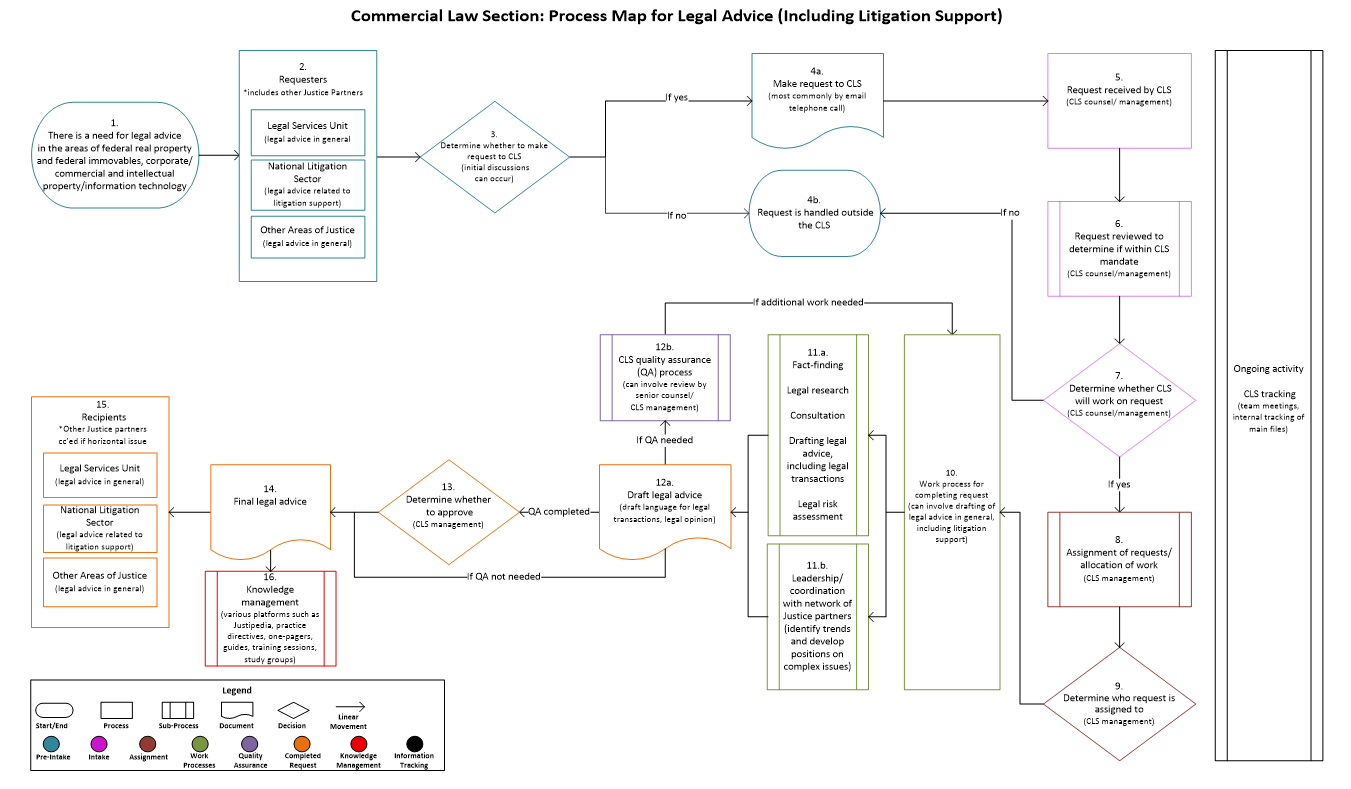
Text version
This process map details a series of work process when a request for legal advice, including litigation support is received by the Commercial Law Section. In general, the following steps outline these work processes from pre-intake to the completion and dissemination of the legal advice.
Pre-Intake
Step 1: There is a need for legal advice in the areas of federal real property and federal immovables, corporate/commercial and intellectual property/information technology.
Step 2: Requesters include (*may involve other Justice Partners):
- Legal Services unit for legal advice in general;
- National Litigation Sector for legal advice and litigation support; and,
- Other areas of Justice for legal advice in general.
Step 3: Requesters determine whether to make the request to CLS; initial discussions can occur.
Step 4a: If yes, the request to CLS, which is most commonly made by email or telephone call and then moves onto step 5.
Step 4b: If no, the request is handled outside the CLS and the work process ends.
Intake
Step 5: Request is received by CLS counsel or management.
Step 6: Request is reviewed by CLS counsel or management to determine if it falls within CLS mandate.
Step 7: CLS counsel or management determine whether CLS will work on the request. If no, it will be handled outside the CLS and the work process ends. If yes, then moves onto step 8.
Assignment
Step 8: Assignment of requests/allocation of work is completed by CLS management.
Step 9: CLS counsel or management determine who request is assigned to.
Work Process
Step 10: Work process for completing request can involve drafting of legal advice in general, including litigation support.
Step 11a: Responding to a request may include fact-finding, legal research, consultation, drafting legal advice including legal transactions, and legal risk assessment.
Step 11b: A request may involve leadership/coordination with network of Justice partners to identify and develop positions on complex issues.
Completed Request
Step 12a: Draft legal advice is completed, which can be in the form of a legal transactions or legal opinion.
- If the quality assurance process is not needed, then step 12b and 13 are skipped and the request moves to step 14.
Step 12b (Quality Assurance): If CLS quality assurance process is needed, it can involve review by CLS senior counsel or management.
- If additional work is needed, the request goes back to step 10.
Step 13: If the quality assurance process is completed, CLS management determine whether to approve.
Step 14: Final legal advice.
Step 15: Recipients include (*other Justice partners cc’ed if horizontal issue):
- Legal Services Unit for legal advice in general;
- National Litigation Sector for legal advice and litigation support; and
- Other Areas of Justice for legal advice in general.
Knowledge Management
Step 16: Knowledge management through various platforms such as Justipedia, practice directives, one pagers, guides, training sessions and study groups.
Information tracking (this is an ongoing activity):
CLS has team meetings and internal tracking of main files.
Aboriginal Law Centre
Aboriginal Affairs Portfolio
Overview of the centre
The Aboriginal Law Centre (the ALC) was established as a centre of expertise (hereafter Centre) within Justice during fiscal year 2012-2013.
The mandate of the ALC is to provide whole-of-government expert legal advice related to the interpretation and application of Section 35 of the Constitution Act, 1982 and Subsection 91(24) of the Constitution Act, 1867. The ALC also takes into consideration the intersection of Indigenous and international law and works on Indigenous legal policy files. The ALC’s mandate recently expanded to include the negotiation of administration of justice as part of self-governance agreements with Indigenous groups.
The ALC can be engaged by client departments and agencies, legal service units, the National Litigation Sector, and other areas within Justice to provide services when a need exists (see Table 1).
|
|
|
The Centre is organized into two teams, one dedicated to providing legal advice and another dedicated to policy work. It is discretionary to engage with the ALC when it is determined that there is a need.
What was found
Areas of Success:
- Protocols and processes - discretionary nature of engagement. The informal and discretionary nature of the ALC were found to be effective aspects of the ALC’s service delivery model. These protocols and processes provide flexibility to stakeholders to engage with the Centre as needed.
- Knowledge management. The quality of knowledge products that the ALC shares and the training it offers are seen as valuable to counsel and client departments and agencies. The information that is provided responds to stakeholder needs by increasing their awareness of the latest legal trends and whole-of-government perspectives in Aboriginal law and allows for more proactive planning.
- Collaboration. Where channels for engagement with stakeholders have been established, they are helpful, appreciated, and support the provision of high-quality legal services.
Opportunities for Improvement:
- Awareness of mandate. There is a need for greater awareness and clarity, particularly with respect to litigation support and policy work. The ALC could consider developing a guideline that would outline the type and extent of services the Centre provides and disseminate this information more broadly.
- Protocols and processes - clarification. While the informal work processes were found to generally work well, there are opportunities to clarify the intake process, and the ALC’s roles and responsibilities, particularly with respect to litigation support.
- Structure of the Centre. Maintaining a high-degree of expertise in the Centre can be difficult, if new recruits do not have the necessary knowledge. Mentorship of junior counsel is seen as a key mechanism in maintaining expertise within the Centre, but can be challenging to maintain with limited resources. Enhanced engagement between the two ALC teams would increase awareness of issues that have implication for both teams.
- Strategic partnerships. There are opportunities for the ALC to increase strategic engagement by sharing relevant information more proactively and broadly among its partners, and developing clear positions on issues that cut across numerous client departments and agencies.

Text version
This process map details a series of work process when a request for legal advice, including legal policy advice and litigation support is received by the Aboriginal Law Centre. In general, the following steps outline these work processes from pre-intake to the completion and dissemination of the legal advice.
Pre-Intake
Step 1: There is a need for legal advice in the area of Aboriginal law.
Step 2: Requesters include:
- Client Department for legal advice including legal policy advice;
- Legal Services Unit for legal advice in general;
- National Litigation Sector for legal advice related to litigation support; and,
- Other areas of Justice for legal advice including legal policy advice.
Step 3: Requesters determine whether to make the request to ALC; initial discussions can occur.
Step 4a: If yes, make request to ALC, which can be formal written request or informal telephone call or email and then moves onto step 5.
Step 4b: If no, the request is handled outside the ALC and the work process ends.
Intake
Step 5: Request received by ALC counsel/management.
Step 6: Request reviewed by ALC counsel/management to determine if within ALC mandate.
Step 7: ALC counsel/management determine whether ALC will work on the request. If no, request handled outside the ALC and the work process ends. If yes, then moves onto step 8.
Assignment
Step 8: Assignment of requests/allocation of work is completed by ALC counsel/management.
Step 9: ALC counsel/management determine who request is assigned to.
Work Process
Step 10: Work process for completing request can involve drafting of legal advice, including legal policy advice or litigation support.
Step 11: Responding to a request may include fact-finding, legal research, consultation, drafting legal advice, review of legal advice or work of other Justice Counsel and legal risk assessment.
Completed Request
Step 12a: Draft legal advice is completed, which can be in the form of a legal opinion, email or telephone call.
- If the quality assurance process is not needed, then step 12b or 12c and 13 are skipped and the request moves to step 14.
Step 12b (Quality Assurance): If ALC quality assurance process is needed, it can involve review by ALC senior counsel/management and/or APP ADM.
- If additional work is needed, the request goes back to step 10. If appropriate the request goes to step 12c.
Step 12c (Quality Assurance): Justice quality assurance process reviewed by LSU, other centers and/or regional office.
Step 13: If the quality assurance process is completed, ALC management and/or APP ADM determine whether to approve.
Step 14: Final legal advice.
Step 15: Recipients include:
- Client Department for legal advice including legal policy advice;
- Legal Services Unit for legal advice in general;
- National Litigation Sector for legal advice related to litigation support; and,
- Other areas of Justice for legal advice including legal policy advice.
Knowledge Management
Step 16: Knowledge management through various platforms such as Justipedia, newsletters and study groups.
Information tracking (this is an ongoing activity):
ALC has daily stand-up meetings, team meetings, bi-weekly whole ALC team meetings and bi-weekly calls with CIRNAC LSU.
Centre for Information and Privacy Law
Public Law and Legislative Services Sector
Overview of the centre
The Centre for Information and Privacy Law (the CIPL) was established as a centre of expertise (hereafter Centre) on April 1, 2014 (formerly ILAP).
The mandate of the CIPL ensures that Justice’s position concerning the interpretation of the Access to Information Act (ATIA) and the Privacy Act (PA) are established in a coordinated and coherent manner that complies with the intent and the letter of these two Acts. The Centre is responsible for supporting the Minister’s statutory obligations under the ATIA and the PA, including legislative and regulatory reforms. The CIPL is expected to provide legal policy advice and engage in policy reform on complex issues related to Access to Information and Privacy (ATIP) law and play an enhanced role in litigation support. One of the CIPL’s central roles is to collaborate with designated ATIP counsel to respond to ATIP legal work.
The CIPL can be engaged by legal service units, the National Litigation Sector, and other areas within Justice to provide services when a need exists (see Table 1).
|
|
|
What was found
Areas of Success:
- Structure of the Centre - work assignments. Each CIPL counsel is assigned to a specific client department or agency portfolio, which allows for a deeper understanding of the client department or agencies operational context, knowledge of previous legal advice provided, and the ability to establish strong working relationships with ATIP designated counsel.
- Collaboration. The CIPL effectively collaborates with its stakeholders by fostering positive and professional relationships. Having ATIP designated counsel has allowed the Centre to create a network and a community of practice in the area of information and privacy law.
- Knowledge management. The CIPL engages in knowledge sharing by providing monthly newsletters, organizing practice group meetings for ATIP designated counsel, and offering training and events. This helps respond to stakeholder needs by increasing awareness of the latest legal trends and whole-of-government perspectives in information and privacy law.
Opportunities for Improvement:
- Clarification of mandate. There is a lack of clarity regarding the mandate of the CIPL, which can lead to issues with respect to stakeholder engagement with the Centre. It would be beneficial to increase the awareness of the type and extent of services of the CIPL through increased information sharing and outreach.
- Protocol and processes. The effectiveness of the CIPL’s protocol is impacted when some LSU counsel send requests directly to the CIPL instead of through their ATIP designated counsel or when the CIPL receives requests from ATIP designated counsel that are of lower complexity. Additional communication of the protocol and the role and responsibilities should be clarified.
- Structure of the Centre - capacity. Given the increased scope of the CIPL’s mandate related to policy work, some capacity challenges were identified. Increased support would allow the CIPL counsel additional time to focus on the provision of legal advisory services and knowledge management and outreach activities.
- Strategic partnerships. There are opportunities to enhance strategic engagement between CIPL and its partners through greater clarification of the roles and responsibilities and more proactive information sharing practices.
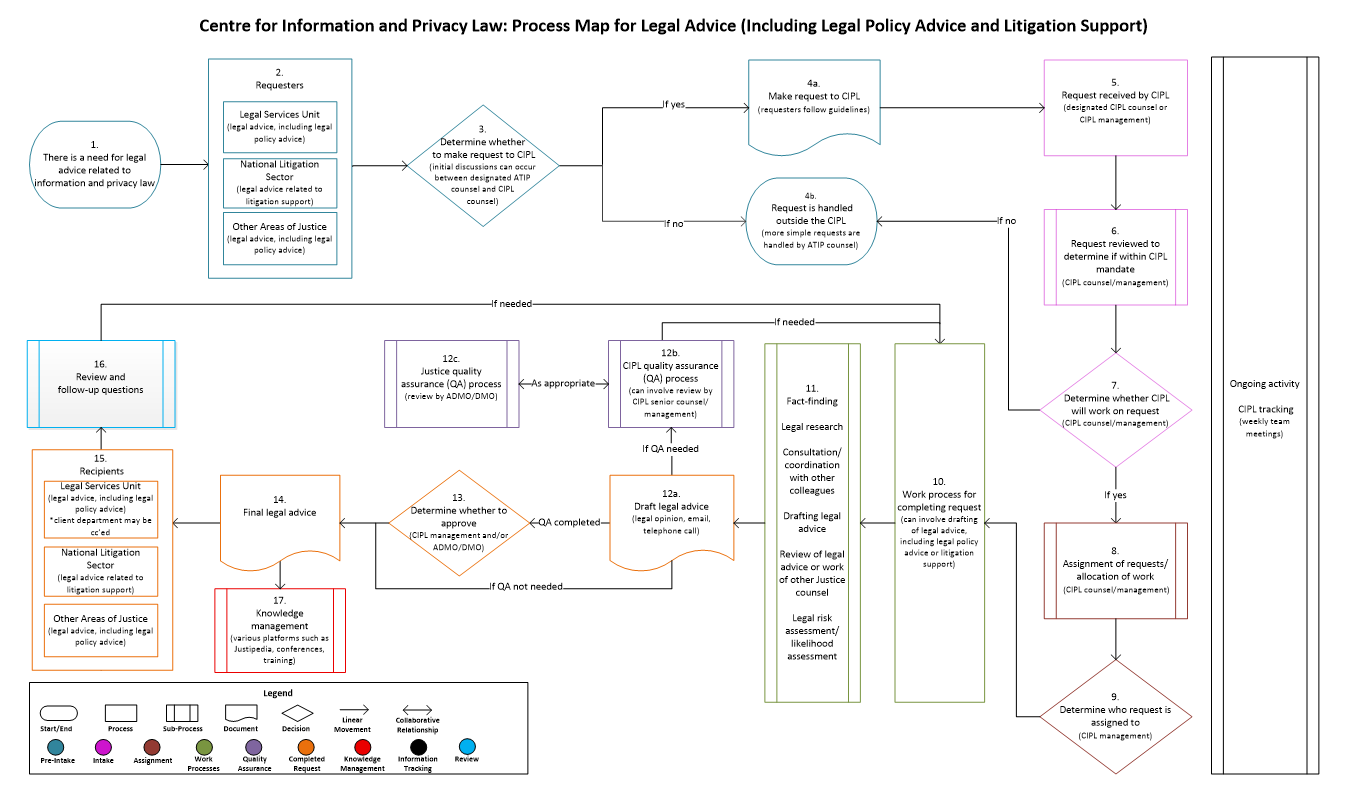
Text version
This process map details a series of work process when a request for legal advice, including legal policy advice and litigation support is received by the Centre for Information and Privacy Law. In general, the following steps outline these work processes from pre-intake to the completion and dissemination of the legal advice.
Pre-Intake
Step 1: There is a need for legal advice related to information and privacy law.
Step 2: Requesters include:
- Legal Services Unit for legal advice including legal policy advice;
- National Litigation Sector for legal advice related to litigation support; and,
- Other areas of Justice for legal advice including legal policy advice.
Step 3: Requesters determine whether to make the request to CIPL; initial discussions can occur between designated ATIP counsel and CIPL counsel.
Step 4a: If yes, requesters follow guidelines to make request to CIPL, and then moves onto step 5.
Step 4b: If no, the request is handled outside the CIPL or more simple requests are handled by ATIP counsel and the work process ends.
Intake
Step 5: Request received by CIPL counsel/management.
Step 6: Request reviewed by CIPL counsel/management to determine if within CIPL mandate.
Step 7: CIPL counsel/management determine whether CIPL will work on the request. If no, request handled outside the CIPL and the work process ends. If yes, then moves onto step 8.
Assignment
Step 8: Assignment of requests/allocation of work is completed by CIPL counsel/management.
Step 9: CIPL counsel/management determine who request is assigned to.
Work Process
Step 10: Work process for completing request can involve drafting of legal advice, including legal policy advice or litigation support.
Step 11: Responding to a request may include fact-finding, legal research, consultation/coordination with other colleagues, drafting legal advice, review of legal advice or work of other Justice Counsel and legal risk assessment/likelihood assessment.
Completed Request
Step 12a: Draft legal advice is completed, which can be in the form of a legal opinion, email or telephone call.
- If the quality assurance process is not needed, then step 12b or 12c and 13 are skipped and the request moves to step 14.
Step 12b (Quality Assurance): If CIPL quality assurance process is needed, it can involve review by CIPL senior counsel/management.
- If additional work is needed, the request goes back to step 10. As appropriate, the request goes to step 12c.
Step 12c (Quality Assurance): Justice quality assurance process reviewed by ADMO/DMO.
Step 13: If the quality assurance process is completed, CIPL management and/or ADMO/DMO determine whether to approve.
Step 14: Final legal advice.
Step 15: Recipients include :
- Legal Services Unit for legal advice including legal policy advice – client department may be copied;
- National Litigation Sector for legal advice related to litigation support; and,
- Other areas of Justice for legal advice including legal policy advice.
Review
Step 16: Review and follow-up questions.
- If additional work is needed, the request goes back to step 10.
Knowledge Management
Step 17: Knowledge management through various platforms such as Justipedia, conferences and training.
Information tracking (this is an ongoing activity):
CIPL has weekly team meetings.
Constitutional, Administrative and International Law Section
Public Law and Legislative Services Sector
Overview of the centre
The Constitutional, Administrative and International Law Section (the CAILS) was established as a centre of expertise (hereafter Centre) within Justice during 2015.
The mandate of the CAILS is to provide its stakeholders with a centralized group of experts in constitutional, administrative, Crown, public international, and international private law. The work of the Centre covers legal advice, including legal policy advice, and litigation support, as well as policy development work involving international private law in four broad areas: international commercial law, judicial cooperation and enforcement of judgements, family law and child protection, and protection of property. In addition, the Centre also provides knowledge management and other outreach activities, such as legal training and conference and practice groups.
The CAILS can be engaged by legal service units, the National Litigation Sector, and other areas within Justice to provide services when a need exists (see Table 1).
|
|
|
The Centre is organized into specific groupings of counsel based on the Centre’s practice areas, for instance some counsel work primarily on international private law matters, public international law matters, or constitutional law matters. It is discretionary to engage with the CAILS when it is determined that there is a need.
What was found
Areas of Success:
- Protocol and processes – nature of engagement. The informal and discretionary nature of the CAILS were found to be effective aspects of the Centre’s service delivery model. These protocols and processes provide flexibility to stakeholders to engage with the Centre as needed.
- Structure of the Centre. The flexible team model within CAILS and the culture of collaboration within the Centre contribute to its effectiveness. The structure and operation of the Centre are seen to have several benefits, including flexibility in work allocation and allowing for development of knowledge across multiple practice areas of the CAILS.
- Knowledge management. The training that is provided by the CAILS, particularly their annual conference, is highly valued and sought after by counsel from across Justice.
- Engagement and collaboration. The CAILS effectively collaborates with its stakeholders. Factors that help facilitate these relationships include proactive communication and effective information sharing practices.
Opportunities for Improvement:
- Clarity of mandate. Further work is required to increase the awareness of the CAILS mandate, particularly with respect to the type and extent of services the Centre provides. Improved communication and outreach would be beneficial, specifically for those counsel who do not regularly engage with the Centre or who are new to Justice.
- Protocols and processes – clarification regarding requests. It would be beneficial to clarify the type of information that should be included within a request to CAILS, as well as developing guidelines on the level of complexity and nature of requests that should be sent to the Centre.
- Strategic partnerships. There are opportunities for the CAILS to increase strategic engagement through additional consultation with stakeholders prior to finalization of the legal advice.
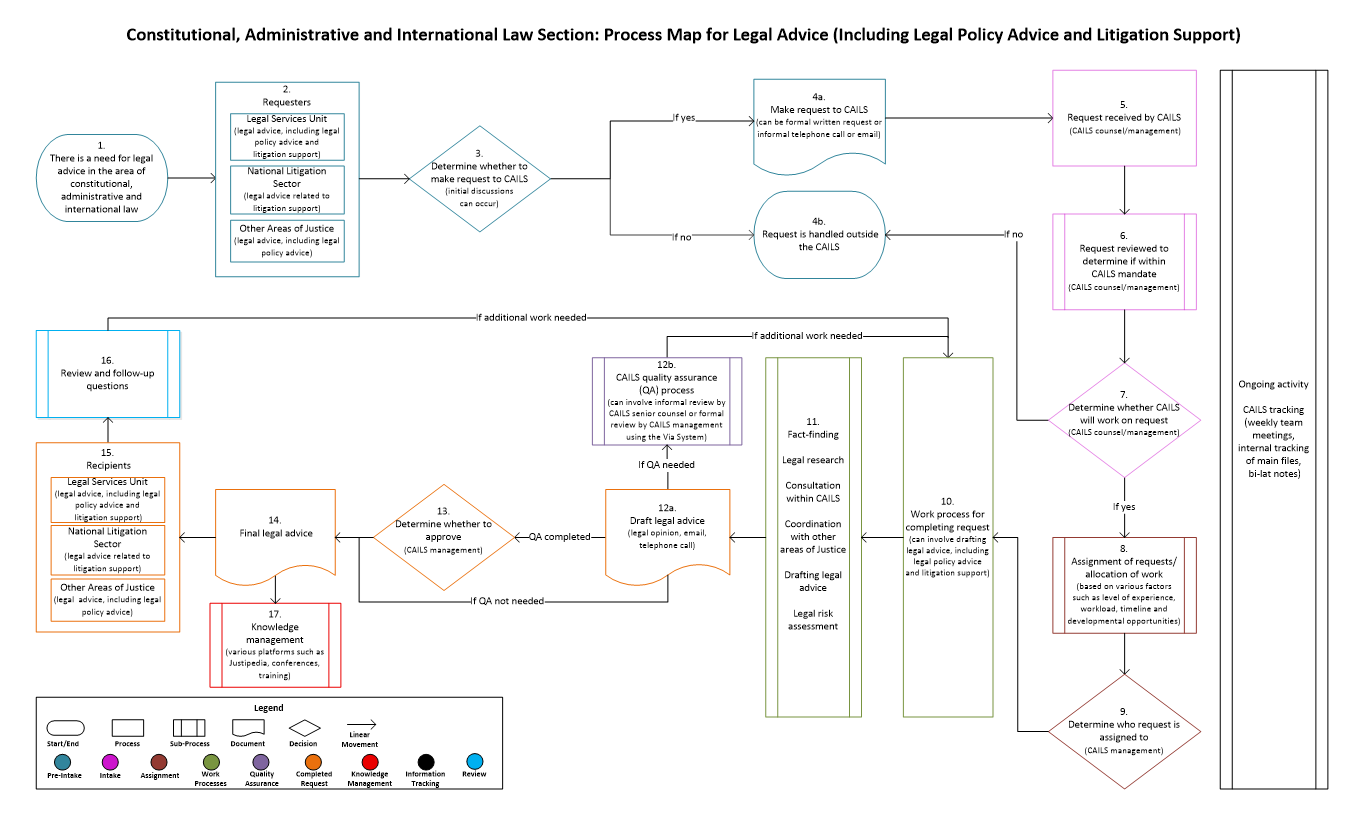
Text version
This process map details a series of work process when a request for legal advice, including legal policy advice and litigation support is received by the Constitutional, Administrative and International Law Sector. In general, the following steps outline these work processes from pre-intake to the completion and dissemination of the legal advice.
Pre-Intake
Step 1: There is a need for legal advice in the area of constitutional, administrative and international law.
Step 2: Requesters include:
- Legal Services Unit for legal advice including legal policy advice and litigation support;
- National Litigation Sector for legal advice related to litigation support; and,
- Other areas of Justice for legal advice including legal policy advice.
Step 3: Requesters determine whether to make the request to CAILS; initial discussions can occur.
Step 4a: If yes, make request to CAILS by formal written request or informal telephone call or email, and then moves onto step 5.
Step 4b: If no, request is handled outside the CAILS and the work process ends.
Intake
Step 5: Request received by CAILS counsel/management.
Step 6: Request reviewed by CAILS counsel/management to determine if within CAILS mandate.
Step 7: CAILS counsel/management determine whether CAILS will work on the request. If no, request handled outside the CAILS and the work process ends. If yes, then moves onto step 8.
Assignment
Step 8: Assignment of requests/allocation of work based on various factors such as level of experience, workload, timeline and developmental opportunities.
Step 9: CAILS management determine who request is assigned to.
Work Process
Step 10: Work process for completing request can involve drafting of legal advice, including legal policy advice or litigation support.
Step 11: Responding to a request may include fact-finding, legal research, consultation with CAILS, coordination with other areas of Justice, drafting legal advice and legal risk assessment.
Completed Request
Step 12a: Draft legal advice is completed, which can be in the form of a legal opinion, email or telephone call.
- If the quality assurance process is not needed, then step 12b and 13 are skipped and the request moves to step 14.
Step 12b (Quality Assurance): If CAILS quality assurance process is needed, it can involve informal review by CAILS senior counsel or formal review by CAILS management by using the Via System.
- If additional work is needed, the request goes back to step 10.
Step 13: If the quality assurance process is completed, CAILS management determine whether to approve.
Step 14: Final legal advice.
Step 15: Recipients include:
- Legal Services Unit for legal advice including legal policy advice and litigation support;
- National Litigation Sector for legal advice related to litigation support; and,
- Other areas of Justice for legal advice including legal policy advice.
Review
Step 16: Review and follow-up questions.
- If additional work is needed, the request goes back to step 10.
Knowledge Management
Step 17: Knowledge management through various platforms such as Justipedia, conferences and training.
Information tracking (this is an ongoing activity):
CAILS has weekly team meetings, internal tracking of main files and bi-lat notes.
Human Rights Law Section
Public Law and Legislative Services Sector
Overview of the centre
The Human Rights Law Section (the HRLS) is a long-standing centre of expertise (hereafter Centre) in Justice. The scope and nature of the areas of practice and services provided by the HRLS have remained largely unchanged over the last ten years.
The HRLS provides specialized legal advice, including legal policy advice and litigation support, on matters related to the Canadian Charter of Rights and Freedoms (the Charter), the Canadian Human Rights Act, and the Canadian Bill of Rights (CBR), as well as Canada’s international human rights obligations. The Centre has a unique role, with the Legislative Branch, in advising the Minister of Justice in the exercise of his statutory responsibilities to examine government bills and proposed regulations for consistency with the Charter and the CBR.
The HRLS can be engaged by legal service units, the National Litigation Sector, and other areas within Justice to provide services when a need exists (see Table 1).
|
|
|
What was found
Areas of Success:
- Protocols and processes. The informal and discretionary nature of the HRLS were found to be effective aspects of the Centre’s service delivery model. These protocols and processes provide flexibility to stakeholders to engage with the Centre as needed.
- Structure of the Centre. The flexible team model within the HRLS has established supportive and collaborative working relationships among counsel and management. The Centre has implemented an effective quality assurance process, particularly for new or junior counsel, which allows counsel to build their expertise while being informally mentored by senior counsel.
- Engagement and collaboration. The HRLS effectively collaborates with its stakeholders to provide practical legal advice grounded in the client departments and agencies realities. Factors that help facilitate this collaboration include having an open dialogue regarding expectations of the request (e.g., timelines), responding to questions, and proactively sharing information.
- Knowledge management. The quality of knowledge products that the HRLS shares and the training it offers are seen as valuable, particularly with respect to its practice groups. The information that is provided increases awareness of the latest legal trends and provides whole-of-government perspectives in human rights law.
Opportunities for Improvement:
- Awareness of mandate. There is a need to increase the awareness of the HRLS’ mandate, particularly with respect to specific areas of expertise the Centre handles in comparison to other Centres with similar practice areas. While requests are easily redirected between Centres, there is an opportunity for broader communication of information regarding the type and extent of services offered along with examples of appropriate requests.
- Structure of the Centre - capacity. The HRLS has experienced some challenges with turnover in the last few fiscal years, as well as some additional demands on resources due to the expansion of their mandate to include Charter statements, which did not receive additional funding. Furthermore, overall demand for policy work has also fluctuated over time, resulting in the need for some HRLS counsel to shift the nature of their work periodically (between legal advice and policy work) depending on demand.

Text version
This process map details a series of work process when a request for legal advice, including legal policy advice and litigation support is received by the Human Rights Law Section. In general, the following steps outline these work processes from pre-intake to the completion and dissemination of the legal advice.
Pre-Intake
Step 1: There is a need for legal advice in the area of human rights law.
Step 2: Requesters include:
- Legal Services Unit for legal advice including legal policy advice;
- National Litigation Sector for legal advice related to litigation support; and,
- Other areas of Justice for legal advice including legal policy advice.
Step 3: Requesters determine whether to make the request to HRLS; initial discussions can occur.
Step 4a: If yes, make request to HRLS by informal telephone call or email, and then moves onto step 5.
Step 4b: If no, request is handled outside the HRLS and the work process ends.
Intake
Step 5: Request received by HRLS through HRLS management mailbox or HRLS counsel/management directly.
Step 6: Request reviewed by HRLS counsel/management to determine if within HRLS mandate.
Step 7: HRLS counsel/management determine whether HRLS will work on the request. If no, request handled outside the HRLS and the work process ends. If yes, then moves onto step 8.
Assignment
Step 8: Assignment of requests/allocation of work based on various factors such as level of experience, workload, timeline and complexity.
Step 9: HRLS counsel/management determine who request is assigned to.
Work Process
Step 10: Work process for completing request can involve drafting of legal advice, including legal policy advice or litigation support.
Step 11: Responding to a request may include fact-finding, legal research, consultation with HRLS, coordination with other areas of Justice, drafting legal advice, review of legal advice or work of other Justice counsel and legal risk assessment.
Completed Request
Step 12a: Draft legal advice is completed, which can be in the form of a legal opinion, email or telephone call.
- If the quality assurance process is not needed, then step 12b and 13 are skipped and the request moves to step 14.
Step 12b (Quality Assurance): If HRLS quality assurance process is needed, it can involve review by HRLS senior counsel/management.
- If additional work is needed, the request goes back to step 10.
Step 13: If the quality assurance process is completed, HRLS management determine whether to approve.
Step 14: Final legal advice.
Step 15: Recipients include:
- Legal Services Unit for legal advice in general;
- National Litigation Sector for legal advice related to litigation support; and,
- Other areas of Justice for legal advice including legal policy advice.
Review
Step 16: Review and follow-up questions.
- If additional work is needed, the request goes back to step 10.
Knowledge Management
Step 17: Knowledge management through various platforms such as Justipedia, conferences, practice groups and training.
Information tracking (this is an ongoing activity):
HRLS tracking has roundtable discussions and internal tracking of main files.
Official Languages Directorate
Public Law and Legislative Services Sector
Overview of the centre
The Official Languages Directorate (the OLAD) was established as a centre of expertise (hereafter Centre) within Justice during 2013.
The mandate of the OLAD is to provide centralized legal advisory services with respect to language rights and policy, international Francophonie, and access to justice in official languages (barring some exceptions). The work of the OLAD covers legal advice, including legal policy advice and litigation support, as well as policy development work involving official languages in accordance with the Canadian Constitution, the Official Languages Act, other legislation covering official language rights, and any other program or initiative related to official languages in Canada or the international Francophonie.
Since November 2015, as a result of the Legal Services Review, Justice has assigned the OLAD’s Official Languages Law Team the exclusive mandate for preparing all legal advice related to official languages law. As a result, no other area within Justice is to provide legal advice or opinions in these matters.
The OLAD can be engaged by legal service units on behalf of the client department or agencies, the National Litigation Sector, and other areas within Justice to provide services (see Table 1).
|
|
|
The OLAD is divided into two groups: the Official Languages Law Team that focuses on the provision of legal advice, and the Justice in Official Languages Team that conducts legal policy work related to access to justice in both official languages. Work is assigned based on client departments and agencies portfolios and LSUs.
What was found
Areas of Success:
- Structure of the Centre – work assignments. Each OLAD counsel is assigned to a specific client department or agency portfolio. This provides the opportunity to develop a deeper understanding of the client department or agencies operational context, knowledge of previous legal advice provided, and the ability to establish strong working relationships.
- Knowledge management. The knowledge products that the OLAD shares and the training it offers are valuable to its stakeholders. The information that is provided responds to stakeholder needs by increasing their awareness of the latest trends and whole-of-government perspectives in official languages law.
- Collaboration. The OLAD collaborates with several client departments and agencies on a number of government-wide initiatives. It also collaborates closely with internal and external stakeholders involved in official languages.
Opportunities for Improvement:
- Clarity of mandate. Further work is required to clarify the mandate of the OLAD, particularly with respect to the type and extent of services that the Centre provides. Increased information sharing would be beneficial, particularly with those counsel who are not regularly involved in files involving official language considerations.
- Protocol and processes. Results suggest that some legal advice continues to be provided by counsel in LSUs, when such legal advice should be provided by the OLAD. Also, some Justice counsel involved in litigation do not follow the protocol in court proceedings involving official languages law matters. Ensuring that all counsel are aware of and adhere to the protocol would better support the work of the OLAD.
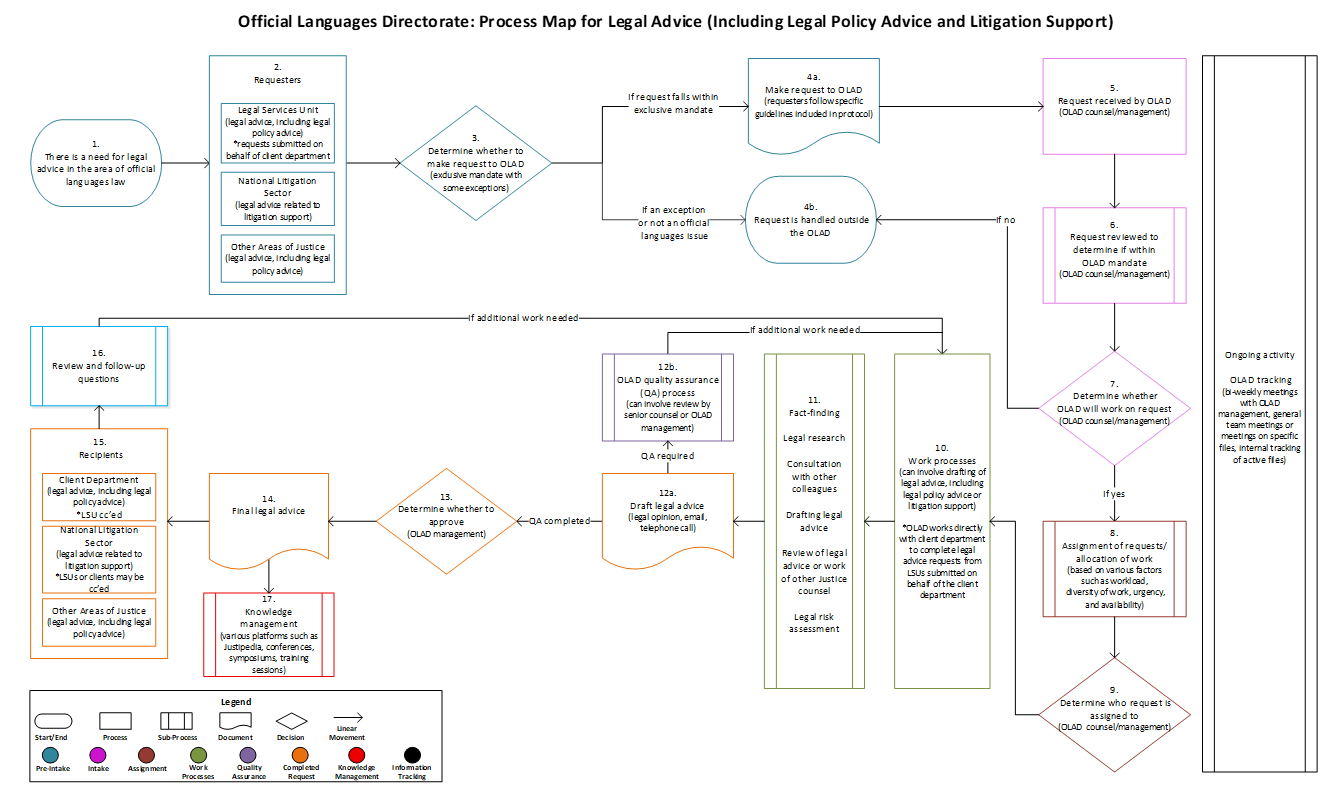
Text version
This process map details a series of work process when a request for legal advice, including legal policy advice and litigation support is received by the Official Languages Directorate. In general, the following steps outline these work processes from pre-intake to the completion and dissemination of the legal advice.
Pre-Intake
Step 1: There is a need for legal advice in the area of official languages law.
Step 2: Requesters include:
- Legal Services Unit for legal advice including legal policy advice – requests submitted on behalf of client department;
- National Litigation Sector for legal advice related to litigation support; and,
- Other areas of Justice for legal advice including legal policy advice.
Step 3: Requesters determine whether to make the request to OLAD; exclusive mandate with some exceptions. If request falls within exclusive mandate it moves onto step 4a. If an exception or not an official languages issue it moves onto step 4b.
Step 4a: Make request to OLAD – requesters follow specific guidelines included in protocol, and then moves onto step 5.
Step 4b: Request is handled outside the OLAD and the work process ends.
Intake
Step 5: Request received by OLAD counsel/management.
Step 6: Request reviewed by OLAD counsel/management to determine if within OLAD mandate.
Step 7: OLAD counsel/management determine whether OLAD will work on the request. If no, request handled outside the OLAD and the work process ends. If yes, then moves onto step 8.
Assignment
Step 8: Assignment of requests/allocation of work based on various factors such as workload, diversity of work, urgency and availability.
Step 9: OLAD counsel/management determine who request is assigned to.
Work Process
Step 10: Work process for completing request can involve drafting of legal advice, including legal policy advice or litigation support. OLAD works directly with client department to complete legal advice requests from LSUs submitted on behalf of client department.
Step 11: Responding to a request may include fact-finding, legal research, consultation with other colleagues, drafting legal advice, review of legal advice or work of other Justice counsel and legal risk assessment.
Completed Request
Step 12a: Draft legal advice is completed, which can be in the form of a legal opinion, email or telephone call.
- Quality assurance process is required and the request moves to step 12b.
Step 12b (Quality Assurance): OLAD quality assurance process is required, it can involve review by OLAD senior counsel or management.
- If additional work is needed, the request goes back to step 10.
Step 13: OLAD management determine whether to approve.
Step 14: Final legal advice.
Step 15: Recipients include:
- Client department for legal advice including policy legal advice – LSU required to be cc’ed;
- National Litigation Sector for legal advice related to litigation support; LSUs or client may be cc’ed and,
- Other areas of Justice for legal advice including legal policy advice.
Review
Step 16: Review and follow-up questions.
- If additional work is needed, the request goes back to step 10.
Knowledge Management
Step 17: Knowledge management through various platforms such as Justipedia, conferences, symposiums and training sessions.
Information tracking (this is an ongoing activity):
OLAD has bi-weekly meetings with OLAD management, general team meetings or meetings on specific files and internal tracking of active files.
Centre of Expertise in Procurement Law
Business Regulatory Law Portfolio
Overview of the centre
The Centre of Expertise in Procurement Law (the CoEPL) was established as a centre of expertise (hereafter Centre) within Justice effective April 1, 2017.
The CoEPL has the exclusive mandate to provide procurement legal advice related to the process of acquiring goods, services or construction, generally related to the pre-contractual, contracting, or contract administration phases (barring some exceptions). The Centre also provides legal advice in the context of litigation for claims and Judicial Review applications brought before the court as they relate to procurement; the conduct of procurement complaints before the Canadian International Trade Tribunal, excluding oral hearings; and legal advice in the context of reviews and investigations conducted by the Office of the Procurement Ombudsman, the Office of the Auditor General, the Parliamentary Budget Officer or other overseeing bodies. As a result, no other area within Justice is to provide legal advice or opinions in procurement law matters.
The CoEPL is co-located with the PSPC and SSC legal services units (LSU). The Centre can be engaged by LSUs on behalf of the client department or agency or the National Litigation Sector to provide services (see Table 1).
|
|
|
What was found
Areas of Success:
- Knowledge management. The quality of knowledge products that the CoEPL shares and the training it offers are seen as relevant and useful to LSU counsel and client departments and agencies.
- Structure of the Centre – capacity and work assignments. The overall structure of the CoEPL including the processes for managing requests, assigning work, and effective inclusion of paralegals, is working well. Staffing levels within the Centre have been relatively stable over time and capacity has been sufficient to manage work requirements.
Opportunities for Improvement:
- Clarification of mandate. Further work is required to clarify and support awareness of the mandate of the CoEPL, particularly with respect to the type and extent of services that the Centre provides.
- Protocol and processes. Although the protocol and processes provide structure in how to engage with the Centre, there is an opportunity to review the required request form and simplify the information to increase efficiency as well as review the follow-up processes subsequent to dissemination of legal advice. There is also some room for improvement with respect to adherence to the protocol to ensure that CoEPL counsel are providing all procurement legal advice (unless covered by an exception).
- Strategic partnerships. While having the CoEPL produce all legal advice related to procurement law offers benefits, there is a desire to ensure that legal counsel from LSUs be more meaningfully engaged with the Centre to ensure a shared understanding of the legal advice provided. Both LSU counsel, and representatives from client departments and agencies, also see potential benefits in having the CoEPL counsel involved in follow-up discussions on the legal advice provided, or other related issues that may not be of a strictly legal nature, but that directly affect the procurement activities undertaken.

Text version
This process map details a series of work process when a request for legal advice and litigation support is received by the Centre of Expertise in Procurement Law. In general, the following steps outline these work processes from pre-intake to the completion and dissemination of the legal advice.
Pre-Intake
Step 1: There is a need with regard to the provision of procurement legal advice.
Step 2: Requesters include:
- Legal Services Unit for legal advice in general – client department cc’ed; and,
- National Litigation Sector for legal advice related to litigation support.
Step 3: Requesters determine whether to make the request to CoEPL; exclusive mandate with some exceptions.
Step 4a: If request falls within exclusive mandate, make request to CoEPL – formal intake form, and then moves onto step 5.
Step 4b: If an exemption or not a procurement issue, request is handled outside the CoEPL and the work process ends.
Intake
Step 5: Request received by CoEPL – CoEPL generic mailbox.
Step 6: Request reviewed to determine if within CoEPL mandate. CoEPL paralegals conduct initial review and, if intent is to reject the request, they provide a summary to CoEPL management and then moves step 7. If request is accepted it moves onto step 8.
Step 7: CoEPL management determine whether CoEPL will work on the request and reviews paralegal summary. If intent is to reject request it then moves to step 8. If no, request handled outside the CoEPL and the work process ends.
Assignment
Step 8: Assignment of requests/allocation of work based on various factors such as level of experience, level of complexity, workload and urgency.
Step 9: CoEPL management determine who request is assigned to.
Work Process
Step 10: Work process for completing request can involve drafting of legal advice, in general litigation support. CoEPL works directly with client department to complete legal advice requests from LSUs.
Step 11: Responding to a request may include fact-finding, legal research, consultation with other colleagues, consultation with other areas of Justice, if required, drafting legal advice, and provide the analysis of the likelihood of an adverse outcome.
Completed Request
Step 12a: Draft legal advice is completed, typically by email.
- Quality assurance process is required and the request moves to step 12b.
Step 12b (Quality Assurance): CoEPL quality assurance process is required, it can involve review by CoEPL senior counsel or management.
- If additional work is needed, the request goes back to step 10.
Step 13: CoEPL management determine whether to approve.
Step 14: Final legal advice.
Step 15: Recipients include:
- Client department for legal advice in general – LSU required to be cc’ed;
- National Litigation Sector for legal advice related to litigation support;
Review
Step 16: Review and follow-up questions.
- If additional work is needed, the request goes back to step 10.
Billing
Step 17: Invoices sent monthly and tracked in iCase/Lex
Knowledge Management
Step 18: Knowledge management through various platforms such as Justipedia, bulletins and training.
Information tracking (this is an ongoing activity):
CoEPL tracking - internal tracking of main files.
- Date modified: